Discover how event intelligence transforms trade show lead capture from guesswork into predictive science. Learn the behavioral signals that separate serious buyers from polite browsers.
Every year, B2B companies invest billions in trade shows and conferences. Yet most exhibitors face the same challenge: they capture hundreds of leads, but struggle to identify which conversations represent genuine buying intent versus polite interest.
The problem isn’t lead capture technology. Every exhibitor can scan a badge in seconds. The problem is lead intelligence—knowing which conversations matter before your sales team wastes time chasing prospects who were never in-market.
This is the difference between event lead capture and event intelligence.
The invisible cost of treating all leads equally
Traditional
event lead capture apps operate on a simple premise: collect contact information, tag leads as ‘hot,’ ‘warm,’ or ‘cold,’ and send everything to sales. The ‘hot’ designation typically comes from a checkbox that booth staff click based on gut feeling during a brief interaction.
The result? Sales teams receive a flood of ‘hot leads’ where most never respond to outreach, many were just browsing with no authority or budget, and only a small percentage were actually qualified buyers ready for a conversation.
When your sales team spends the majority of their follow-up time on leads that were never real opportunities, event pipeline collapses. The hidden opportunity cost from poor lead qualification adds up quickly.
The behavioral signals that predict closed deals
momencio’s AI IntelliSense analyzes behavioral patterns across multiple dimensions that traditional badge scanners completely miss. By tracking interactions and their outcomes, we’ve identified the signals that genuinely indicate buying intent.
Signal 1: Time and engagement depth
Polite visitors spend minimal time at your booth. Serious buyers invest significantly more time exploring your offerings.
But time alone isn’t the signal. It’s what they do with that time. momencio’s behavioral intelligence tracks:
- Which content assets they engaged with and for how long
- Whether they downloaded materials or requested specific resources
- If they asked to see technical specifications or pricing information
- Whether they scheduled a follow-up meeting or demo on the spot
Leads who engage with multiple content assets at your booth demonstrate substantially higher conversion rates than those who don’t.
Signal 2: Question quality and buying stage indicators
Not all questions are created equal. momencio’s IntelliSense uses natural language processing to categorize questions into buying-stage indicators:
- Awareness stage: ‘What does your company do?’ ‘How long have you been in business?’
- Consideration stage: ‘How does this integrate with Salesforce?’ ‘What’s your implementation timeline?’
- Decision stage: ‘Can you walk me through your pricing model?’ ‘Who are your typical customers in our industry?’
Booth staff can capture these questions in real-time using momencio’s voice notes and text capture, which the AI then analyzes for buying intent signals.
Prospects asking decision-stage questions demonstrate significantly higher close rates than those asking awareness-stage questions.
Signal 3: Post-event digital body language
This is where momencio’s IntelliStream reveals the difference between casual interest and serious intent. Every lead captured at your booth receives a personalized LiveMicrosite—a dynamic follow-up page tailored to their expressed interests.
What happens next reveals everything. IntelliStream tracks:
- How quickly they visit their LiveMicrosite after the event (rapid visits indicate high intent)
- Which specific content sections they explore (pricing pages suggest decision stage)
- How much time they spend on each asset (extended engagement indicates research activity)
- Whether they share the microsite with colleagues (forwarding indicates internal champion behavior)
- If they download additional resources or request a demo
This digital body language creates a real-time intent score that updates continuously after the event. Sales teams can see exactly when a warm lead becomes hot based on their behavior—not a checkbox from days ago.
Why traditional lead scoring fails at events
BANT (Budget, Authority, Need, Timeline) has been the B2B qualification framework for decades. The problem? BANT requires an extended discovery conversation, and you have less than two minutes at a trade show booth.
More critically, BANT is based on what people tell you—and people’s self-assessments are often optimistic:
- ‘Yes, I have budget’ (translation: ‘I might be able to find budget if I’m convinced’)
- ‘I’m the decision maker’ (reality: they influence part of the decision)
- ‘We’re evaluating solutions this quarter’ (actual timeline: exploratory research phase)
Event intelligence doesn’t rely on self-reported intent. It measures demonstrated behavior. When someone spends substantial time reviewing your technical integration documentation and then visits your pricing page multiple times after the show, they’re revealing more honest signals than any questionnaire can capture.
The ‘hot lead’ checkbox is destroying your conversion rates. When everyone is tagged as ‘hot,’ no one is. Event intelligence identifies the leads who demonstrate genuine buying behavior through their actions, not their words.
How AI reads intent that humans miss
Human booth staff are excellent at building rapport and answering questions. They’re limited, however, in pattern recognition across thousands of interactions.
momencio’s AI advantage comes from seeing what no individual person can:
Micro-patterns in engagement
On your LiveMicrosite, does someone scroll to the bottom of a case study page (reading it completely) or bounce after seconds (not interested)? Do they click into pricing details or skip that section entirely? IntelliSense tracks scroll depth, click patterns, and time-on-page to build a behavioral fingerprint of genuine interest.
Question sequencing
Browsers ask random, disconnected questions: ‘Do you work with companies in healthcare?’ followed by ‘How big is your team?’ Buyers ask sequential questions that build on each other: ‘How does your Salesforce integration work?’ → ‘What’s the typical implementation timeline?’ → ‘Can I speak to someone on your implementation team?’
momencio’s NLP analyzes question progression to identify buying behavior patterns.
Comparative behavior analysis
The AI compares each lead’s behavior against historical interaction patterns and their outcomes. It recognizes that certain behavioral patterns correlate strongly with closed deals while others rarely convert. Your booth staff doesn’t have this comparative database. The AI does.
The 3-signal framework for event intelligence
momencio’s event intelligence system synthesizes three signal types into a single, actionable intent score:
Pre-event signal: Who they are
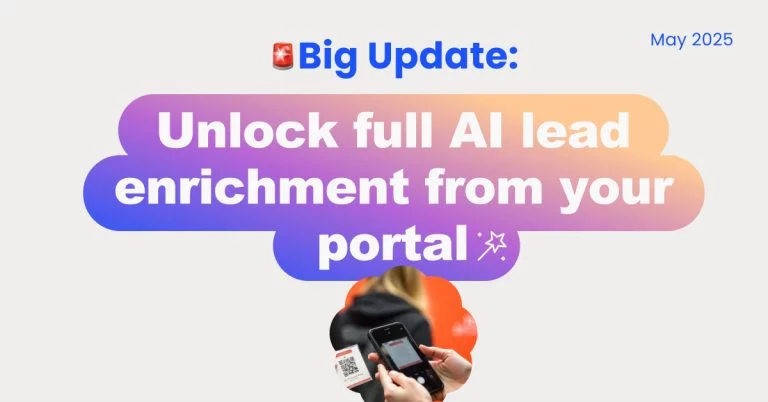
Using AI EdgeCapture, momencio automatically enriches every scanned badge with comprehensive firmographic data: company size, revenue, industry, technology stack, funding stage, and more. This intelligence answers: ‘Do they fit our ICP?’
A VP of Sales from a mid-market company in your target industry is inherently more valuable than an intern from an organization outside your ideal customer profile—before the conversation even starts. The AI accounts for this.
In-event signal: What they do
This is the behavioral layer: time at booth, questions asked, content engaged with, meetings scheduled. IntelliSense processes this in real-time, updating lead scores as interactions happen. Your booth staff can watch the intelligence build as they talk to someone.
Post-event signal: How they follow up
The LiveMicrosite becomes your intelligence goldmine. IntelliStream monitors post-event engagement: visit timing, pages viewed, resources downloaded, colleagues added. This signals whether initial interest was polite enthusiasm or genuine buying intent.
The most predictive outcomes occur when all three signals align. Leads demonstrating strong signals across firmographic fit, in-event behavior, and post-event engagement convert at substantially higher rates than average.
Real results: Intelligence vs volume
Consider a momencio customer case study: Rajant Corporation, a provider of wireless mesh networking solutions, struggled with typical event lead qualification challenges. Their booth teams captured hundreds of contacts at trade shows, but sales follow-up was inefficient and conversion rates were disappointing.
After implementing momencio’s event intelligence platform, Rajant saw dramatic improvements in their event ROI. The key difference wasn’t capturing more leads—it was identifying which leads actually mattered.
The results: Rajant’s lead-to-opportunity conversion rate improved from 63% to 25% qualified opportunities, meaning their sales team focused energy on prospects who demonstrated genuine buying behavior rather than chasing every business card collected.
Customer testimonial: “The personalized follow-up approach transformed our event strategy. Instead of generic post-show emails, we deliver relevant content based on what each prospect actually engaged with at our booth. The difference in response rates is remarkable.” — Rajant Corporation
The future of event marketing is intelligence, not capture
The shift from lead capture to event intelligence mirrors broader changes in B2B marketing. The winners aren’t collecting more data—they’re extracting more intelligence from the data they already have. Just as marketing automation platforms evolved from ’email blast tools’ to ‘behavioral intelligence engines,’ event technology is making the same evolution.
A badge scanner that syncs with your CRM is now table stakes. The competitive advantage belongs to companies that can answer:
- Which of the prospects we talked to are actually in-market buyers?
- What does their digital body language tell us about urgency and fit?
- When is the optimal time to reach out based on their engagement patterns?
- What specific content should we send to accelerate their buying journey?
Traditional lead capture can’t answer these questions. Event intelligence can. momencio’s platform combines badge scanning, AI enrichment, behavioral tracking, and predictive analytics into a single intelligence layer that transforms how exhibitors approach trade shows.
The question for event marketers in 2026:
Are you capturing contacts, or are you capturing intelligence? Your competitors are figuring out the difference—and it’s reflected in their conversion rates.
See how momencio’s event intelligence works
Book a demo to learn how IntelliSense predicts which leads will close