Most booth presentations are written for a buyer who doesn’t exist.
The content team builds something thorough. They know their product, they know their market, they produce materials that cover the bases. What they produce, almost without exception, is built for an imaginary average: detailed enough for the technical evaluator, strategic enough for the executive, accessible enough for a first-time visitor. That buyer does not exist. The real buyers who walk into the booth get content that was almost right for someone else.
It is a preparation failure. It happens quietly, in the weeks before the show, when nobody asks the one question that would change everything: who is actually going to be standing on the other side of this screen?
This is not negligence. It is the default. And the default is quietly costing exhibitors deals they never know they lost. If you want to understand how your event lead generation can actually produce pipeline rather than just names on a list, this is the conversation that needs to happen first.
The failure starts weeks before the show
Most exhibitors do not prepare generic content because they are lazy. They prepare generic content because building content for a trade show is already a significant project, and nobody on the team has been asked to build it differently.
The brief is usually something like: we need a deck for the show, we need the product brochure updated, we need a case study. What the brief almost never contains is: we need a version of this for a technical buyer, a different version for a budget holder, and a third version for someone who has never heard of us before.
So the team builds one deck. Well-designed, thoroughly reviewed, approved by three stakeholders. And completely undifferentiated for the range of buyers who will actually stand in front of it.
The decision to show everyone the same slides is made weeks before the event, not on the show floor.
The event managers and field reps deploying that content cannot fix a preparation problem in the moment. Not on a busy show floor where conversations overlap, decisions need to be made in seconds, and there is no time to rebuild a presentation mid-conversation. The failure is upstream. It is in how content was prepared, not how it was presented.
What it costs when the content does not fit the buyer
Let us be specific about what happens to each visitor type when they encounter a generic booth experience. These are not edge cases. They are the majority of the people walking into most B2B exhibit booths at any given show.
The technical evaluator
They arrived with specific questions about architecture, integrations, and implementation timeline. They are three weeks into a formal vendor evaluation with a shortlist of four companies. They walked into the booth and were shown a top-of-funnel product overview. They left politely, with a brochure they will not read, and removed the company from their shortlist during the cab back to the hotel. This conversation will not appear in any post-show report.
The enterprise decision-maker
They do not have time for a full demo. They needed to understand in two minutes whether the product is enterprise-ready: security model, scalability, customer references at their size. Instead they received the same opening four slides their junior team member saw yesterday at a different show. They moved on. The follow-up email that arrived on Thursday did not change their mind.
The early-stage prospect
They are genuinely curious and open to learning. They needed a clear, simple explanation of the problem being solved and why it matters for a company at their stage. Instead they received a deck built for a buyer who already understands the category. They left confused rather than interested. A different first impression might have started a six-month sales process. This one ended in the aisle.
The existing customer
They stopped by to say hello and see what was new. They were shown the same acquisition-focused pitch their procurement team received three years ago. The opportunity to deepen the relationship, surface an expansion conversation, or simply make them feel valued was missed entirely.
Four visitor types. One set of slides. Four missed conversations.
None of these exits will appear in your post-show report. Badge count will look normal. Lead volume will meet the target. The deals that did not happen are invisible, and that invisibility is precisely what makes the default so difficult to challenge.
The rep is not the problem
Before going further, something needs to be said clearly: the person standing at that booth is not responsible for this failure.
They are managing multiple simultaneous conversations, qualifying in real time, handling objections the briefing did not cover, adapting to questions nobody anticipated. They are doing this for eight hours straight, often while traveling, often at their first time at this particular show. Asking them to also curate and rebuild a content presentation mid-conversation is asking them to fix a preparation failure on the floor.
The problem is upstream. And the fix is upstream. Good in-booth engagement strategies are built on a foundation of organized content, not on the rep’s ability to improvise under pressure.
What better preparation actually requires
The teams that get this right do not build more content. They build organized content. The distinction matters because more content adds burden while organized content removes it.
A useful frame is segments and stages. Most B2B exhibitor teams can define three to five visitor profiles that represent the majority of people who will walk into their booth: technical evaluators, business decision-makers, early-stage prospects, existing customers, and partner or channel leads. Each profile needs a different selection from the content library, not a completely different presentation, but a curated set of the most relevant assets for that conversation.
Before the show, the job is to map those profiles against the content that already exists, identify genuine gaps, fill them, and organize everything so the rep can navigate to the right selection without thinking. This is a content organization exercise, not a production sprint. The better approach to this pre-event phase is covered in detail in how to plan your exhibition marketing strategy, particularly the section on persona-level content routing.
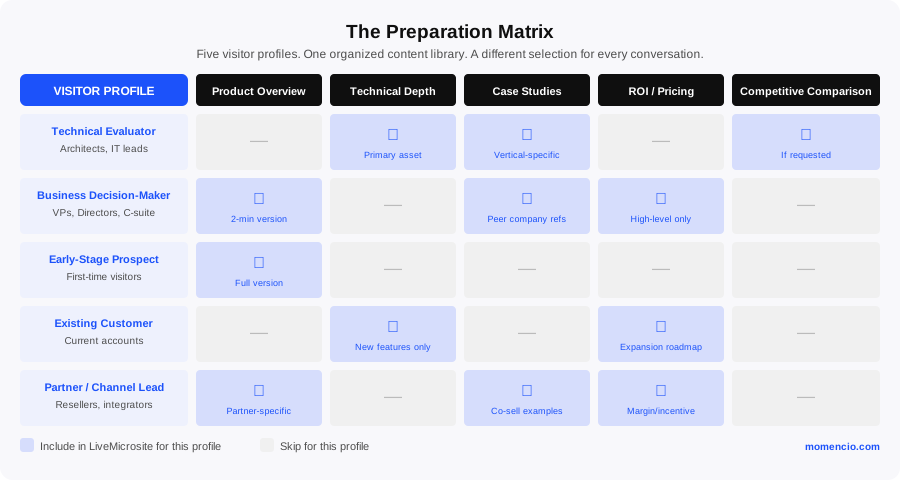
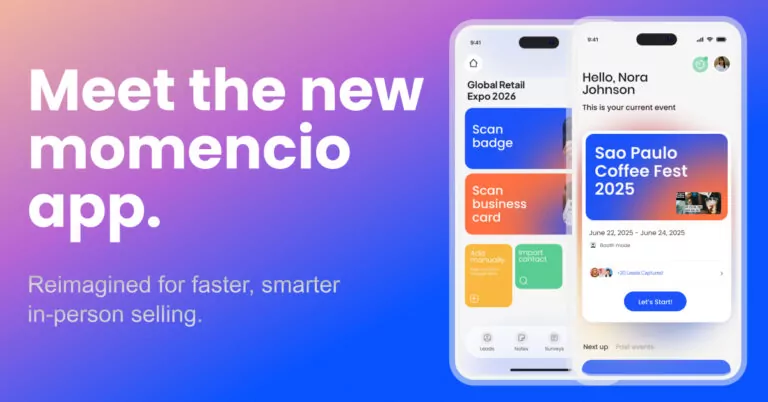
momencio’s Digital Assets Library is built for exactly this organizational layer. Product decks, vertical case studies, technical overviews, ROI frameworks, and competitive comparisons all live in one cloud-synced, offline-ready library. The rep does not search through shared drives or forward files to themselves the night before. They open the app and the content for the conversation in front of them is already organized and accessible in seconds.
For a tactical guide on reading the buyer signals in the moment and selecting content accordingly, aligning your booth content with buyer intent covers the specific signals to read and the content decisions that follow from them.
The conversation does not end when the visitor walks away
Here is where most exhibitor teams lose the gains they made on the floor.
A rep has a sharp, well-calibrated conversation with a technical evaluator. They showed the right content, answered the right questions, and left the visitor genuinely interested. Then the visitor walks to the next booth, picks up three more conversations over the rest of the day, attends two sessions, and by the time the follow-up email arrives two days later, the specificity of what made that first booth different has blurred into the general noise of the show.
The follow-up is the wrong generic email with the wrong generic attachment. The impression made on the floor evaporates.
The rep did everything right on the floor. The follow-up undid it.
This is the problem that LiveMicrosites solve, and it is worth being precise about what that means in practice.
A LiveMicrosite is not an email with a PDF attached. It is a personalized landing page built on demand from the content library, tied to a single lead, a single conversation, and a single context. The rep selects the specific assets relevant to what was just discussed (the technical architecture doc, the case study from the visitor’s vertical, the ROI calculator) and sends a link to a page that opens with the visitor’s name and contains exactly those resources, nothing else.
It can be sent from the show floor before the visitor has reached the next booth, while the conversation is still fresh and the company is still top of mind. The rep does not wait for the post-show debrief or the flight home to start the follow-up.
From that point, IntelliStream tracks everything in real time: every page view, every asset opened, every return visit. The rep knows if the technical evaluator came back and spent twelve minutes reading the architecture overview. Sales knows before the follow-up call whether a lead is warm or cold. The 40 unspoken rules that experienced exhibitors follow all point to the same principle, captured clearly in this roundup of trade show floor best practices: same-day follow-up with specific, relevant content outperforms delayed generic outreach by a measurable margin.
And because the microsite is live, its content can be updated after the send. If new information becomes relevant, or if the rep wants to add a resource the visitor mentioned, there is no need to re-send anything. The link is live. The page updates. The lead sees the current version. For the deeper argument on why the 48-hour window after a booth conversation is the highest-value moment in the event cycle, capturing intent at the booth makes that case in full.
What this looks like in practice
The preparation phase, four to six weeks before the show, is where this strategy lives or dies. The event marketing manager or content lead maps expected visitor profiles against the existing content library. Where gaps exist, they are filled with targeted additions: a one-page technical summary, a vertical-specific case study, a competitive differentiator sheet. Everything is uploaded and organized in the Digital Assets Library by profile and by topic. The rep briefing includes not just talking points but content navigation guidance: here is what to show a technical evaluator, here is what to show a business decision-maker, here is what you send when someone asks for the competitive comparison.
At the booth, the rep qualifies the visitor in the first sixty seconds. Not intrusively, but listening for signals that indicate who this person is and what they need. They navigate to the right content selection. The conversation has a backbone that fits the visitor, not a default that was built for nobody in particular.
Before the visitor reaches the next booth, the rep builds and sends a LiveMicrosite in under a minute. The visitor receives a page with their name at the top and the specific resources that were relevant to their conversation: the content that fits their situation, not a generic brochure or a default deck assembled for everyone.
That evening, the rep reviews IntelliStream and sees which leads re-engaged with their microsites. The technical evaluator opened the architecture doc and read it for fourteen minutes. That is not a cold lead. That is a warm one with a clear, documented next step.
After the show, follow-up does not start from zero. It starts from context: what content was shown, what was discussed, what engagement happened after the send. All of it recorded and visible to sales before the first follow-up call. This is what turns a booth visit into a pipeline entry rather than a badge scan.
The barrier to personalized booth content is not effort. It is organization. Most exhibitor teams already have the content they need. They need a system that makes it accessible in the moment, deliverable in a way that continues the conversation after the visitor walks away, and trackable in a way that tells sales who is actually engaged.
momencio provides the Digital Assets Library, the LiveMicrosite delivery layer, and the engagement tracking to make all of that happen within the workflow your team already uses. To see how it fits your event program, request a demo and the team will walk you through it.
Frequently asked questions
- How do you prepare different booth content for different buyer types without building dozens of new assets?
- You do not need to start from scratch. In most cases the content already exists across sales decks, case studies, product documents, and vertical materials. The preparation work is organization, not production: map your expected visitor profiles against the content you already have, identify genuine gaps, and structure the library so the right assets are findable in seconds. The Digital Assets Library in momencio is built for this: organized by profile, available offline, and updated centrally so every rep on the floor has the same current version without anyone emailing attachments the night before the show.
- What content should exhibitors have ready for a first-time visitor versus someone already evaluating vendors?
- For a first-time visitor, the content job is clarity. A direct explanation of the problem you solve, one compelling proof point, and something that makes them want to continue the conversation after the show. For someone in active evaluation, the content job is depth and fit: technical specifics, relevant case studies, competitive differentiators, and a clear path to a next step. Showing evaluation-stage content to a first-time visitor overwhelms them. Showing acquisition-stage content to an evaluator wastes their time. The prep work is ensuring both paths are ready and that the rep knows which signals indicate which track.
- How do you personalize follow-up for 60 leads from a single show day without it becoming a manual project?
- The personalization work happens at the moment of capture, not after the show. When the rep adds a short note about the conversation and tags which content was relevant, that context travels with the lead record. The LiveMicrosite is built from that context at the point of send, before the visitor has left the floor, and it contains exactly what was discussed. By the time the rep is back at their desk, the follow-up has already happened, engagement data is already coming in, and the manual work is following up on warm leads, not composing emails from memory.
- How do you know whether the content you sent after a show is actually being read?
- With static email attachments, you do not. With LiveMicrosites and IntelliStream, you know in real time which leads opened their page, which assets they viewed, how long they spent, and whether they came back. The difference between a lead who opened the architecture doc twice and one who never clicked through is not a guess. It is a data point that tells sales exactly where to focus before the first follow-up call.
- How far in advance should an exhibitor be thinking about booth content personalization?
- Four to six weeks is a useful baseline for most mid-size exhibitor teams. That gives enough time to audit existing content against expected visitor profiles, identify production gaps without rushing to fill them, upload and organize the library, brief the booth team on content navigation by visitor type, and test the full delivery flow before the show opens. Teams that begin this work in the week before the event are usually fixing problems on the floor rather than running the strategy they planned.
- Does personalized content delivery only work for large enterprise booths, or is it relevant for smaller teams?
- It is more relevant for smaller teams than for large ones because smaller teams have less margin for wasted conversations. A three-person team at a regional conference cannot afford to show the wrong content to the right buyer. Every conversation counts more proportionally, and every follow-up email that misses the mark costs more. The tooling scales accordingly: a small team uses the same Digital Assets Library and LiveMicrosite capability as a large one, with the same ability to deliver a personalized experience without increasing the workload of the rep on the floor.