Event marketing ROI is a simple formula surrounded by a complicated set of judgment calls. The formula itself takes one line. The judgment calls, what counts as revenue, what counts as cost, how to handle pipeline that won’t close for nine months, are where most B2B exhibitors get stuck.
This guide covers the full picture. The formula, a worked B2B example, the three variants you might use depending on your reporting window, the metrics that feed the calculation, and the benchmark numbers that tell you whether your ROI is any good. Written specifically for B2B exhibitors at commercial trade shows, conferences, and field events, where sales cycles run long and a single booth conversation can take nine months to show up in closed-won revenue.
What event marketing ROI actually measures
Event marketing ROI measures the financial return you get from an event relative to the total cost of participating in it. For a B2B exhibitor, that return has two components that matter: revenue closed as a direct result of the event, and pipeline value created that is expected to close over the following months.
Event ROI is different from event ROO (return on objectives). ROI asks a financial question: did the dollars invested produce more dollars back? ROO asks a broader question: did the event meet its stated objectives, whether those were financial, brand-related, relational, or operational. Both are useful. ROI is the one the CFO will ask about and the one this guide covers.
The common mistake is using revenue as a synonym for ROI value. Revenue is the narrowest input. For most B2B exhibitors, pipeline value is the larger and more important number, because B2B sales cycles mean direct in-event revenue is rare. An honest event ROI calculation has to include pipeline value. Without it, you are under-reporting the return on every event that does its job well.
The event marketing ROI formula
The core formula:
Event marketing ROI (%) = [(Event value − Event cost) ÷ Event cost] × 100
A positive percentage means the event produced more value than it cost. A 200% ROI means the event returned twice its cost in value. A 500% ROI means five times. Negative ROI means the event lost money.
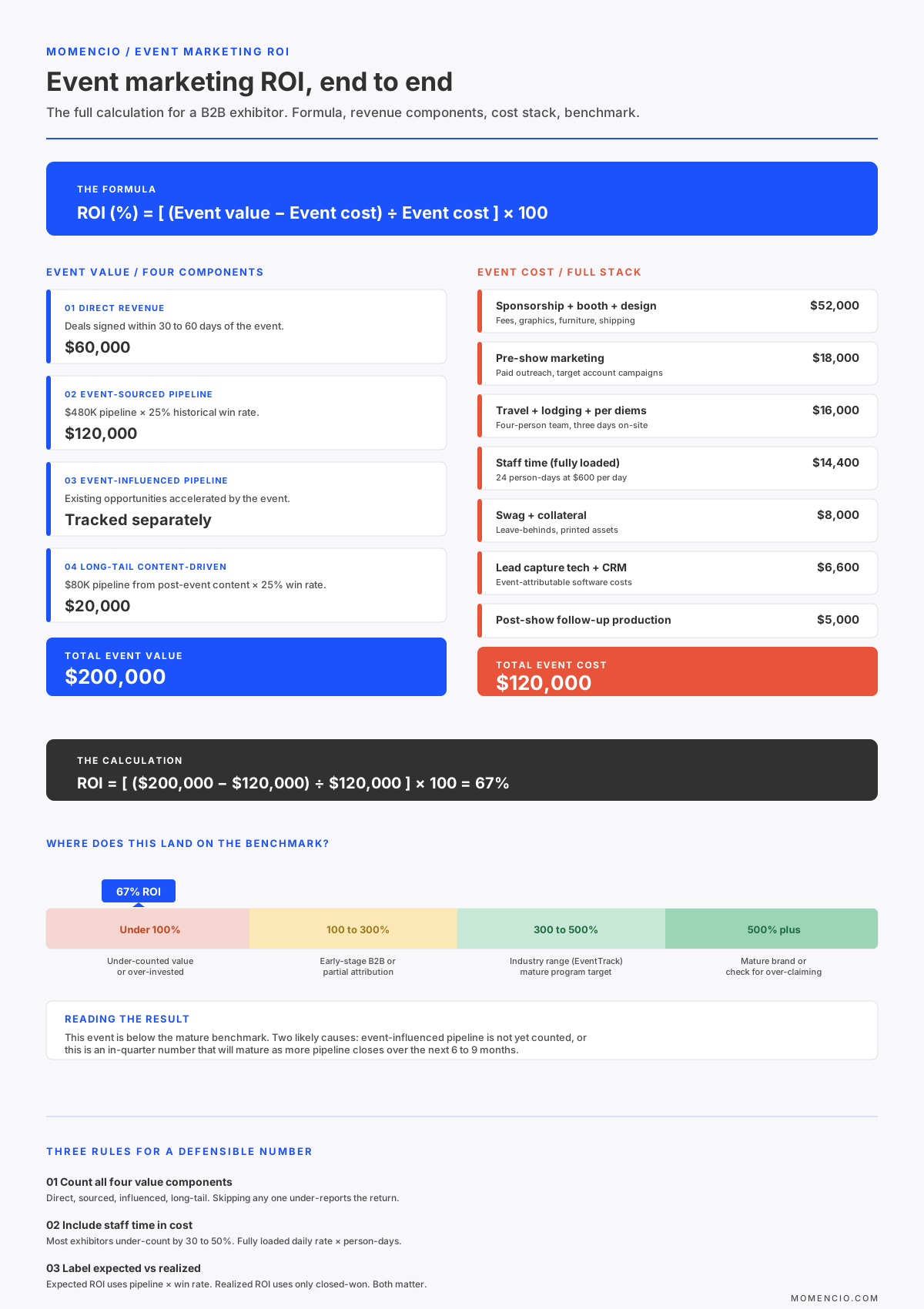
Here is a worked B2B example. A mid-market SaaS company exhibits at a three-day industry trade show. Total cost: $120,000, including sponsorship and booth, travel and lodging for the team, pre-show marketing, lead capture technology, and staff time.
The event produces: $60,000 in deals signed within 30 days (a small portion of booth conversations closed quickly), $480,000 in qualified pipeline at a 25% historical win rate (expected $120,000 in closed-won over the following 9 months), and an additional $80,000 in pipeline influenced through on-demand content from the event over the following 6 months at the same win rate (expected $20,000 in closed-won).
Total expected event value: $60,000 + $120,000 + $20,000 = $200,000.
ROI = [($200,000 − $120,000) ÷ $120,000] × 100 = 67%.
The event returned $1.67 for every dollar spent. Whether that is good depends on the benchmark, which we will cover in section six.
What counts as “revenue” for a B2B event
This is where most B2B exhibitor ROI calculations fail. The instinct is to count only immediate revenue, deals signed within 30 or 60 days of the show. For B2B, that is almost always a tiny fraction of the true return, because the sales cycle runs longer than the reporting window.
An honest event value calculation includes four components.
Direct revenue
Deals signed at the event itself or within the first 30 to 60 days afterward. Rare for B2B enterprise sales, more common for transactional or mid-market deals. Count this in real dollars as it closes.
Event-sourced pipeline value
New opportunities created where the event was the first meaningful touchpoint. Multiply the qualified pipeline dollar value by your historical win rate to get expected closed-won value. If you have 20 opportunities worth $500,000 in pipeline and you close 25% of your B2B opportunities on average, event-sourced pipeline value is $125,000 in expected revenue.
Event-influenced pipeline value
Opportunities that were already in motion before the event but progressed faster or further because of event interactions. This is the hardest component to quantify honestly. Most exhibitors either skip it (under-reporting) or claim 100% credit (over-reporting). The practical approach: assign a percentage weight, typically 20 to 40%, to the closed-won value of influenced opportunities. Document the assumption so the number is defensible.
Long-tail content-driven pipeline
Pipeline created in the weeks after the event from content, recordings, and assets the event produced. This shows up when a prospect who watched an on-demand recording or downloaded a session asset two months later becomes an opportunity. Count it against the event only if the content was produced for and at the event, and the attribution can be traced.
Sum these four components to get total event value. The discipline of counting all four is what separates a serious ROI calculation from a vanity number.
What counts as “cost” for a B2B event
Most exhibitors under-count event cost by 30 to 50%. The obvious line items are the ones everyone captures. The hidden ones are the ones that matter for an honest ROI.
A complete event cost should include:
- Sponsorship, booth, or exhibitor fees
- Booth design, graphics, furniture, shipping, storage
- Pre-show marketing: paid outreach, target account campaigns, landing pages
- Travel, lodging, per diems for the attending team
- Staff time: fully loaded cost of the hours spent by marketing, sales, and executives before, during, and after the show
- Swag, collateral, leave-behinds
- Lead capture technology and CRM integration costs attributable to the event
- Post-show follow-up costs: content production, email sequences, any paid nurture
- Opportunity cost: what the team could have been producing if they were not at the event
Staff time and opportunity cost are the two items most exhibitors skip. A four-person team spending three days at a show plus three days of travel and prep represents roughly 24 person-days. At a fully loaded daily rate of $600, that is $14,400 in staff cost alone. If this is missing from your calculation, every ROI number you produce is inflated. Include it.
Three ROI formulas, three situations
The core formula handles most cases. Two variants exist for specific reporting situations.
Simple ROI: in-quarter reporting
ROI (%) = [(Event value − Event cost) ÷ Event cost] × 100
Use this for reporting within the current quarter using direct revenue and expected pipeline value. This is what most CFO conversations will require.
Incremental Revenue ROI: profit-focused variant
ROI (%) = [(Event revenue − Event expenses) ÷ Event expenses] × 100
Identical structure, but uses only closed revenue, not pipeline. Used for retrospective reporting 9 to 12 months after the event when most of the pipeline has closed. This is the validation number, not the in-quarter reporting number.
Pipeline Contribution ROI: the B2B variant
ROI (%) = [(Event-sourced pipeline value − Event cost) ÷ Event cost] × 100
Uses qualified pipeline dollar value instead of expected closed-won. Useful when your finance team wants to see the top-of-funnel contribution separately. Tends to produce the highest-looking ROI number, which is both its advantage and its risk. Always report it alongside the expected closed-won calculation to avoid over-claiming.
The practical rule: use the simple ROI formula by default. Report the pipeline contribution version only when it is specifically requested, and always pair it with the expected closed-won number. Use the incremental revenue variant for backward-looking validation 9 to 12 months after the event.
What is a good event marketing ROI?
This is the question most competing articles hedge on. The honest answer has a range, but the range is knowable.
Industry data from multiple 2024 and 2025 studies converges on these figures:
- The EventTrack study reports that 48% of brands realize an ROI between 300% and 500%, with 44% averaging around 300%.
- The widely cited Lyyti benchmark for event marketing is a 5:1 ratio, or $5 earned for every $1 spent, which equals 400% ROI.
- Bizzabo’s research finds companies with effective event ROI measurement achieve 5x greater marketing returns than those without structured measurement, a figure that roughly aligns with the 400 to 500% range.
These numbers all reference the simple ROI formula: value minus cost divided by cost. A realistic target range for a B2B exhibitor running a program of events is 300 to 500% per event, calculated using all four revenue components and full cost including staff time.
The range moves depending on company stage and event type. Three adjustments:
Company stage
Early-stage B2B companies typically run lower event ROI (100 to 250%) because their brand recognition is lower and their win rates are still being established. Mature B2B companies with strong brand recognition often run higher (400 to 700%) because their pipeline conversion rates are better.
Event type
Large sponsor-based trade shows tend to run lower ROI than smaller targeted industry conferences, because the cost is higher and the audience is less qualified. A well-chosen 300-person industry conference often out-performs a 20,000-person trade show on ROI, even with lower absolute pipeline numbers.
Sales cycle length
For sales cycles of 3 to 6 months, simple ROI calculated at 9 months post-event is a reliable number. For sales cycles of 9 to 18 months, the in-quarter ROI calculation will always look worse than the real number, because most of the pipeline has not yet closed. Benchmark against your own prior events, not against external numbers, until you have 12 to 18 months of post-event data to work with. See momencio’s top 10 event ROI metrics for the full metric-by-metric benchmarking approach.
If your current event ROI is below 200%, something is either being under-counted on the value side or over-invested on the cost side. Most often, it is the former. Check your influenced pipeline component and your long-tail content-driven pipeline. If you are above 500%, check that your value calculation is honest, especially the influenced-pipeline component. Very high ROI numbers on B2B events usually mean the pipeline weighting is too generous or the win rate assumption is inflated.
One useful sanity check: calculate realized ROI retrospectively for any event from 12 to 18 months ago, using only actual closed-won revenue. Compare it to the expected ROI you reported in-quarter at the time. If the retrospective number is within 20% of the expected number, your measurement system is reliable. If it is off by 40% or more, your leading indicators or attribution weights need adjustment.
The metrics stack that feeds the ROI calculation
Event marketing produces dozens of measurable signals. Not all of them belong in the ROI calculation. A useful mental model: three tiers.
Primary metrics: these go into the ROI calculation
Event-sourced pipeline value. Event-influenced pipeline value. Direct closed-won revenue. Cost per opportunity (CPO). These are the numbers that answer the ROI question directly. If you only measure four things, measure these.
Secondary metrics: these predict the primary metrics
Qualified lead count, MQL-to-SQL conversion rate, SQL-to-opportunity conversion rate, event-sourced pipeline velocity (time from badge scan to opportunity creation), speed-to-qualification (time from capture to SQL). These tell you how healthy the pipeline is before it closes, which lets you report leading indicators at 30/60/90 days while the real ROI number is still maturing.
Supporting metrics: these describe engagement, not revenue
Attendance, booth traffic, session attendance, content downloads, social mentions, NPS. These are useful for diagnosing what happened at the event but should not sit in the ROI calculation. Treating them as ROI inputs is how exhibitors end up with ROI numbers that look great on a dashboard and cannot be traced to a single dollar of pipeline.
The discipline is to keep the tiers separate in reporting. Primary metrics in the ROI conversation. Secondary metrics in the pipeline health conversation. Supporting metrics in the event post-mortem conversation. Mixing them is the single most common reason event ROI reports lose credibility with finance.
The two reasons B2B event ROI gets reported wrong
Two specific structural issues trip up most B2B event ROI calculations. Both are solvable.
The 6 to 12 month lag problem
B2B sales cycles routinely run 6 to 18 months. The budget review cycle runs quarterly. This creates a timing mismatch: the ROI question is asked in the same quarter as the event, when 80 to 90% of the pipeline has not yet closed. The temptation is to either under-report (count only closed revenue) or over-claim (count all pipeline at 100% value).
The practical solution: report leading indicators in-quarter and retrospective ROI at 9, 12, and 18 months. Leading indicators at 30/60/90 days include event-sourced pipeline value (at historical win rate), pipeline velocity, and speed-to-qualification. These are real numbers that correlate with eventual closed-won. Retrospective ROI is calculated once enough pipeline has closed to be meaningful. Label both clearly: “expected ROI” for the in-quarter number, “realized ROI” for the retrospective. This is covered in depth in Forrester’s Leaders Face Five Challenges When It Comes To Event Measurement.
The multi-touch attribution problem
A B2B buyer typically interacts with your company 15 to 30 times across a buying journey that runs 6 to 9 months. Events are one touchpoint among many. Giving the event 100% credit over-states its impact; giving it 0% because it was not the last touch understates it. Both are wrong.
The practical solution: use position-based attribution with a realistic time window. Give the event 30 to 40% credit for opportunities where it was the first touchpoint, 20% for opportunities where it was a middle touchpoint, and 30 to 40% where it was the closing touchpoint. Set your CRM attribution window to 90 to 180 days for B2B events, not the 14 or 30 day default. Most exhibitors never adjust this and systematically under-credit their events as a result. For the full framework, see momencio’s event ROI analysis guide.
The measurement workflow
A repeatable six-step process any B2B exhibitor can implement. The full program view is covered in momencio’s master trade show ROI guide.
Step one: set goals in pipeline terms before the event. Target event-sourced pipeline value, target CPO, target cost per qualified conversation. Avoid lead-count goals, they encourage the wrong behavior at the booth.
Step two: capture lead context at source. Badge scans alone are insufficient. Capture the conversation topic, rep name, qualifying signals, and agreed next step. Context is what lets the sales team continue the conversation, which is what produces pipeline, which is what produces ROI. momencio’s event ROI calculators cover the lead-value math that feeds directly into this calculation.
Step three: tag every captured lead in CRM with a dedicated event campaign field. This is the single most important operational step. Without it, the attribution is guesswork. With it, you can pull any event’s full pipeline contribution at any time.
Step four: report leading indicators at 30, 60, and 90 days. Pipeline created, pipeline velocity, SQL conversion rate, CPO. These are the numbers you defend the budget with in-quarter.
Step five: calculate realized ROI at 6, 9, and 12 months post-event. Use the incremental revenue variant of the formula. This is the number that validates whether your leading indicators were reliable and whether the event is worth repeating. momencio’s guide to measuring event ROI in real time covers the operational side of this reporting.
Step six: run a portfolio review annually. Rank every event in the program by realized ROI. Cut or replace the bottom 20%. Expand investment in the top 20%. Most B2B exhibitors never do this and end up repeating underperforming events out of habit, while strong-performing events get the same budget as weak ones because nobody is looking at the portfolio as a portfolio.
The workflow works because every step compounds. Goals in pipeline terms produce the right booth behavior. Lead context capture produces the follow-up quality. CRM tagging produces the attribution. Leading indicators produce the in-quarter reporting. Realized ROI produces the validation. Portfolio review produces the budget discipline. Skip any step and the calculation at the end is guesswork.
The report leadership will actually read
The final output of all this measurement is not a dashboard. It is a one-page summary that a CFO or CRO can read in 90 seconds and understand clearly. Structure it as follows.
Top of page: event name, date, total cost, realized-to-date value. ROI number clearly labeled as expected or realized.
Middle: the four value components listed separately with dollar values and the assumption behind each. Pipeline weights and attribution logic explicitly stated so the number is defensible.
Bottom: the leading indicators at 30/60/90 days for in-quarter reports, or the closed-won validation for retrospective reports. A one-line recommendation: repeat, modify, or cut.
This is the report that keeps event budgets funded. Pipeline-first, not lead-first. Honest about what is known and what is still in motion. Clear about which number is an estimate and which is realized. The B2B exhibitors whose event programs survive budget scrutiny are the ones producing reports in this format, not the ones producing 40-slide decks of engagement metrics. Get the measurement right, and the budget conversation takes care of itself.
Build the measurement system that supports the reporting
momencio captures lead context at source, tags every interaction to a specific event campaign, and feeds CRM directly with the attribution logic built in. Pipeline-ready reporting from day one. See how it works.