
Most hybrid event marketing content is written for the person planning the event. The organizer who needs to pick a platform, build an agenda, and produce two audiences at once. That is a useful problem to solve, but it is not the problem most B2B marketers are actually trying to solve.
The harder problem, and the one almost nobody is writing about, is what to do when you are the exhibitor at someone else’s hybrid event. You did not choose the platform. You did not design the agenda. You are handed a guest list that mixes people in the room with people watching from their desks, and you are expected to come home with pipeline.
This piece is written for that exhibitor. The argument is straightforward. Hybrid event marketing is not one play. It is two plays you have to run at the same show, and each one produces a different kind of lead that your sales team needs to follow up on differently. The exhibitors who win at hybrid events are the ones who have separate operating models for the room and the screen, and a capture system that unifies what comes out of both.
The two-track reality of a hybrid event
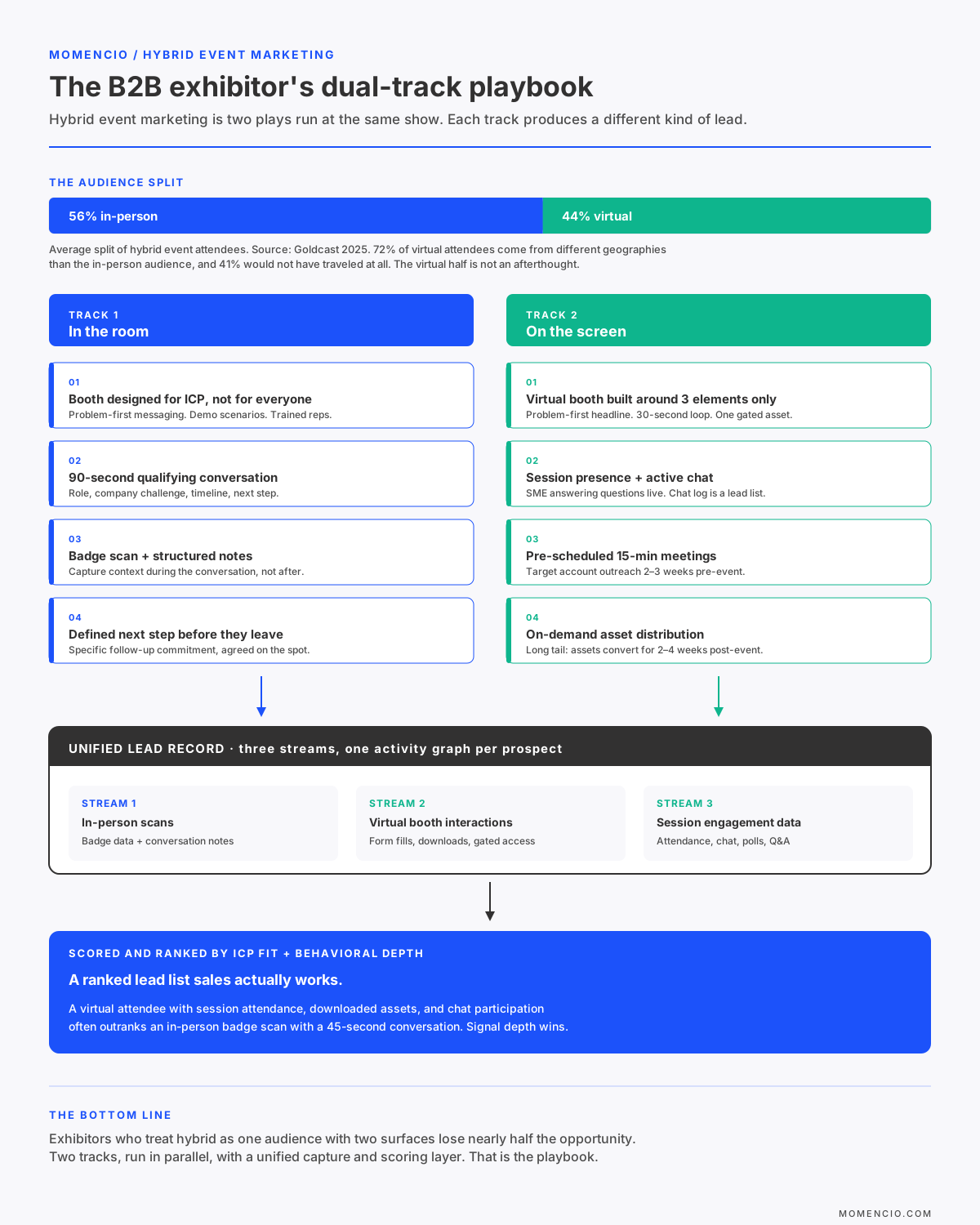
Start with a number that most exhibitors never internalize. According to Goldcast’s analysis of hybrid event attendance, on average 56% of hybrid event attendees join in person and 44% attend virtually. The split is not fringe. It is nearly half the audience.
Who are those 44%? They are not accidental attendees. Research from multiple 2025 and 2026 studies on virtual event behavior paints a clear profile. Roughly 72% of virtual attendees come from different geographic regions than the in-person audience, and about 41% say they would not have traveled to the in-person event at all. Meaning, for a B2B vendor selling across regions, the virtual half of the audience often contains the prospects that your physical booth was never going to reach. These are not lower-intent attendees. They are different-context attendees.
The mistake most exhibitors make is running a single playbook, the in-person one, and then bolting on a “virtual presence” as an afterthought. The booth is designed, the reps are briefed, the giveaway is ordered, and then someone in marketing is asked to “also make sure we show up virtually.” What that usually produces is a logo on a virtual sponsor page that nobody clicks, a session that nobody attends, and a post-show lead file that captures almost nothing from the virtual half of the audience.
The exhibitors generating real pipeline from hybrid events do something different. They build two programs. The in-person track runs on the floor, at the booth, through rep conversations. The virtual track runs in the platform, through session sponsorship, virtual booth design, chat presence, and on-demand asset distribution. Both tracks produce leads. Both tracks produce behavioral signals. And both tracks feed a single unified record that sales can actually work.
Track 1: how to show up in the room
The in-person track at a hybrid event looks almost identical to the in-person track at any other trade show. A booth, a team, a qualification framework, a lead capture system, a follow-up process. Most of the best practice here is well-covered: pre-show outreach to target accounts, a booth experience that filters for your ICP rather than everyone with a badge, reps trained to qualify in 90 seconds, and a capture system that records context alongside contact details.
What changes at a hybrid event is the audience of your rep conversations. When you are in a purely in-person event, the conversation at your booth is between the rep and the visitor. At a hybrid event, those conversations are often recorded, livestreamed, or referenced later in virtual sessions, chat transcripts, or on-demand recaps. A rep delivering a throwaway line at an in-person booth can end up quoted in a virtual session recap watched by three hundred people who were not in the room.
That changes how the in-person track should be run. The messaging needs to be repeatable content, not ad-libbed pitch. The examples your reps use need to hold up when they are pulled out of context. The demos and stories that happen at the booth are part of the virtual experience too, whether you planned for that or not.
The other thing that shifts at a hybrid event is the opportunity cost calculation on the booth itself. If the room holds 56% of the audience and the virtual platform holds 44%, a booth budget that consumes 100% of your event spend is by definition under-investing in nearly half your market. The question is not whether to run the in-person play. It is how to re-allocate some portion of what would have been a larger booth spend toward the virtual track, because that is where the under-served half of the audience is sitting.
Track 2: how to show up on the screen
The virtual track is where most B2B exhibitors lose ground at hybrid events, and it is also where the clearest competitive advantage is available. Because so few exhibitors run a real virtual play, the ones who do compete against a much thinner field.
Four elements matter here, in order of impact.
Virtual booth design that actually converts
Your virtual booth is a landing page inside someone else’s platform. Most virtual booths fail because they treat the space like a digital brochure. A logo, a company description, a list of products, a contact form. Visitors land, scan for 15 seconds, and leave.
A virtual booth that converts has three elements and three only. A headline that names a specific problem the ICP recognizes. A 30-second loop, either a demo or a customer clip, that plays on landing without a click. And one high-value gated asset, typically a research finding, a diagnostic tool, or an exclusive benchmark, that a visitor exchanges context for. No giveaways, no generic brochure downloads. One asset, gated behind a form that captures role, company, and the specific problem they came looking for.
Everything else on a virtual booth is noise. Product catalogs, team bios, press releases, sponsor tiers. They look professional and they convert nothing. The discipline is to strip the virtual booth down to the three elements that do work, and to treat every click on the form as a qualified lead that gets scored against your ICP immediately.
Session sponsorship and chat presence
Most virtual audiences do not wander the expo hall. They attend sessions. That is where their attention lives during the event. A booth that nobody visits is a rounding error compared to a session that reaches three hundred attendees who are actively engaged.
Session sponsorship at hybrid events works differently from physical sponsorship. In the room, sponsorship is about logo placement and signage. Virtually, the currency is presence in the chat. A sponsored session where your subject matter expert is active in the chat during the session, answering specific questions that tie to your product category, generates more qualified conversations than any virtual booth ever will. The chat log becomes a lead list because everyone who asked a relevant question has self-identified.
The discipline here is to prioritize sessions that align with your ICP’s actual interests, not the sessions with the biggest name on the agenda. A 75-attendee breakout on a specific operational problem your product solves produces more pipeline than a 2,000-attendee keynote where nobody will remember your logo.
Pre-scheduled virtual meetings
The single highest-converting virtual tactic is the pre-scheduled 15 or 20 minute meeting booked before the event starts. Most hybrid event platforms allow exhibitors to send meeting invitations to registered virtual attendees. Almost nobody uses this. The ones who do come home with a full calendar of qualified conversations that required zero booth traffic to generate.
The playbook is simple. Pull the registered virtual attendee list as soon as it becomes available. Cross-reference it against your CRM and target account list. For the accounts that match, send a personalized meeting invite two to three weeks before the event, offering a specific reason to talk. Not a demo. A conversation about a specific problem you know the account is working on, based on publicly available signals. Ten to fifteen of those invitations, well-targeted, typically produce three to five booked meetings. Those five meetings will often out-convert every walk-up conversation your physical booth produces across the entire show.
On-demand asset distribution
The virtual audience has a long tail that in-person audiences do not have. A session that runs live during the event will continue to be watched on-demand for weeks afterward. Most exhibitors do not plan for this and miss most of the virtual audience’s engagement because it happens after they have packed up.
The play is to ensure that every asset you produce for the event, including any sessions you sponsor or speak at, is available on-demand through the platform with a clear next-step CTA attached. A whitepaper linked in the session description. A calculator or diagnostic tool referenced in the speaker’s remarks. A personalized microsite that virtual attendees land on when they click through from the platform. These assets will continue generating leads for weeks, as long as they are tracked and fed back into the same scoring system. momencio’s hybrid events playbook covers how to structure this on-demand distribution so the long tail of the virtual audience converts as reliably as the live one.
The unification problem: reconciling three streams of lead data
By the end of a hybrid event, a B2B exhibitor typically has three separate streams of lead data, and most of them never get reconciled.
Stream one is in-person badge scans from the booth. These are the traditional lead records, with whatever context the rep captured during the conversation.
Stream two is virtual booth interactions. Form fills, asset downloads, gated content accesses. These come out of the event platform, often as a separate CSV export.
Stream three is session engagement data. Attendance, watch time, chat participation, poll responses, Q&A submissions. These are usually available from the platform but rarely get pulled into the lead file at all.
When these three streams stay separate, a specific failure happens. The same prospect shows up as three different records in three different places. Jane attended the in-person session, scanned at the booth, and later watched two virtual breakouts on-demand. The sales rep working her account sees a badge scan in the CRM. The marketing team sees two virtual engagement events in the platform export. Nobody connects them. The result is that Jane gets a generic “thanks for stopping by” email, when the correct follow-up would reference both the in-person conversation and the on-demand content she clearly found valuable.
This is where the capture and unification layer changes the outcome. An AI EdgeCapture™ system that pulls badge scans, virtual booth interactions, and session engagement into a single activity stream per prospect is not a nice-to-have at a hybrid event. It is the difference between a sales team that can work the pipeline and a sales team that has three partial views of every lead.
momencio’s IntelliStream™ is built around this unification problem. Every capture surface, whether a physical badge scan, a virtual form submission, a content download, or a session interaction, feeds the same unified activity stream. The lead record in the CRM contains the full behavioral graph, not three disconnected fragments, which means the rep working the account knows which in-person conversation Jane had and which on-demand content she engaged with afterward. The follow-up reflects both touchpoints, not one.
Why virtual engagement signals should not be ranked the same as badge scans
The second reason the streams need to be unified is that the signals inside them are not equal. An in-person badge scan is a binary event. It means the visitor physically walked up to your booth and allowed the scan. That is one piece of information, and it is a relatively weak signal on its own.
A virtual engagement is a behavioral graph. When a virtual attendee watches three sessions, downloads a whitepaper, submits a chat question referencing a specific pain point, and revisits your virtual booth twice over the course of the event, that is five distinct signals that together tell a much richer story than a single badge scan. The virtual attendee is often more qualified than the in-person visitor, not less, because you have a longer and more detailed record of what they cared about.
This is where most post-show lead scoring fails at hybrid events. Exhibitors rank the in-person leads first because those feel “real,” and treat virtual engagement data as secondary information. The correct ranking is the reverse. The in-person lead with a badge scan and a 45-second conversation is a single touchpoint. The virtual lead with session attendance, downloaded assets, and chat participation is a behavioral portrait. A scoring model that weighs these correctly surfaces the highest-intent prospects from both tracks, regardless of how they engaged.
This is the problem AI IntelliSense™ is designed to solve. It scores every captured interaction against the ICP profile and the behavioral depth of the engagement, so that a multi-touch virtual engagement is recognized for what it is, and a single badge scan is recognized for what it is. The result is a ranked lead list that tells sales who to call first based on genuine buying signals, not based on which surface they happened to be captured through.
The dual-track operating model
An exhibitor with a serious hybrid event program has ten things in place before the doors open, physically or virtually.
- A defined split of the event budget between the in-person track and the virtual track, with the virtual share scaled to the expected virtual audience proportion, typically 30 to 45%.
- A booth designed for the in-person audience with messaging and demos that remain coherent when referenced in virtual session recaps or chat transcripts.
- A virtual booth built around three elements only: a problem-specific headline, a 30-second demo or customer clip, and one high-value gated asset.
- A pre-event outreach program aimed specifically at the registered virtual attendee list, targeting 10 to 15 pre-scheduled meetings before the event opens.
- Session sponsorship or speaking slots selected for ICP alignment rather than audience size, with a subject matter expert active in the chat during each session.
- A unified capture layer that pulls in-person scans, virtual booth interactions, and session engagement into one activity stream per prospect.
- A scoring model that weights virtual behavioral signals appropriately against in-person touchpoints, so the ranked lead list reflects real intent.
- A personalized follow-up mechanism, ideally a microsite per prospect, that references the specific interactions each person had across both tracks.
- An on-demand asset distribution plan so that virtual engagement continues for two to four weeks after the event and feeds the same scoring pipeline.
- A pipeline reconciliation cadence that the sales team runs in the first week after the event, working the ranked lead list rather than the raw export.
Most of this is not about platform choice or budget. It is about recognizing that hybrid events are not one audience split across two surfaces. They are two audiences that have to be worked differently and reconciled at the end. The exhibitors who understand this stop complaining about hybrid event ROI and start treating the virtual half of the audience as the opportunity it actually is.
Run both tracks with one capture system
momencio’s virtual and hybrid events capability gives B2B exhibitors a single platform that captures in-person badge scans, virtual booth interactions, session engagement, and on-demand activity, all unified into one ranked lead record. Combined with pipeline forecasting and AI-driven scoring, every interaction from both tracks feeds directly into sales with full context. See how it works.