There is a metric that trade show teams report with genuine pride – ‘daily foot traffic counts’. Hundreds of visitors, sometimes thousands, logged past the stand. And then, in the week after the show, the same team stares at a list of badge scans that produces two or three real pipeline conversations.
Foot traffic is not the goal, qualified conversations are. The distinction seems obvious until you watch how most trade show booth ideas are actually evaluated: by how much attention they draw, not by who they draw in and what happens next.
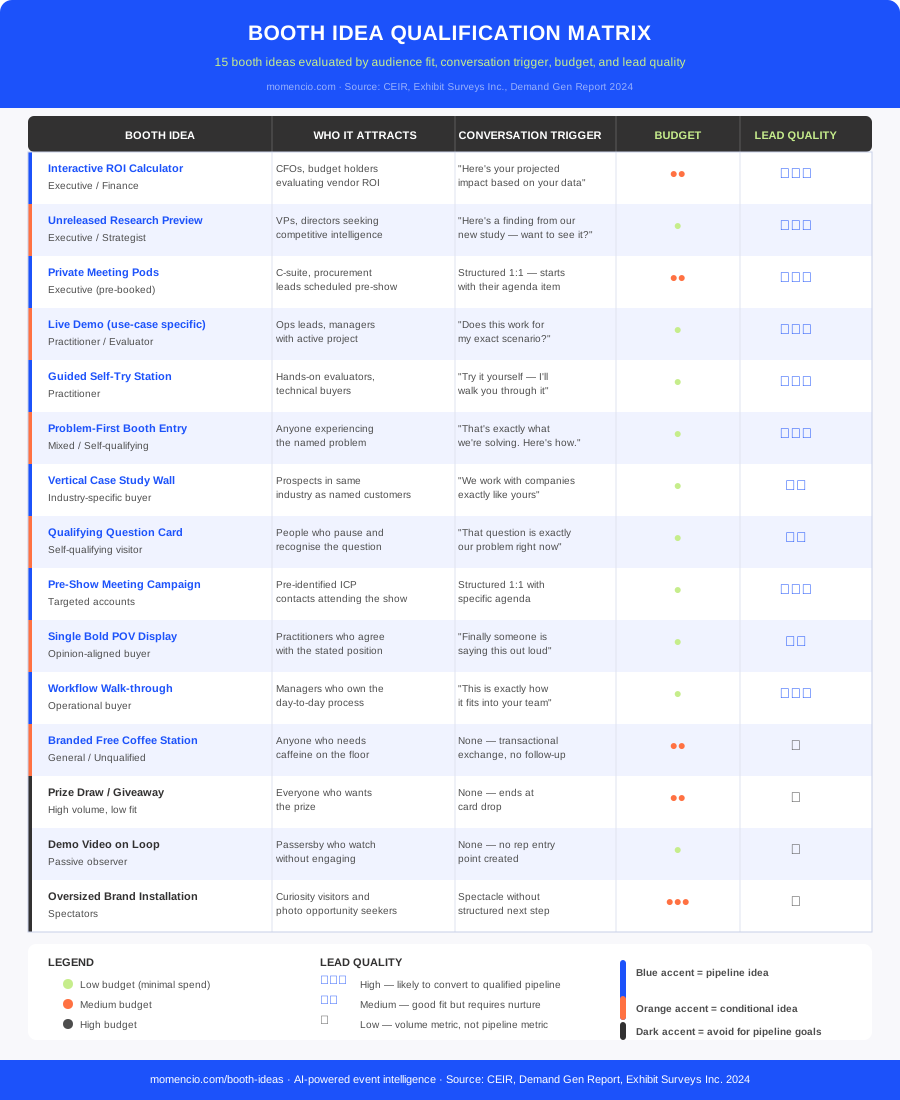
This piece looks at the category differently. Each idea below is evaluated against a single question: does this attract the specific person you are trying to get in front of, and does it create a reason for them to stay and talk? Ideas that fail that test — even spectacular, expensive, high-traffic ones — are not good booth ideas for B2B event lead generation teams.
The attraction trap: why foot traffic is a vanity metric
Exhibition floor economics work against you in a specific way. The most attention-generating booth activities — games with prizes, spin-the-wheel giveaways, celebrity appearances, oversized installations — are optimized for volume, not fit. They produce crowds of people who want the prize, not your product.
The cost of this is not just wasted badge scans. It is the opportunity cost of your best reps spending their highest-energy hours on conversations that were never going to convert. At a three-day show where a qualified rep can realistically run 30 to 40 meaningful conversations, the people they talk to matter enormously.
Research consistently shows that the quality of face-to-face interaction is the primary factor in post-show purchase intent. The buyer who stops because your booth asks them a question relevant to their actual problem is more valuable than ten who stopped because you were giving away AirPods.
The shift in mindset is not from “attract more visitors” to “attract fewer visitors.” It is from “attract everyone” to “attract the right people and create the conditions for a conversation worth having.” That conversation, when captured and scored properly, is what feeds your post-event pipeline.

The filter: how to evaluate any booth idea against lead quality
Before committing to any booth concept, run it through four questions.
First: who specifically does this attract? Not broadly — specifically. An ROI calculator on a screen attracts CFOs and heads of finance who are actively thinking about justifying spend. A branded selfie station attracts people who want content for their LinkedIn. These are different audiences and they produce different trade show ROI outcomes.
Second: what conversation does it start? The best booth ideas are conversation starters, not conversation substitutes. A demo video playing on a loop gives visitors a reason not to talk to your team. An interactive tool that requires a rep to walk them through it creates mandatory in-booth engagement.
Third: what does the visitor have to invest to engage? Low-barrier attractions — spin wheels, free coffee, branded swag — draw people who are investing nothing and expecting nothing in return. Slightly higher-barrier engagements — a tool that requires 90 seconds of their time, a conversation that starts with a specific question — self-select for visitors with genuine interest.
Fourth: what does the rep do next? The booth idea and the qualification conversation are not separate things. The idea should set up the conversation, not replace it. If your booth experience ends without a natural handoff to a rep, you have an engagement activity, not a pipeline activity. The rep’s job is to take that conversation and turn it into a structured lead record before the visitor walks to the next booth.
Ideas that attract executives
Senior buyers — VPs, C-suite, heads of function — are at trade shows with a specific agenda. They are evaluating vendors, looking for strategic insight, or trying to understand where their category is heading. They do not stop for games. They stop when something communicates that you understand the problem they are responsible for.
Interactive ROI or cost calculators
A well-built, screen-based calculator that asks a visitor to input their current spend, volume, or performance metrics and outputs a projected impact is one of the highest-converting booth tools for senior buyers. It communicates analytical credibility, it creates a personalized output they can take back to their team, and it gives a rep a concrete result to build a conversation around.
The key design principle: the calculator should produce a result the visitor did not already know. Generic outputs (“you could save up to 30%”) are dismissed. Specific, model-driven outputs tied to the numbers they entered carry weight — especially when the follow-up conversation is backed by AI lead scoring that helps prioritize which executives are worth the most immediate attention post-show.
Research or data previews
If your company publishes industry research — benchmarks, surveys, annual studies — previewing an unreleased finding at a show is a powerful executive draw. The framing: “We’ve just wrapped a study on X. Want to see the early findings?” This positions your team as a source of insight, not just a vendor. It works particularly well in categories where benchmarking against industry averages is a regular executive concern.
Executive briefings and private meeting spaces
For enterprise-focused exhibitors, a small dedicated meeting area within or adjacent to the booth transforms the dynamic entirely. Instead of trying to hold a strategic conversation in a noisy open booth, you can offer a scheduled or walk-in session in a space that signals the meeting matters. Pre-booked meetings with senior targets — set up weeks before the show through pre-show outreach via LinkedIn and email — convert at significantly higher rates than floor conversations.
Ideas that attract practitioners
Practitioners — the people who will actually use your product, implement it, or manage it day-to-day — are looking for something different. They want to understand whether the product works, how it fits their workflow, and whether it solves the specific operational problem they are living with. They are often more willing to invest time in a booth conversation than executives, and they frequently carry significant influence over purchase decisions.
Live product demos with real use cases
Not a recorded video, not a slideshow, not a generic walkthrough — a live demo built around a scenario that is recognizable to the practitioner standing in front of you. “Here is what this looks like if you’re running a three-day event with 200 reps and no dedicated event tech team” is a more powerful demonstration than a feature tour.
The discipline is in the scenario selection. Choose one or two use cases that map directly to the most common problems your ICP faces at this specific show, and build the demo around those. Train your team to adapt the narrative based on what the visitor tells you in the first minute. What gets captured after that conversation — the specific use case the practitioner resonated with — is what makes the post-event follow-up relevant rather than generic.
Hands-on tools and workflow walk-throughs
Letting a visitor interact with the product themselves — under rep guidance — is more persuasive than watching someone else use it. The cognitive commitment required to operate something, even briefly, creates a different level of engagement than observation. If your product has a UI a practitioner can navigate in under two minutes, build a guided self-try station into the booth experience.
Problem-specific entry points
Rather than leading with your product category, lead with the specific problem. A banner that says “Losing pipeline after events?” is more effective than one that says “AI-powered event intelligence platform.” It filters visitors by recognizing themselves in the problem statement. The rep’s opening line follows the same logic: “Are you dealing with [specific problem]?” qualifies intent in one exchange and opens a conversation that your lead capture platform can document immediately.
Ideas that attract specific industries and verticals
If your product has deep penetration in specific verticals, the booth can be structured to signal that fluency explicitly. Case study walls built around named customers in recognizable industries tell a prospect “we understand your world” before a rep says a word.
Vertical-specific messaging on booth graphics — not generic industry terms, but specific enough to be recognizable to an insider — performs better than category-level positioning at shows with diverse audiences. A financial services company sees “regulatory reporting efficiency” and knows you understand their compliance context. A logistics operator sees “multi-carrier rate reconciliation” and knows you are not a generic software vendor.
The underlying principle is credibility by specificity. Broad claims attract broad curiosity. Specific claims attract the people for whom those claims are immediately, personally relevant. When those claims connect back to the kind of behavioral intelligence you can surface from the conversations that follow, the entire booth experience becomes a qualification system rather than a marketing exercise.
Low-budget ideas that punch above their weight
Budget constraints change what is possible in booth design, but they do not change what is possible in booth performance. Some of the highest-converting booth tactics require minimal investment.
A well-designed printed question on a card, placed at the booth entry — “How many of your last event leads became sales conversations?” — costs almost nothing and does meaningful qualification work before a rep even engages. Visitors who stop to think about the answer are already self-identifying as someone the question is relevant to.
Single-topic thought leadership: one specific, evidence-backed point of view printed clearly on a board or monitor. Not ten features. One argument. “Badge scans are not leads” or “Your follow-up email is arriving four days too late.” Polarizing, specific claims attract the visitors who agree strongly enough to want to talk about it.
The pre-show meeting campaign is free and frequently underused. Identify the target accounts attending the show from the registered attendee list and reach out six to eight weeks in advance. A structured outreach via LinkedIn and email that offers something specific — a research finding, a relevant case study, a 15-minute conversation about a named problem — generates a disproportionate return on time invested compared to floor-only engagement. Paired with a solid trade show preparation checklist, a pre-show outreach campaign is the single highest-ROI activity most exhibitors neglect.
What to avoid: ideas that attract everyone and qualify no one
Prize draws and high-value giveaways are the most common example. They produce high scan volume and low pipeline. The visitor’s transaction with your booth is complete the moment they drop their card in the bowl. There is no reason to stay, no conversation that follows, and no way to distinguish genuine interest from opportunism in the list you export after the show. The result is a lead retrieval dataset that requires hours of qualification work that should have happened on the floor.
Passive entertainment — demo videos running on loop, brand content playing on screens — is another. It gives visitors a reason to watch without engaging, and gives reps no entry point into a conversation. The booth becomes background.
Complexity without payoff: oversized installations that create a spectacle but do not lead to a clear next interaction. If a visitor spends two minutes experiencing your booth concept and walks away without talking to a rep, the installation did not do its job regardless of how impressive it looked.
The common thread in all of these is that they are optimized for the metric that is easiest to report — traffic, scans, impressions — rather than the metric that matters, which is qualified conversations and captured intent.
The booth ideas that produce real pipeline share one characteristic: they give a rep something to work with. Whether it’s a calculator output, a demo scenario, a problem question, or a research finding, the best booth experiences are designed to start conversations, not replace them. What your team captures from those conversations — the qualification notes, the intent signals, the specific pain points — is what turns a show appearance into a measurable pipeline contribution.
Turn booth conversations into pipeline — before you leave the venue
The ideas in this article only work if the conversations they start are captured, qualified, and followed up with precision. momencio’s universal lead capture, AI IntelliSense™ lead scoring, LiveMicrosites™, and real-time event dashboards give your team the infrastructure to convert booth conversations into pipeline that actually closes. See how it works.