Every exhibitor has seen it. An attendee slows as they approach your booth. They glance at the graphics, make eye contact with a rep, maybe even pause for a moment. Then they keep walking.
The walkaway is the single most common outcome at any trade show. On an average show floor, a booth will be passed by thousands of attendees for every one who stops and engages. Most exhibitors treat this as noise, a numbers game where you just need more eyeballs. It is not. The walkaway is a structured rejection, and the reasons behind it are both predictable and fixable.
This article diagnoses the three distinct moments where booth visitors reject your booth, the psychological mechanics behind each rejection, and the specific changes that convert walkaways into conversations. These are not booth-design tips. They are engagement-engineering decisions that shape what happens in the first ten seconds, the first thirty seconds, and the first two minutes of every visitor interaction.
Get these three moments right and the same booth, the same team, and the same budget will produce measurably more qualified conversations. Get them wrong and no amount of booth spend or pre-show outreach will close the gap.
TL;DR
Why do booth visitors walk away at trade shows? Three distinct walkaway moments: the aisle walk-by (booth fails the three-second relevance filter), the hover-and-leave (staff behavior or layout signals ‘not open’), and the conversational exit (rep pitches instead of diagnosing). Each has a specific fix.
The three walkaway moments
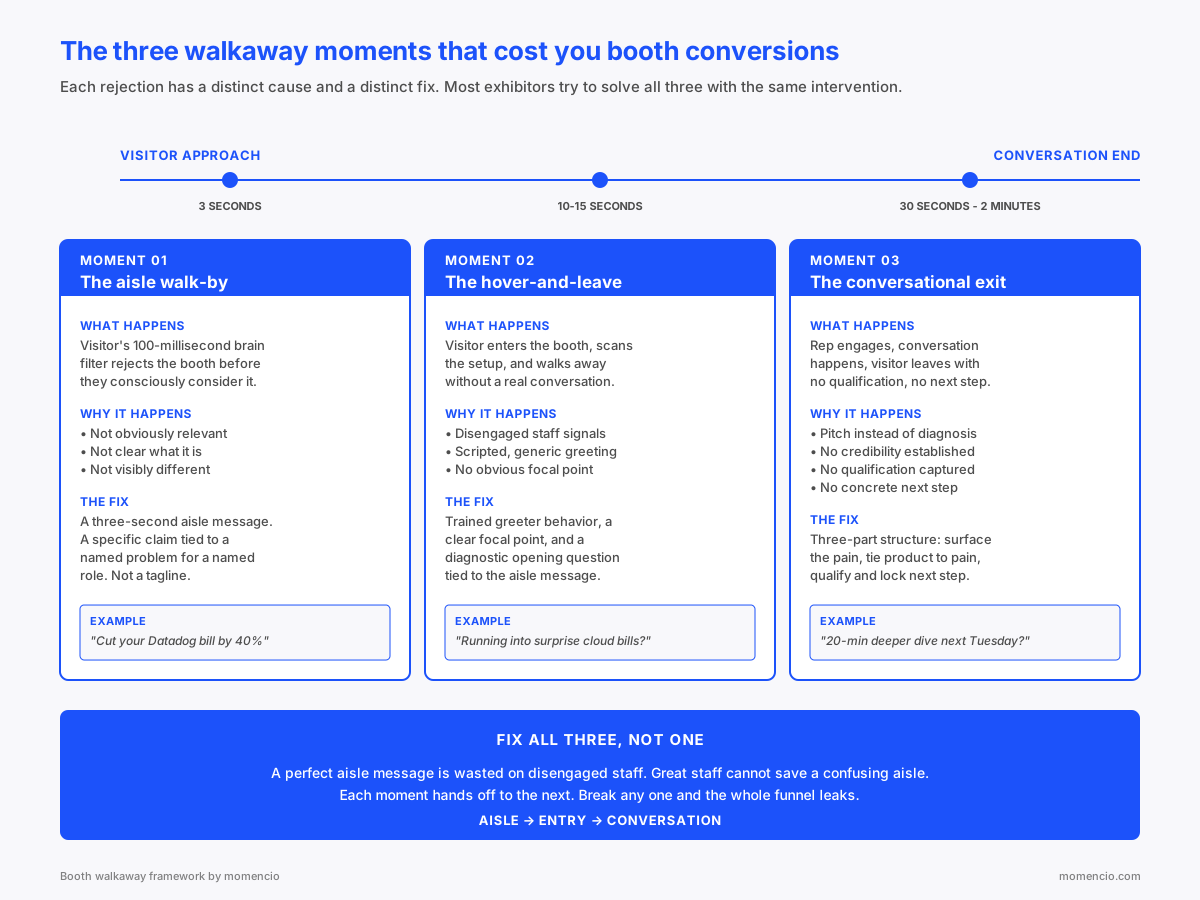
Most exhibitors think of the walkaway as a single event. It is not. There are three distinct walkaway moments, each with its own cause and its own fix.
The aisle walk-by is the rejection that happens before the visitor even slows down. They are moving past your booth and decide, in under three seconds, that stopping is not worth their time. They never engage. You never even know they considered you.
The hover-and-leave is the rejection that happens once the visitor has slowed. They are within your booth’s airspace. They are looking at your signage, your screens, your setup. And within ten to fifteen seconds, they turn and walk away before any rep has spoken to them, or spoken to them in any way that mattered.
The conversational exit is the rejection that happens after a rep has engaged. The conversation started, lasted 30 seconds to two minutes, and ended with the visitor politely disengaging. No qualification, no next step, no meaningful data captured.
Each walkaway has a different root cause. Each has a different fix. Most exhibitors try to solve all three with the same intervention, usually a louder booth or more aggressive greeters. Neither works. The three moments need to be addressed separately.
Walkaway moment #1: the aisle walk-by
The aisle walk-by is a filtering decision the visitor’s brain makes before conscious thought is involved. Landmark research from Princeton psychologists Willis and Todorov established that humans form stable trait judgments from a face in roughly 100 milliseconds, and that these snap judgments hold up remarkably well against longer, more considered evaluations. You can read the Association for Psychological Science summary of the Willis-Todorov study for the underlying research. The same mechanism applies to booths. Within two to three seconds of coming into visual range, attendees have already decided whether to stop.
What are they deciding on? Three things run in sequence. Is the booth relevant to them. Is it clear what it is. Is it worth their limited time right now.
If the booth fails any one of these three filters, the visitor keeps walking. They do not deliberate. They do not reconsider. The filter runs so fast that even the visitor does not notice they have made a decision.
Why most booths fail the relevance filter: The top of the booth is dominated by the company logo, a tagline, and sometimes a product shot. Nothing in that layout tells the visitor whether this company is relevant to their specific job. A VP of operations scanning the aisle has no way to know whether “Modernizing enterprise workflows” is for them or for somebody else. So they default to keep walking.
Why most booths fail the clarity filter: The single biggest mistake exhibitors make is assuming the visitor knows what they do. They do not. At a large industry show, an attendee may walk past 200 booths in a day. Their brain is not decoding every tagline from scratch. It is looking for pattern matches against the jobs and problems they already care about. A clever headline is cognitive friction. A specific headline about a named problem is cognitive speed.
Why most booths fail the worth-it filter: Even if the booth is relevant and clear, the visitor is weighing whether stopping is worth it. If the booth looks like every other vendor booth in the row, the answer is no. Differentiation at the aisle level is not about being loud. It is about being specifically, visibly different in a way the filter can recognize at speed.
The fix: a three-second aisle message
The aisle message is the single piece of text or visual element that a passing attendee will see and understand in under three seconds. Not your logo. Not your tagline. The one specific claim or question that tells them whether this booth is for them.
A useful template: a direct claim or problem statement, in plain language, aimed at a specific role or outcome.
Instead of “The future of enterprise observability”, try “Cut your Datadog bill by 40% without losing alerts”. Instead of “Transforming how teams collaborate”, try “For PMs whose Jira boards have become unusable”. Instead of “AI-powered insights for modern businesses”, try “What your churn data is not telling you”.
The specificity of the message does the filtering work for you. A visitor for whom the message is relevant will stop. A visitor for whom it is not will keep walking, which is the correct outcome. You do not want the non-ICP visitor filling your calendar with unqualified conversations.
This is a booth-design decision, but it is not a cosmetic one. Most booth graphics are designed by people who optimize for brand aesthetic, not for the three-second aisle filter. When the tradeoff is between a beautiful abstract visual and a specific claim, the specific claim wins every time for pipeline outcomes.
Walkaway moment #2: the hover-and-leave
The visitor has slowed. They are within your booth’s footprint. Their eyes are scanning your setup. And then they walk away without a rep ever engaging them, or with a rep engaging them in a way that felt like being greeted by a kiosk.
This walkaway is almost always caused by one of three failures. None of them are about the booth’s visual design. All of them are about the humans in the booth.
The disengaged staff failure: Two reps are talking to each other. One is on a phone. A third is eating. The visitor interprets this, correctly, as a signal that nobody in the booth wants to be interrupted. They keep walking. Even if the booth’s aisle message was perfect, the staff’s body language just told them this is not a place to engage.
The over-eager greeter failure: A rep approaches the visitor within one second of entry with a scripted opener: “Can I tell you about our product?” or “Have you heard of us?” The visitor, who has had this experience fifty times that day, executes a trained defensive response: “Just looking, thanks.” They are gone in ten seconds.
The unclear-where-to-look failure: The booth is busy, the setup is complex, the screens are playing different things, and the visitor cannot tell what they are supposed to do. No obvious focal point, no obvious flow, no obvious next action. They default to walking away because continuing to stand there feels socially awkward.
Each of these failures produces the same visible outcome: a visitor who slowed, considered, and left without a conversation. The underlying cause determines the fix.
The fix: trained greeter behavior, one focal point, and a specific opening question
The first two seconds after a visitor enters your booth are handled by a rep, not by design. Train the greeter to do three things.
First, maintain open, available body language. Standing at the edge of the booth facing outward. No phone. No side conversation with another rep. Making eye contact with visitors as they approach.
Second, deliver a specific opening, not a scripted greeting. Instead of “Hi, can I help you?”, use a direct question tied to the booth’s aisle message. If the aisle message is “Cut your Datadog bill by 40%”, the opener is “Are you running into surprise Datadog bills this quarter?” This does two things: it qualifies the visitor instantly (they either say yes and you have a conversation, or they say no and they leave without the awkwardness), and it signals that you are not going to run through a generic pitch.
Third, point to the focal point. Every booth should have a single focal point: a screen, a demo station, a printed artifact, a calculator, something that the conversation can anchor on. The greeter physically gestures toward it. “Let me show you how this works” is more inviting than “Can I tell you about our product.”
The Exhibit Concepts guideline that booth staff should greet attendees within 5 to 10 seconds of approach is correct, but what matters more is the content of the greeting. A late greeting with a specific opening question converts far better than an immediate greeting with a generic pitch.
Walkaway moment #3: the conversational exit
This is the rejection that costs exhibitors the most and gets diagnosed the least. The rep engaged. The conversation lasted 30 seconds to two minutes. The visitor was polite. And then they said some version of “let me check back later”, scanned their badge, and left. No qualification. No next step. The badge record in the CRM says “met at the show”, and that is it.
This walkaway is not a filtering problem. It is a conversation-design problem. The rep failed to do one or more of four things in the window they had.
They failed to surface a real pain: The rep asked “So what brings you to the show?” or “Have you heard of us?” and got a polite answer. They never reached the visitor’s actual problem. The rest of the conversation was a generic product walk-through that the visitor has heard from three other vendors already that morning.
They failed to earn credibility: The rep launched into features, capabilities, and differentiators without first establishing that they understood the visitor’s world. The visitor, sensing that the rep was pitching without listening, politely disengaged.
They failed to qualify in the conversation: The rep did not capture role, company size, buying stage, or current situation. They just had a pleasant chat. When the visitor walked away, there was no way to route the lead correctly, no way to tier it, and no way to personalize follow-up.
They failed to set a next step: The conversation ended with “great to meet you, stop by again if you have questions.” No meeting booked, no asset shared, no specific reason to reconnect. The visitor walks away and the exhibitor has no hook to follow up on.
The fix: a disciplined three-part conversation structure
The top-performing booth reps follow a structure, even if they do not articulate it. The structure has three parts and takes two to three minutes to execute well.
Part one: surface the pain: Start with a diagnostic question, not a pitch. “How are you currently handling [specific process]?” or “What is the thing about [relevant area] that frustrates you most right now?” The goal is to get the visitor talking about their actual problem within the first 30 seconds. If they are not talking about a problem by the one-minute mark, either they are not an ICP match or the rep is pitching instead of listening.
Part two: tie the product to the pain: Once the pain is surfaced, reference one specific way the product addresses it. Not a feature list. One direct, relevant connection. “What you just described is exactly what we built [feature name] for. Let me show you what that looks like.” This anchors the rest of the conversation in the visitor’s specific situation, not a generic pitch.
Part three: qualify and set the next step: Before the visitor walks away, the rep captures the structured qualification data (fit tier, topic tag, intent level, next action) and confirms a specific next step. “Based on what you described, it sounds like a 20-minute deeper dive next week would be worth it. Can I send you a calendar link right now?” The next step is concrete and immediate, not “let me send you something.”
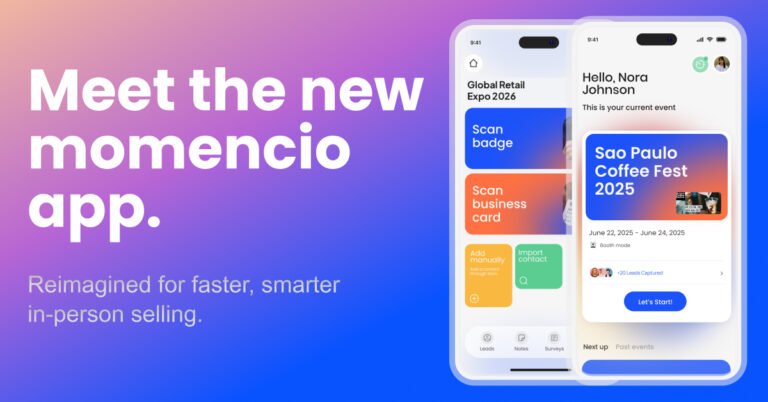
The conversation context from this structure is the single most valuable asset the booth produces. Capturing it in the moment, ideally with a lead capture tool that enforces the structured fields at entry rather than hoping the rep remembers to fill them in later, is the difference between a CRM record that converts and one that sits idle. Platforms like momencio’s universal lead capture system are built around this point: every conversation ends with a structured, qualified record, not a badge scan and a memory.
The compounding effect of fixing all three moments
Most exhibitors try to fix one walkaway moment and expect the other two to resolve. They do not. Each moment has its own root cause, and fixing one does not fix the others.
A perfect aisle message brings more visitors into the booth, but if the staff is disengaged, those visitors still walk away. A well-trained staff with great body language still loses conversations if the aisle message was so vague that only low-fit visitors stopped in the first place. A disciplined conversation structure produces great qualified records, but if the aisle message is confusing and the staff is distracted, very few visitors reach the conversation in the first place.
The exhibitors who compound conversion over time address all three moments as a single system. The aisle message filters for fit. The staff behavior converts interested visitors into conversations. The conversation structure turns conversations into qualified pipeline. Each moment hands off cleanly to the next. A visitor who stops because the aisle message was relevant, engages because the staff greeted them specifically, and leaves with a booked next step represents pipeline that the average exhibitor never produces, regardless of booth size or budget.
For a structural view of how these on-floor decisions fit into the broader exhibitor operating system, our trade show strategy guide covers the surrounding frame. For teams specifically looking at booth design decisions that attract the right visitors rather than just any visitors, our article on booth ideas that attract qualified visitors goes deeper into the design mechanics.
Frequently asked questions
- Why do most booth visitors walk away?
- Three distinct walkaway moments, each with its own cause. The aisle walk-by happens when the booth fails the visitor’s 100-millisecond relevance filter. The hover-and-leave happens when staff behavior or booth layout signals “not open for conversation.” The conversational exit happens when the rep pitches instead of diagnosing, fails to qualify, or fails to set a specific next step.
- What is the single most important thing to fix first?
- The aisle message. If the booth is not signaling relevance to the right visitors in under three seconds, fixing the staff or the conversation structure will not compensate. Start at the top of the funnel.
- How long does an exhibitor have to make a first impression?
- Research by Willis and Todorov established that humans form stable trait judgments from faces in 100 milliseconds. The booth equivalent is two to three seconds, the typical time an attendee’s visual field takes to scan a booth at walking pace. Every booth design decision should be evaluated against what a passing attendee will understand in that window.
- Is it a booth design problem or a staff problem?
- Usually both, and in sequence. Booth design decides who slows down. Staff behavior decides who engages. Conversation structure decides who produces qualified pipeline. Most exhibitors focus entirely on one of these three and wonder why conversion stays flat.
- What should booth staff say as their opening line?
- Not a scripted greeting. A specific question tied to the booth’s aisle message. If the aisle message is about a specific problem, the opener is a diagnostic question about whether the visitor has that problem. This filters fit instantly and signals that the rep is not going to run through a generic pitch.
- How do I know if my conversation structure is working?
- Track the percentage of booth conversations that end with a structured qualification record and a specific next step. If more than 30% of your booth conversations end with “let me send you something” and no concrete follow-up, the conversation structure is the bottleneck, not the booth or the attendee pool.
Turn walk-pasts into qualified pipeline
The walk-away is fixable. The fix is not a bigger booth or a flashier activation. It is disciplined engagement at three specific moments: the aisle filter, the booth entry, and the conversation. momencio gives exhibitors the infrastructure to capture qualified conversations with structure, context, and follow-up built in. See how it works.