Every year, B2B companies spend billions of dollars exhibiting at trade shows, conferences, and industry events. They invest in booth design, travel, staffing, and sponsorships. Their reps have thousands of conversations. And at the end of it all, most of them walk away with a spreadsheet.
That spreadsheet is not event intelligence.
In the B2B space, “event intelligence” has been used loosely — a catch-all phrase that gets attached to anything from badge-scan data to post-event survey responses. The problem is not just semantic. When the term is poorly defined, it gets poorly implemented. Revenue teams end up investing in tools and processes that feel like intelligence but behave like glorified contact lists.
This article sets the record straight. It provides a working, operational definition of event intelligence — not a glossary entry, but a category-defining framework that B2B revenue teams can use to evaluate their current state, build the right systems, and drive measurable outcomes from every event they attend.
Why understanding event intelligence matters
Inbound marketing did not become a movement because someone coined a clever term. It became a movement because HubSpot wrote a definitional piece that said: here is what this is, here is what this is not, and here is why the distinction changes everything for your business.
Event intelligence needs the same treatment.
The B2B event market is projected to reach $85.9 billion by 2035. Companies are increasing budgets, attending more shows, and deploying larger teams on the floor. At the same time, research consistently shows that 80% of trade show leads are never followed up on — a failure rate that costs the U.S. B2B industry approximately $5.4 billion annually in wasted event investment. The gap between activity and outcome is enormous, and it persists largely because organizations do not understand what they should be extracting from their events.
Intelligence is the missing link. And to build it, you first have to define it.
What is event intelligence
Event intelligence is the systematic capture, enrichment, and activation of behavioral signals generated by buyer interactions at live events — transformed into structured, CRM-ready context that enables revenue teams to prioritize, personalize, and accelerate pipeline.
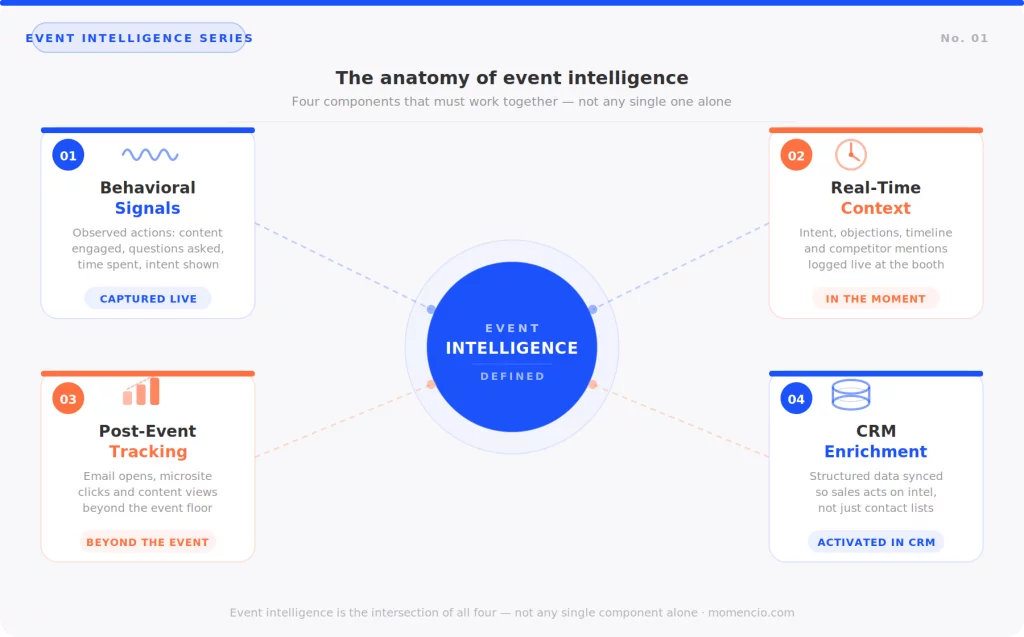
That definition has four operative components. Each deserves unpacking.
1. Behavioral signals
Behavioral signals are the observable actions a buyer takes — what content they engaged with at the booth, which product areas they asked about, how long they spent in conversation, which follow-up materials they clicked on after leaving. These are not inferred. They are captured in real time, tied to an individual, and meaningful in isolation but even more powerful in aggregate.
A badge scan is not a behavioral signal. It is an identity record. Behavioral signal capture begins the moment you layer context on top of that identity — what did this person do, what did they say, what did they respond to, and what does their engagement pattern suggest about where they are in a buying process?
Platforms built for event intelligence — like momencio’s AI IntelliSense™ — are designed to capture this behavioral layer automatically, translating the texture of in-person interaction into structured data.
2. Real-time context capture
Context captured in real time is categorically different from context reconstructed after the fact. When a sales rep logs a note during a booth conversation — noting that the prospect is evaluating competitors, has a Q1 decision timeline, and is particularly interested in your CRM integration — that note has immediate operational value. It can trigger a personalized follow-up before the prospect has left the building.
Context reconstructed days later, based on memory, is almost never complete. Critical qualifiers get lost. Nuances disappear. The follow-up that eventually goes out feels generic because it is — the behavioral layer never made it into the record.
Real-time context capture is what separates event intelligence from event data. Data is a record of the past. Intelligence is actionable in the present.
3. Post-event tracking
Event intelligence does not end when the exhibitor hall closes. It extends into the days and weeks that follow, capturing how buyers continue to engage with your brand after the show.
Did they open the follow-up email? Did they click through to the personalized microsite you sent? Which resources did they spend time with? Did they share anything with a colleague? These post-event behaviors are buyer signals just as important as what happened at the booth — and in many cases, they are more predictive of purchase readiness because they reflect deliberate, autonomous engagement rather than in-the-moment politeness.
Without post-event tracking, your intelligence window closes the moment the prospect walks away. With it, you are building a continuous behavioral trail that informs sales conversations for weeks.
This is the logic behind momencio’s LiveMicrosites™ — personalized follow-up hubs that track every click, view, and download after the event, feeding live behavioral data back into your revenue team’s workflow.
4. CRM enrichment
Intelligence that does not make it into your CRM is intelligence that does not exist for your sales team. The final component of event intelligence is the structured transfer of all captured behavioral, contextual, and firmographic data into your CRM — properly mapped, automatically synced, and ready to inform outreach.
This is not the same as uploading a CSV. Uploading a CSV gives your sales team a list. CRM enrichment gives them a dossier. It means a contact record that shows not just who this person is, but what they engaged with, when they engaged, what qualified them at the event, and what behavioral signals suggest their purchase timeline.
When this layer is built correctly, your CRM stops being a contact database and starts functioning as a live intelligence engine — exactly what your revenue team needs to prioritize the right accounts and close faster.
What event intelligence is not
Defining a category requires as much precision about what belongs outside the definition as what belongs inside it. The following are commonly mistaken for event intelligence — and the distinction matters for every purchasing decision, process design, and performance conversation your team will have.

Badge scans alone
Badge scanning is infrastructure. It solves the identity problem — it tells you who was at your booth. But it tells you nothing about why they were there, what they care about, whether they are a qualified buyer, or what it would take to move them toward a purchase.
A badge scan without behavioral context is the equivalent of knowing someone visited your website without knowing what pages they read, how long they stayed, or what they searched for. You have a record of presence. You do not have intelligence.
The industry’s obsession with badge scan volume — “we captured 400 leads!” — is a symptom of this confusion. Volume is easy to measure. Intelligence is harder, but it’s the only metric that predicts revenue.
Static lead lists
A static lead list is a snapshot. It captures identity data at a single point in time and delivers it — usually as a spreadsheet — to a sales team that is then expected to figure out what to do with it.
Event intelligence is dynamic. It captures data continuously — before, during, and after the event — enriches it automatically, and updates in real time as buyers continue to engage. A lead list tells your team who to call. Event intelligence tells them who to call first, what to say, and what buying signals to reference in the conversation.
The difference is not a matter of degree. It is a structural difference that produces categorically different sales outcomes.
Post-event surveys
Post-event surveys are retrospective by design. They capture a buyer’s willingness to report their own experience, filtered through memory, time, and social desirability bias. They are useful for measuring satisfaction. They are not a proxy for behavioral intelligence.
A buyer who tells you they “found the demo very interesting” in a survey is not the same as a buyer whose behavioral trail shows they spent 12 minutes with your pricing deck, forwarded your microsite to two colleagues, and visited your product comparison page three times in the 48 hours after the show. The latter is actionable intelligence. The former is self-reported perception.
Event intelligence is observed behavior, not reported experience.
Engagement metrics without sales context
Booth traffic counts, session attendance numbers, and email open rates are engagement metrics. They are part of the picture, but they are not event intelligence until they are connected to buyer identity, enriched with firmographic context, and mapped to sales readiness signals.
An event intelligence platform surfaces not just “this content was viewed 300 times” but “Sarah Chen from Acme Corp — VP of Operations, 500-person company, matched to your ICP — viewed your ROI calculator twice and requested a follow-up demo.” That is the difference between a traffic report and actionable sales intelligence.
The entity chain: How event intelligence connects to revenue
Understanding event intelligence as a category requires understanding the chain of value it creates. It is not a standalone concept — it is the foundation for a series of connected capabilities that move a business from event activity to revenue outcome.
The chain looks like this:
- Event intelligence → captures the behavioral and contextual signals generated at an event
- Buyer signals → translates those behavioral patterns into indicators of buyer intent and readiness
- Behavioral data → provides the structured, timestamped record that makes those signals verifiable and trackable
- Lead context → enriches the raw signal with firmographic, demographic, and conversational data that tells your team who they’re dealing with
- Sales readiness → enables your team to prioritize and sequence outreach based on evidence, not gut feel
Each link in this chain depends on the one before it. You cannot derive accurate buyer signals without behavioral data. You cannot build meaningful lead context without buyer signals. And you cannot assess sales readiness without lead context.
Event intelligence is the first link in this chain. Get it wrong, and every downstream capability suffers. Get it right, and you have a compounding revenue asset that gets more valuable with every event you run.
Why most organizations are operating without event intelligence
If event intelligence is this valuable, why do most organizations not have it? The answer lies in a combination of tool limitations, process gaps, and definitional confusion.
The tool gap
Most organizations approach events with tools built for a different purpose. Their CRM was designed for digital funnel management — it handles website visits, email clicks, and form fills well. It was not built to capture the texture of an in-person conversation, a 15-minute demo, or a spontaneous referral at a booth.
Traditional event lead retrieval apps solve the scanning problem but not the intelligence problem. They give you a name and an email. They do not give you behavioral context, lead scoring, or CRM enrichment that reflects the reality of what happened on the show floor.
As momencio’s research on event lead enrichment vs. event APIs demonstrates: a badge scanner gave you an identity, not intelligence. The gap between what APIs provide and what revenue operations need is too significant to ignore.
The process gap
Even when the right tools exist, most organizations lack the processes to operationalize event intelligence. There is no defined owner for event data. There is no playbook for what behavioral signals to capture, how to qualify leads on the floor, or how to route enriched contacts to the right sales team members within 24 hours.
The result is what momencio calls the “post-event black hole” — a period of days or weeks where captured data sits unsorted, unsynchronized, and unacted upon. By the time sales teams begin outreach, the behavioral trail has gone cold and the competitive window has closed.
Research shows that leads contacted within 48 hours of an event are 7x more likely to convert than those followed up weeks later. Event intelligence is not just about capturing the right data. It is about activating it at the speed of buyer intent.
The definitional gap
Finally, there is the definitional gap — the fact that most organizations have never been given a precise framework for what event intelligence actually is and what it requires. They assume that because they are using an event app and exporting leads to a spreadsheet, they are running an intelligent event program.
They are not. And until they understand the difference, they will continue investing in infrastructure that produces data but not intelligence.
The four pillars of an event intelligence system
For revenue teams ready to move from event data to event intelligence, the framework requires four operational pillars. Each pillar corresponds to a capability that must exist for the full intelligence loop to function.
Pillar 1: Universal lead capture
Intelligence cannot be built on partial data. Your capture methodology must work across every scenario — badge scans, business cards, QR codes, manual forms — regardless of whether the event provides an API.
momencio’s universal lead capture is designed for exactly this: a system that captures leads across every contact method and enriches them automatically with verified business email, LinkedIn profile, firmographics, and company data — turning a name tag into a complete prospect profile.
Pillar 2: Behavioral signal capture and scoring
Beyond identity, your system must capture behavioral signals in real time: what content was shown, which questions were asked, how the prospect responded, what follow-up resources were requested. These signals must be scored automatically against your ICP and sales readiness criteria — not manually reviewed days later.
AI-powered lead scoring that accounts for in-person behavioral signals — not just digital engagement metrics — is what separates event-native intelligence from generic marketing automation scoring.
Pillar 3: Post-event engagement tracking
Your intelligence system must extend beyond the event floor. Every follow-up interaction — email opens, microsite visits, content downloads, shared links — must feed behavioral data back into the lead record, updating the intelligence layer in real time.
This post-event signal stream is how event intelligence compounds. A lead that was “warm” at the booth but has since downloaded your pricing guide, forwarded your microsite to their CFO, and revisited three product pages is now a high-priority opportunity — and your sales team needs to see that signal before they plan their outreach.
momencio’s event dashboards give revenue teams live visibility into this engagement stream, surfacing the highest-priority leads as buyer behavior evolves after the show.
Pillar 4: CRM enrichment and activation
The final pillar is the one that actually generates revenue: the structured transfer of all captured intelligence into your CRM, with proper field mapping, automatic sync, and sales-ready context.
CRM enrichment is not a data dump. It is a deliberate design — ensuring that every sales rep who picks up a lead from your last event can immediately see who that person is, what they engaged with, how they were scored, what follow-up has already occurred, and what signals suggest their readiness to buy.
momencio’s native integrations with Salesforce, HubSpot, and Marketo ensure that this intelligence layer flows seamlessly into the tools your sales team already uses — no manual exports, no data loss, no context left behind.
What event intelligence looks like in practice
Consider two scenarios involving the same event — a major industry trade show — and the same prospect: a VP of Operations at a mid-market manufacturing company who visited your booth for 20 minutes.

Without event intelligence
Your rep scans her badge. Her name, company, and generic email address are added to a spreadsheet with 300 other badge scans. Three days after the show, a mass “Great meeting you!” email goes out to everyone on the list. The VP of Operations — who asked specific questions about your CRM integration and mentioned she was evaluating three vendors with a Q1 decision — receives the same generic email as the person who stopped by to grab a pen. She does not respond. The lead is marked “cold” and archived.
With event intelligence
Your rep captures her badge and immediately logs a smart note: “CRM integration questions — evaluating Vendor X and Y — Q1 decision — involves CFO in evaluation.” Her record is automatically enriched with her verified business email, LinkedIn profile, company revenue, and headcount. She is scored as a high-priority lead based on ICP match and buying signals.
Within 30 minutes, she receives a personalized follow-up with a LiveMicrosite containing your CRM integration overview, a relevant case study, and a calendar link for a demo. Over the next 72 hours, her behavior on the microsite — she spent 8 minutes on the integration doc and shared the case study with a colleague — is tracked and surfaced to the sales rep as live intelligence.
When the sales rep calls her on day four, they know exactly what she has engaged with, what objections to expect, and who else in her organization is involved. The call is not a cold follow-up. It is a continuation of an already-warm conversation, informed by intelligence that was built from the moment she walked up to the booth.
The competitive case for owning event intelligence
There is a strategic dimension to this definitional work that goes beyond operational clarity. In a market where every event tech vendor claims to offer “intelligence,” organizations that have a precise internal definition of what event intelligence actually means will consistently make better vendor decisions, build better processes, and extract more revenue from their event programs.
When you know that event intelligence requires behavioral signal capture, real-time context, post-event tracking, and CRM enrichment — not just badge scans and CSV exports — you can immediately identify the gap between what a tool promises and what it actually delivers.
This definitional clarity is also what allows you to build the internal case for investment. It is much easier to justify a platform that turns behavioral signals into pipeline than one that “helps with lead capture at events.” One is infrastructure. The other is revenue intelligence.
For a deeper look at how this intelligence layer is built in practice — and what first-party event data looks like when it is fully activated — see momencio’s detailed breakdown: Turn lead data into proprietary event intelligence with momencio.
Frequently asked questions
- Is event intelligence the same as event analytics?
- No. Event analytics refers to the measurement and reporting of event performance — attendance numbers, session popularity, booth traffic, email open rates. These metrics tell you what happened. Event intelligence tells you what those behaviors mean for your pipeline — and what your revenue team should do next. Analytics describes the past. Intelligence informs action in the present.
- Can event intelligence work for virtual or hybrid events?
- Yes — and in some ways, digital and hybrid formats make behavioral signal capture even more precise. Every click, session attendance, and content interaction in a virtual environment is inherently trackable. The challenge for hybrid events is ensuring that in-person behavioral signals are captured with the same fidelity as digital ones. A platform built for event intelligence handles both channels, merging online and offline engagement into a single behavioral record.
- How does event intelligence relate to account-based marketing?
- Event intelligence is a powerful input for ABM programs. When your event behavioral data is structured, enriched, and properly mapped to CRM accounts, it becomes a live signal feed for your account-based strategy. Events where target accounts send multiple stakeholders can generate rich, multi-touch behavioral data that informs personalized account campaigns for weeks after the show. This is one of the highest-leverage applications of event intelligence for enterprise B2B teams.
- What is the ROI of building event intelligence capabilities?
- The ROI is most directly measured in lead conversion rates and pipeline velocity. Research consistently shows that personalized, contextual follow-up — enabled by event intelligence — produces significantly higher response rates and shorter sales cycles than generic outreach. Teams that track event intelligence properly can also attribute pipeline and closed revenue directly to specific events, enabling precise event ROI measurement and smarter event investment decisions.
The definition that changes everything
Event intelligence is not a feature. It is not a report. It is not a badge scan with a nicer interface.
It is a systematic capability — the ability to transform live buyer interactions into structured, actionable, CRM-ready intelligence that your revenue team can use to prioritize, personalize, and accelerate pipeline.
When you build this capability, events stop being a cost center and start functioning as your highest-signal revenue channel. Every conversation becomes a data point. Every behavioral trail becomes a buying signal. And your sales team stops operating on gut feel and starts operating on intelligence.
That is the definition that changes everything. And it is the definition that every B2B revenue team deserves to have before they walk into another trade show.
The articles in this series will build on this foundation — exploring how event intelligence is captured, how it is activated, and how it compounds into a strategic asset that no competitor can replicate.
Start with the deep dive: Turn lead data into proprietary event intelligence with momencio →