Most trade show leads arrive in the CRM as a name and a company. This guide shows where the damage happens, what it costs, and how a Field Revenue Intelligence approach gives your CRM the whole story, not a fragment of it.
A trade show is one of the few places where a buyer walks up to you, tells you what they need, and hands over their details. Then, a week later, that conversation lands in your CRM as a row in a spreadsheet: a name, a company, an email that may or may not be right, and nothing about what was actually said.
That gap between what happened at the booth and what reaches the CRM is where most of the value of an event is lost. It is not a sales problem or a marketing problem. It is a data problem, and it starts the moment the badge is scanned.
Bad trade show data is the symptom. The underlying problem is that in-person buyer interactions, at events and everywhere else in the field, never become usable revenue context. This article covers where the data goes wrong, what the research says it costs, and how a Field Revenue Intelligence approach turns each interaction into event intelligence your CRM can act on: who wants what, how badly, and what to do next.
Where trade show data goes wrong
Bad trade show data is rarely one big mistake. It is a series of small losses at four points between the booth and the pipeline.

1. At the booth: the scan captures a person, not a conversation
A badge scanner records whatever the event organiser stored on the badge. Often that is a name, a company and an email. Sometimes it is a badge ID and nothing else. What it never records is the part that matters: what the visitor asked about, what problem they described, and how soon they want to fix it. That lives in the memory of whichever staff member had the conversation, and it fades by the end of the day. Context captured in real time is a different thing from context reconstructed later.
2. After the show: the export arrives late and incomplete
Many exhibitors still wait for the organiser to send a lead file after the event. That file arrives days later, often with missing job titles, mistyped emails, duplicate entries and no notes. By the time someone opens it, the visitor has been back at their desk for a week and has stopped thinking about your booth.
3. In the CRM: records are loaded by hand and treated the same
When the file is loaded, every lead looks identical. A buyer who asked for pricing sits next to a student who wanted a free pen. Sales reps cannot tell them apart, so they either follow up with a generic email to everyone or cherry-pick the few names they remember. Both approaches waste most of the list. This is the gap between event data and event intelligence in its most visible form.
4. Months later: the list quietly goes stale
Even records that were correct on show day do not stay correct. People change jobs, titles and email addresses. Commonly cited estimates put business contact decay at roughly 2 to 3% a month, which means a fifth to a third of a list is wrong within a year if nothing refreshes it.
What bad data actually costs
It is tempting to treat messy lead data as an admin annoyance. The research says it is a revenue problem.
- Poor data quality costs the average organisation about $12.9 million a year, by Gartner’s estimate.
- Most companies lose between 15% and 25% of revenue to bad data, according to research published in MIT Sloan Management Review.
- In a Harvard Business Review study where managers checked 100 recently created records in their own company, only 3% of the data sets met a basic quality standard, and 47% of newly created records contained at least one critical error.
That last finding matters most for events, because trade show leads are, by definition, newly created records. Nearly half of them arrive with something wrong.
The cost of that error is not fixed. It grows the longer the record sits uncorrected. The well-known 1-10-100 rule of data quality puts it simply: it costs about $1 to verify a record when it is created, $10 to clean it up later, and $100 to live with the consequences of never fixing it.

For an event lead, the $100 stage looks like a rep calling a number that no longer works, a marketing email bouncing off a mistyped address, or a hot buyer being nurtured as a cold contact because nobody recorded that they were ready to buy.
Why speed and context decide whether a lead converts
Two things separate a trade show lead that turns into a deal from one that does not: how quickly someone follows up, and whether the follow-up reflects the conversation that happened.
The best-known research on follow-up speed comes from a Harvard Business Review audit of 2,241 US companies. Researchers submitted a web enquiry to each one and timed the response. The average first response took 42 hours. Nearly a quarter never replied at all. Companies that responded within an hour were about seven times more likely to qualify the lead than those that waited even one more hour, and about 60 times more likely than those that waited a day or longer.

That study looked at online enquiries, but the pattern holds on the show floor. A person who spent ten minutes at your booth is at peak interest while they are standing there. Every hour that passes without a relevant follow-up, that interest cools. A generic email a week later does not restart it. We covered the cold truth about hot leads in more detail earlier in this series.
Speed only helps, though, if the follow-up is right. A fast message that ignores what the visitor asked about is just a fast way to get ignored. That is why context has to be captured at the same time as the contact details, not reconstructed afterwards.
The problem of decay
There is one more reason to fix data at the point of capture: it does not stay fixed on its own.

At 2.1% a month, roughly 22% of a list is wrong after a year. At 3% a month, it is closer to 30%. Either way, a list captured in September and left alone is a quarter wrong by the following summer.
The practical answer is not an annual clean-up. It is to verify each record at capture, and then keep it current by watching what the contact does afterwards. A contact who opened your follow-up last month is almost certainly still at the same company. A contact who has not engaged in six months needs checking before a rep spends time on them. This is what makes first-party event intelligence an asset that compounds instead of a list that rots.
What enriched intent means in plain terms
It helps to separate three things that are usually lumped together: data, enrichment and intelligence.
- Data is what the scanner gives you. A name, a company, an email. Accurate, maybe, but not actionable.
- Enrichment adds labels to that record: correct title, company size, industry, location, a verified email. Useful, and necessary. But a better-labelled record is still just a record. A rep reading it cannot tell whether this person is a serious buyer or someone who wanted a free pen.
- Intelligence is what you get when the record also carries what the buyer said, what they did afterwards, a score built from both, and a next step. It answers the only question sales cares about: what should I do with this person, and why?
Enriched intent is the third thing. It is not a score bought from a third-party data provider and it is not a guess. It is evidence: what the person told you at the booth, and what they clicked, opened and watched after you spoke, attached to one CRM record.

The right-hand record in Figure 5 answers four questions with evidence rather than memory:
- Who they are. Correct name, title, company, size, industry and location, with errors fixed and gaps filled.
- What they said. The problem they described, the product they asked about, the timeline, any objection, captured while the buyer was still in front of you.
- What they did next. Which follow-up content they opened, how long they spent, whether they came back. Behaviour, not opinion, and it keeps updating the record after the show.
- What happens now. A score, an owner and a booked next step. The record tells the rep what to do, not just who to call.
Most event tools stop at the second stage and call it done. That is why so many CRMs are full of data and empty of intelligence.
How momencio turns an in-person interaction into revenue context
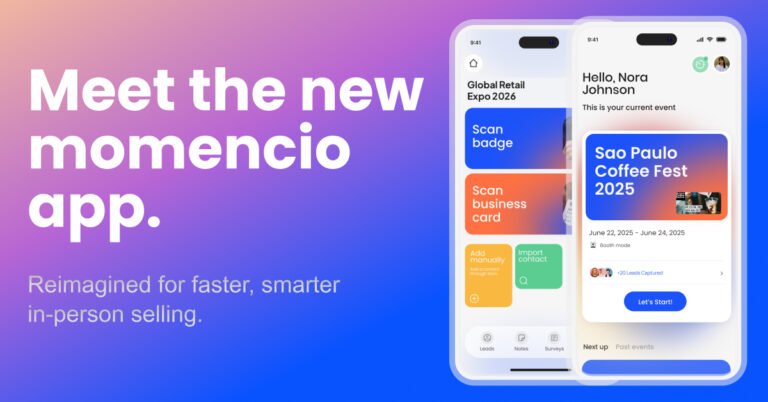
momencio is a Field Revenue Intelligence platform. The trade show is the entry point, not the category. The same process applies to a booth conversation, a customer visit, a roadshow or a hallway meeting: the in-person interaction is captured, qualified and tracked so that what reaches the CRM is revenue context, not a name.
Here is how it replaces the four broken steps from Figure 1 with six connected ones.
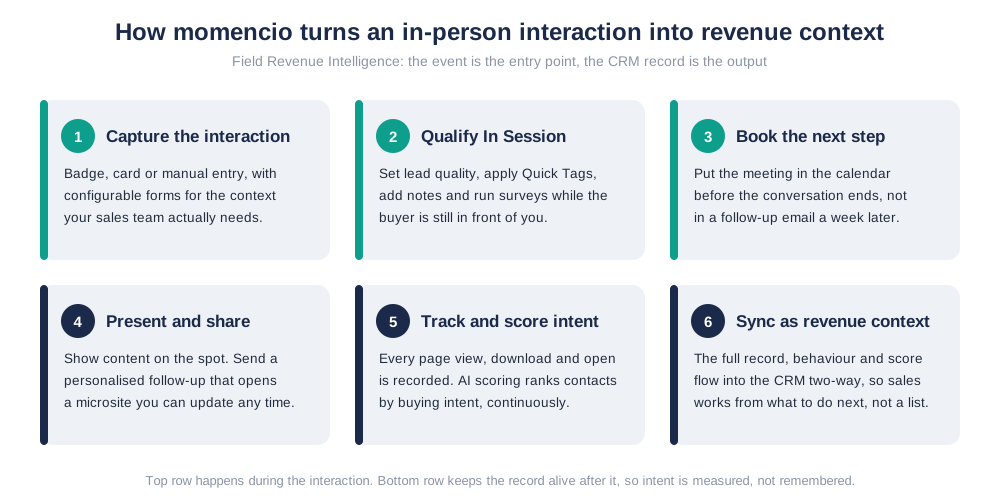
Step 1. Capture the interaction, not just the contact
Staff scan a badge or business card, upload a photo to assign later, or add a contact by hand. Configurable forms collect the details and the qualification context your sales team actually needs, rather than whatever the organiser put on the badge. Every capture method works offline and syncs when the connection returns, so a busy hall with no signal does not mean a stack of cards to type up later.
Step 2. Qualify In Session, while the buyer is still there
In Session brings qualification into the conversation. The rep sets lead quality, applies Quick Tags for the products or problems discussed, adds notes and runs a short survey, all while the interaction is happening. Hot and cold leads are separated at the source, by the person who spoke to them, not a week later by someone reading a spreadsheet.
Step 3. Book the next step before the conversation ends
A meeting can be booked directly from the app while the buyer is standing there. This removes the most common point of failure in event follow-up: the promise to be in touch that never turns into a calendar entry.
Step 4. Present and share, with a follow-up that keeps working
Reps present PDFs, videos and interactive content on the spot, then send personalised follow-up materials by email. The email leads to a LiveMicrosite that you can update at any time, so the follow-up stays current even after the show is over. AI Lead Enrichment fills in title, company details and a verified email in the background, so the record is corrected before the first message goes out.
Step 5. Track engagement and score intent continuously
Every page view, content download and email open on the microsite is recorded against the contact. AI-powered lead scoring uses that behavior, together with what was captured In Session, to rank contacts by buying intent. The score keeps moving after the event: a contact who watches the full demo the next morning moves up; one who never opens anything moves down. Live dashboards show leads captured, sessions, surveys, meetings booked and progress against target in real time.
Step 6. Sync to the CRM as revenue context
The full record, with notes, tags, survey answers, engagement history and score, flows into the CRM through native two-way integrations, including Salesforce and HubSpot, with no manual uploads. Sales does not receive a list to sort through. It receives a ranked set of people, each with the reason for the ranking and a next step already attached. For teams running account-based programmes, the same record updates the account score before the day ends.
The difference from a conventional lead capture tool is not any single step. It is that the interaction, the behaviour and the score live on one record that keeps updating. Data collection is reactive; it waits for someone to do something with it. This is intelligence activation: the record itself tells sales where the intent is.
An action plan for your next show
Use this before, during and after the event.
| When | What to do | Why it matters |
| Before the show | Agree the three to five qualifying questions every lead will be asked. Decide the lead scoring rules. Set up the CRM fields and the follow-up content for each product or use case. | Qualification only works if every staff member asks the same questions in the same way. |
| Before the show | Test the capture app, the CRM connection and the follow-up sequence with a dummy lead. | Finding a broken sync on day one of the show is too late. |
| During the show | Scan every visitor. Qualify In Session: set lead quality, add a note and a tag, and run the survey before they leave the booth. Book the meeting on the spot where there is one to book. | A scan with no note is a record with no intent. |
| During the show | Review the day’s leads each evening. Send same-day follow-ups to anyone scored hot. | Interest is highest within hours of the conversation, not days. |
| After the show | Confirm every interaction has synced to the CRM with its notes, tags, survey answers and score. Check for duplicates and bounced emails within 48 hours. | This is the $1 stage of the 1-10-100 rule. Fix it now. |
| After the show | Work leads in score order, not alphabetical order. Watch microsite engagement and let the score re-rank the list as buyers open, read and return. | Reps should get a ranked list with reasons, not a spreadsheet. |
| 30 days later | Report on leads captured, leads qualified, follow-ups sent within 24 hours, meetings booked and pipeline created. | These are the numbers that justify the next show budget. |
What to measure
Bad data hides in averages. These five numbers show whether the process is working, event by event. Field marketers can pull all of them from live dashboards rather than waiting for a spreadsheet.
- Complete-record rate: Share of leads with a name, verified email, title, at least one note and a qualification score. Target: above 90%.
- Time to CRM: Hours between the booth conversation and the record appearing in the CRM. Target: same day.
- Time to first follow-up: Hours between capture and the first personalized message. Target: under 24 hours for hot leads.
- Engagement rate: Share of leads who open or view follow-up content. This is your live measure of whether the data was right and the follow-up was relevant.
- Qualified-to-meeting rate: Share of hot leads that turn into a booked meeting within 30 days. This is the number leadership cares about.
The short version
Trade show leads go bad because the conversation is separated from the contact details at the moment of capture, and nobody puts them back together. The research shows that this costs real money, that speed of follow-up decides whether a lead qualifies, and that records decay by a quarter or more within a year if left alone.
The fix is not a better scanner or an annual clean-up. It is treating every in-person interaction as a source of revenue context: capture it with the conversation attached, qualify it In Session, book the next step on the spot, follow up with content that reports back, score intent from behavior, and sync all of it to the CRM as one living record. That is what Field Revenue Intelligence means in practice, and it is why the CRM stops being a list of names and becomes a record of who wants what, and how soon.
Want to see what your next show’s leads would look like as enriched intent instead of a spreadsheet? Book a demo and we will walk you through it with your own event.