
A small business does not need to wait for a large exhibition, conference, or trade show to start using events as a serious growth channel. Those larger events still matter because they create reach, visibility, partnerships, and high-volume market access. Micro events add a different kind of value: they give a small business more control over the room, the guest list, the conversation, and the follow-up.
That matters because budgets are being watched closely. Gartner reported that 2025 marketing budgets remained flat at 7.7% of company revenue, while teams still had to do more with the money they already had. For a small business, that makes every event decision more important. The question is no longer only where to show up. The better question is how to create the right conversations and make sure none of them disappear after the event ends.
A micro event helps with that. It can be a breakfast roundtable, a private product demo, a local customer meetup, a founder-led workshop, a partner session, or a small educational event built around one clear problem. The format is smaller, but the business intent can be serious when the planning, capture, and follow-up are handled properly.
What is a micro event
A micro event is a small-scale gathering designed to offer a more intimate and focused experience than a traditional large event. That definition is useful because it keeps the focus on the reason micro events work: they are built around a specific audience, a specific problem, and a specific reason to attend.
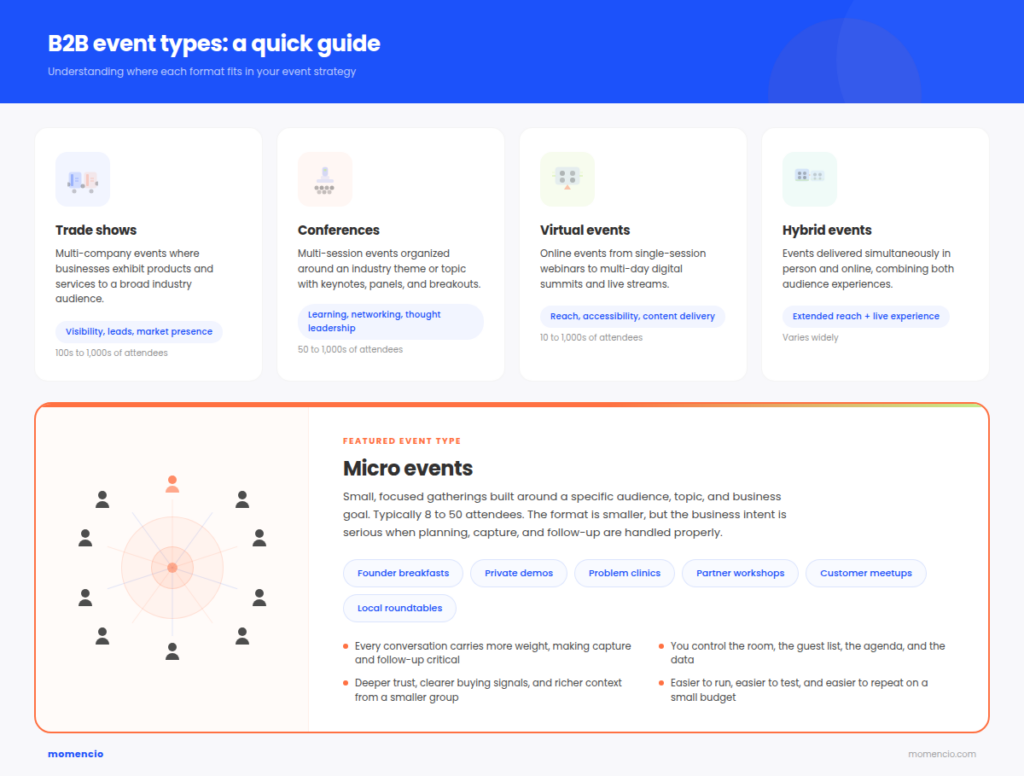
In simple terms, a micro event is a small business event where quality matters more than size. It may have 8 people, 25 people, or 50 people. The exact number matters less than the shared reason everyone is in the room. A strong micro event makes it easy for people to speak, ask questions, meet the host, understand the offer, and leave with a clear next step.
Micro events can happen in person, online, or as a hybrid format. For small business owners, the in-person version is often the strongest starting point because it creates trust faster. When a prospect sits across the table, handles the product, hears other customers speak, or asks a direct question, the conversation becomes much richer than a cold email or a paid ad click.
Why micro events are becoming more useful
Micro events are growing because people want more relevant rooms and more useful conversations. 63% of organizers expected increased demand for micro events and intimate gatherings in 2025. The same trend makes sense for small businesses because smaller rooms are easier to shape around a clear topic and a clear audience.
The value is practical. A large event can help a brand reach more people in less time, especially when the brand needs market exposure. A micro event helps when the business wants deeper discussion, better learning, stronger trust, and clearer buying signals from a smaller group. The two formats can sit beside each other in the same event plan.
Cost is also part of the decision. GES notes that average exhibit hall booth space can range from $100 to $150 per square foot, which means a 10 by 10 booth can cost $10,000 to $15,000 before other expenses. That does not make trade shows less valuable. It simply explains why many small businesses need an additional event format they can run more often, test faster, and manage with a smaller team.
What small businesses can use micro events for
A micro event works best when it has one job. When the goal is too broad, the invite becomes weak, the agenda becomes crowded, and the follow-up becomes vague. Small businesses get better results when the event is designed around one useful business outcome.
| Business goal | Micro event idea | What it can create |
| Build trust with prospects | A 12-person breakfast roundtable around one industry problem | Direct conversations with people who already care about the topic |
| Show a product or service | A private demo evening for invited buyers | Questions, objections, and buying signals from people in the room |
| Educate a local market | A short workshop hosted with a partner | Authority, referrals, and new relationships in a specific area |
| Deepen customer relationships | A customer-only meetup or feedback session | Retention signals, product feedback, and expansion conversations |
| Test a new offer | A small invite-only clinic around one painful problem | Fast feedback before spending more on ads or larger campaigns |
The common thread is focus. A micro event should not try to entertain everyone, educate everyone, and sell to everyone at once. The best version gives a specific group a useful reason to attend, then makes the next step easy after the event.
The real value is the context you capture
A small room gives you something many larger channels struggle to give you: context. You can hear how people describe their problem. You can see which part of your product makes them lean in. You can notice who asks pricing questions, who brings up timing, and who is only there to learn. Those details are easy to lose when the follow-up depends on memory, scattered notes, or a stack of cards.
This is where micro events become more than a pleasant networking exercise. Each conversation can tell you what the attendee cares about, what stage they are in, what content they need next, and how soon they may be ready for a deeper sales conversation. The event itself creates the moment. The follow-up system decides whether that moment turns into revenue.
For small business owners, this is important because every attendee carries more weight. If only 20 people attend, losing context from 5 of them is a serious loss. A micro event needs a simple way to capture attendee details, notes, interests, and next steps before the room clears.
Micro event formats that are easy to run
You do not need to start with an elaborate production. The right format depends on your audience, your offer, and the kind of conversation you want to create. These formats are simple enough for a small team to manage and useful enough to create real business value.
| Format | Best for | Ideal size | Follow-up focus |
| Founder breakfast | Relationship building with high-fit prospects | 8 to 15 people | Personal notes and meeting requests |
| Problem clinic | Helping prospects solve one common pain point | 10 to 25 people | Useful resources based on each question asked |
| Private product demo | Showing a product to serious buyers | 5 to 20 people | Feature interests, objections, and pricing questions |
| Partner workshop | Reaching a trusted partner audience | 15 to 40 people | Shared lead context and next-step content |
| Customer meetup | Retention, referrals, and feedback | 10 to 30 people | Expansion interest and product feedback |
| Local industry roundtable | Authority building in a defined market | 10 to 20 people | Discussion themes and future invite list |
How to plan a micro event without making it complicated
Start with one audience. A small business owner may be tempted to invite every possible buyer, customer, partner, and friend of the business. That makes the event harder to position. A better starting point is one group with one shared problem. For example, local clinic owners who want better patient follow-up, early-stage founders who need their first sales process, or retail brands that want more repeat customers.
Next, define the promise of the event. The promise should be clear enough that someone can understand it in one sentence. A weak promise sounds like a general networking evening. A strong promise tells the attendee what problem they will understand better or what decision they will be able to make after attending.
Then choose the simplest format that can deliver that promise. A breakfast roundtable may work better than a panel. A live demo may work better than a long presentation. A workshop may work better than a social mixer. The format should help people participate, not sit silently through content that could have been emailed.
Keep the agenda short. Most micro events do not need more than 60 to 90 minutes. Give people a welcome, a clear topic, a short teaching or demo section, guided discussion, and a next step. The smaller the room, the more every minute should earn its place.
Finally, plan the capture and follow-up before the event starts. Decide what information you need from each attendee, what questions you want answered, what notes must be recorded, and what content you may send afterward. If follow-up is treated as an afterthought, the event becomes harder to measure.
Where momencio fits into a micro event
A micro event may be small, but the follow-up still needs to be organized. An event lead capture app helps small teams record who attended, what they cared about, and what should happen next. This matters because a warm in-person conversation can go cold quickly when the follow-up is delayed or too generic.
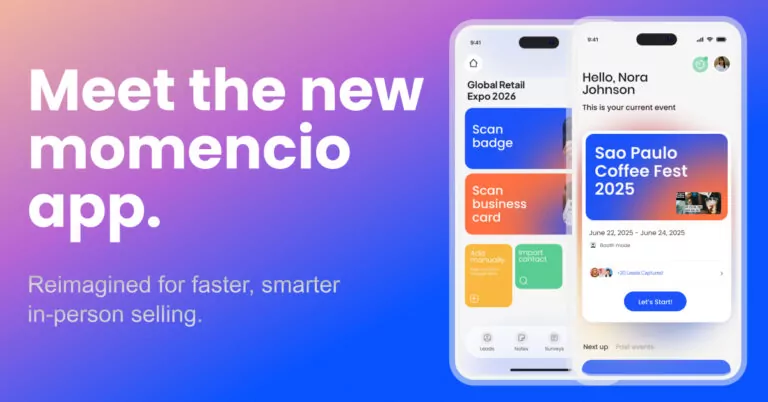
momencio is an event lead capture app with built-in event intelligence. In plain terms, it helps you capture people through badge scans, QR codes, manual entry, and business card scanning, then keep the details connected to notes, interests, and follow-up actions. For a micro event, that means the host does not have to rely on memory or scattered spreadsheets after the room empties.
For small events where attendees may share business cards or wear simple name tags, AI EdgeCapture™ can capture and enrich lead data from badges, business cards, and name tags. The official product details note that enrichment depends on image quality and publicly available data, so it should be treated as a useful aid rather than a guarantee of perfect information. That is the right expectation for small businesses: use the tool to reduce manual work, then verify important details before making major decisions.
The strongest fit for micro events is personalized follow-up. With LiveMicrosites™, each attendee can receive a trackable page with content tied to the conversation, such as a deck, product page, case study, offer, or next step. The page can be updated after it is sent, so the business does not need to resend a new link every time the follow-up content changes.
After the event, IntelliStream™ helps show who viewed, clicked, downloaded, revisited, or kept engaging with the content. That gives a small business a simple way to see which conversations still have energy after the event. It also makes event ROI easier to understand because the business can connect attendance, content engagement, and next steps in one view.
The point is not to make a small event feel like a large production. The point is to make sure every meaningful interaction is captured, followed up, and measured with care. That is where the backing of an event app can help a small business look more organized without adding a heavy process.
How to measure whether a micro event worked
Attendance is only the starting point. A micro event with 18 right-fit attendees can be more useful than a room of 100 people who have no clear need, no buying role, and no reason to stay connected. The useful question is what changed because the event happened.
Start by looking at the fit of the people in the room. Did the right customers, prospects, partners, or local decision-makers attend? Then look at participation. Did people ask questions, share their own challenges, request more information, scan a QR code, book time, or engage with the follow-up content afterward? Those are stronger signs than headcount alone.
You should also measure speed. How quickly did each attendee receive the right follow-up? How many people opened, clicked, or revisited the content? How many asked for a quote, trial, meeting, referral, or next conversation? A micro event works when it creates movement, not just attendance.
Common mistakes to avoid
The first mistake is inviting too broadly. A micro event loses its strength when the guest list becomes a mix of unrelated people with unrelated needs. A focused room creates better discussion and makes the follow-up easier to personalize.
The second mistake is making the event too sales-heavy. People will attend a small event when they believe they will learn something useful, meet relevant people, or solve a real problem. A short product moment can work well, but the event should still feel valuable even before someone is ready to buy.
The third mistake is collecting contact details without context. A name and email are not enough. You need to know why the person came, what question they asked, what topic mattered to them, and what they should receive next. This is especially important for small businesses because every lead has a higher cost of attention.
The fourth mistake is waiting too long to follow up. People may like your event and still forget the details after a few days. The first follow-up should feel timely, personal, and useful. It should remind them of the conversation and give them a clear reason to continue.
A simple 30-day plan for your first micro event
A small business can plan a useful micro event in 30 days if the scope stays tight. The aim is to create one focused gathering, learn from it, and build a repeatable event motion from there.
| Week | What to do | Output |
| Week 1 | Choose one audience, one topic, one goal, and one simple event format. | A clear event concept and invite promise |
| Week 2 | Build a focused invite list and send personal invitations. | A targeted guest list with confirmed interest |
| Week 3 | Prepare the agenda, discussion questions, content, capture flow, and follow-up assets. | An event-ready plan that does not depend on memory |
| Week 4 | Host the event, capture attendee context, send personalized follow-up, and review engagement. | Qualified conversations and a clear next-step list |
After the first event, review what worked before planning the next one. Which invite message got replies? Which questions opened up the room? Which content did attendees engage with afterward? Which type of attendee showed the strongest intent? Those answers can shape your next micro event and help you build a repeatable system instead of a one-off activity.
Micro events give small businesses a practical way to start
A micro event is not a shortcut. It still needs a clear audience, a useful promise, thoughtful hosting, and strong follow-up. The advantage is that it gives small businesses a realistic way to build trust through live interaction without waiting for a large event budget or a larger team.
Used well, micro events can help you test your message, deepen customer relationships, create referrals, educate prospects, and find serious buyers in a smaller room. The businesses that benefit most will be the ones that treat the event as the start of the relationship, then follow up with the same care that went into the gathering itself.
FAQs
What is a micro event?
A micro event is a small, focused gathering built around a specific audience, topic, or business goal. It can be a roundtable, workshop, private demo, customer meetup, partner session, or local networking event.
How many people should attend a micro event?
There is no fixed number. Many micro events work well with 8 to 50 people. The right size depends on the goal, the room, the format, and how much direct interaction you want.
Are micro events replacing trade shows?
Micro events work best as a companion to trade shows, conferences, and larger event programs. Large events help with reach and visibility. Micro events help with focused conversations, relationship building, and targeted follow-up.
Are micro events useful for small businesses?
Yes. They are useful because small businesses can host them with a focused budget, invite a specific audience, and create direct conversations that are easier to follow up on.
What are good micro event ideas for small businesses?
Good ideas include founder breakfasts, customer meetups, expert clinics, private product demos, partner workshops, local roundtables, and problem-solving sessions for a specific type of customer.
How do you measure micro event ROI?
Measure the quality of attendees, the number of useful conversations, meetings booked, follow-up engagement, content views, repeat visits, referrals, and sales opportunities created after the event.
Do you need an event app for a micro event?
You can run a micro event without an app, but an event app helps when you want to capture attendee details, record notes, send personalized follow-up, and see which attendees keep engaging after the event.
Can momencio support both micro events and larger event programs?
Yes. momencio can support smaller gatherings as well as larger event programs by helping teams capture leads, enrich contact data, send personalized follow-up, track engagement, and measure event performance.
Ready to turn every event conversation into a clear next step? Book a demo with momencio.