When a trade show misses its number, the conversation that follows almost always moves toward budget. Whether to reallocate, reduce, or cut entirely. That instinct is understandable, and it is also where the diagnosis tends to stop before it has actually started.
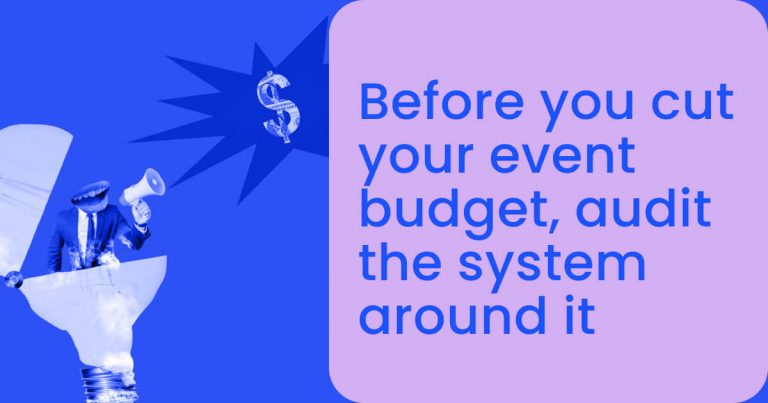
The spend is rarely where the breakdown lives. What drives disappointing event returns is almost never the cost of the booth or the size of the floor space. It tends to live in the structure surrounding the event — how the target accounts were identified before the doors opened, how conversations were qualified during the two days on the floor, and how whatever signal was captured got converted into something with commercial momentum in the weeks that followed. Those three layers are where the actual performance gap sits, and none of them show up in a line-item review.
The reason this matters is that cutting the budget on a structurally broken program does not fix the program. It just reduces the exposure to a process that was already failing quietly. And reallocating to another channel before understanding what actually broke tends to reproduce the same pattern somewhere new, because the underlying logic of how the function approaches pipeline generation has not changed.
| Audit area | What to check | Why it matters |
| Pre-event targeting | ICP match, priority accounts, booked meetings | Determines whether the right people were in motion before the event |
| Booth qualification | Notes, buying intent, next step | Separates real pipeline from badge scans |
| Follow-up speed | 24–48 hour response, personalization | Prevents high-intent leads from going cold |
| CRM attribution | Source tagging, opportunity influence, campaign structure | Makes event impact visible |
The real variable is what happens around the booth
The companies that consistently get better returns from trade shows tend to share a set of disciplines that have very little to do with booth size or floor position. They know exactly who they want to meet before the show opens. They book meetings in advance rather than depending entirely on walk-up traffic. Their booth staff are trained to qualify conversations, not simply scan badges. Context and notes get captured alongside contact information. Follow-up happens within 24 to 48 hours, and it is specific rather than generic. And every interaction gets recorded in the CRM in a way that makes attribution possible later.
That last element is worth pausing on. If the event source data in the CRM is incomplete or inconsistently tagged, deals that were genuinely influenced by the event become invisible in the reporting. The event looks like it underperformed. In some cases, it performed fine — the tracking just could not see it.
Badge scans compound this further. Returning from a show with 300 scans can feel like momentum. In practice, 300 scans with no qualifying notes, no stated next step, and no follow-up process attached to them will produce close to zero pipeline. The scan captures presence. It captures nothing about intent, fit, or where the conversation actually went.
Small booths can work fine. The booth is rarely the whole problem.
What an honest audit actually looks like
Before making any decision about whether to continue, change, or exit a particular event, it is worth running a structured retrospective across the last two shows attended. Not a post-event survey. A diagnostic review of the actual data.
The questions worth asking are fairly specific:
- Who did we actually meet?
Of everyone scanned or spoken to, how many matched the ideal customer profile? How many showed genuine buying intent at the time of the conversation? - What happened after?
How many of those contacts received follow-up within 24 to 48 hours? How many had qualifying notes recorded in the CRM? How many converted to a booked meeting? - What does attribution look like?
Are there open opportunities or closed deals from the past six to twelve months where the event played a role, even if it was not the primary source? Are any of those being missed because the CRM data does not connect them?
Working through those questions across two shows tends to produce one of three conclusions. Either the events themselves are genuinely the wrong fit — wrong audience, wrong timing, wrong context for the buying cycle — and a channel decision makes sense. Or the events have potential but something in the execution is consistently failing, whether in preparation, qualification, follow-up, or tracking. Or some combination of both, where certain shows are worth preserving with a different operational approach and others are worth exiting.
All three of those conclusions are defensible. What is harder to defend is making a budget decision before knowing which one applies.
Read the 6 questions if you are deciding whether to cut trade show budgets
The structural question underneath the channel decision
There is a broader pattern worth naming here. Event ROI conversations tend to get framed as channel efficiency questions — is this the right place to spend? — when they are often execution design questions in disguise. The channel may be entirely appropriate. What surrounds it may be underdeveloped.
Spending less will not help much if the process is broken. And the process is rarely evaluated with the same rigor as the spend.
A useful reframe for any marketing leader sitting with disappointing event numbers: before asking whether to cut, ask whether the program was ever set up to succeed on the operational level. Pre-event account targeting. Meeting scheduling before arrival. Staff qualification training. Note capture protocols. Follow-up timing and relevance. CRM hygiene for event attribution. If several of those were absent or inconsistent, the event did not really get a fair test.
That audit will not always lead to a decision to continue investing. Sometimes it confirms that the event itself is genuinely the wrong fit for the audience or the buying stage. But it ensures the decision is made on accurate information rather than on a misread of where the performance gap actually sat.
The distinction matters — because the teams that skip this step and reallocate budget tend to find themselves having the same conversation about a different channel six months later.
Before cutting event spend, audit whether the event failed because of audience fit, execution design, follow-up discipline, or attribution gaps. The problem may not be the event. It may be the system around it.
Events should not be judged only by what happened at the booth. They should be judged by how well every interaction was captured, qualified, followed up, and connected to revenue. momencio helps teams build that operating layer — from lead capture and engagement to CRM visibility and event-to-sales attribution. Book a demo to see how your next event can become easier to measure, easier to manage, and easier to convert.
The difference between two companies at the same show often comes down to the event operating system they designed before the doors opened.