
The number most event teams report after a trade show is leads captured. Four hundred leads. Six hundred leads. A thousand leads. The number sounds productive. It is usually meaningless.
A lead without context is a name on a list. A name on a list is not pipeline. Pipeline requires qualification: what does this person need, when do they need it, who else is involved in the decision, and what should the next step be? When those answers are missing from the lead record, sales receives a spreadsheet of contacts and spends the next two weeks cold-calling people who may or may not remember visiting the booth. CEIR research consistently finds that roughly 80% of trade show leads never receive any follow-up at all. The problem is not laziness. It is that the leads arrived without enough information for anyone to know what to do with them.
Lead generation and pipeline generation are structurally different operations. Lead generation collects contact information. Pipeline generation builds qualified, scored, contextualized records with a defined next step attached to each one. Most event programs are designed for the first. This article shows how to build a system that delivers the second.
The cost of the lead-volume approach is real and measurable. Every unqualified lead that enters the CRM consumes sales time: time spent researching the contact, crafting a generic outreach email, making a call that goes to voicemail, and eventually marking the record as “no response” after three attempts. Multiply that by three hundred unqualified leads from a single show and you have a sales team that spent its first two weeks post-event on activity that produced zero pipeline. The system produced the wrong output, and everyone downstream paid the price.
Why most event lead generation produces lists, not pipeline
The default event lead generation process has three steps: scan the badge, maybe type a note, upload the list to the CRM on Monday. This process was designed for volume. It captures identity (who was at the booth) and discards everything else (why they were there, what they need, how soon they need it, and whether they have budget authority).
The structural problem is that identity capture and pipeline generation require different inputs. Identity capture needs a name, a title, a company, and an email address. Pipeline generation needs those plus behavioral context (what the prospect engaged with), qualification data (their pain points, timeline, and competitive situation), and a scored priority level that tells sales who to call first and what to say.
When event teams are measured on leads captured, they optimize for scanning speed. When they are measured on pipeline generated, they optimize for conversation quality, capture depth, and follow-up precision. The metric you choose determines the system you build.
Layer 1: capture design
What you collect at the booth determines what sales can do with the lead afterward. This is the foundational layer of a pipeline generation system, and most teams get it wrong because they design capture around what is easy to collect, not what is useful to act on.
A badge scan gives you identity data. That is the minimum, not the goal. The goal is to capture enough structured context during the booth conversation that the lead record can be scored, prioritized, and routed without manual review.
Designing capture means making three decisions before the show opens. First: what does a complete lead record look like for your sales team? Ask them. If they cannot tell you, build the answer together. At minimum, a pipeline-ready record includes the prospect’s stated problem, their evaluation timeline, their role in the buying decision, any competitors they mentioned, and the agreed next step.
Second: how will reps capture this information in real time, during the conversation, without disrupting the flow? This is where lead capture tools earn their value. Structured qualification fields that a rep can complete in under ninety seconds, with predefined response options for speed and an open-text fallback for nuance, produce data that is both fast to log and actionable to score.
Third: where does this data go? If capture feeds a spreadsheet that gets emailed to the sales director, the system has already failed. Capture must feed directly into your CRM through real-time sync so that lead records are available, enriched, and scorable before the show ends. momencio’s integrations handle this sync automatically, pushing structured lead data into Salesforce, HubSpot, and other CRM platforms as it is captured.
Layer 2: qualification at the point of interaction
Qualification after the event is guesswork. The rep who had the conversation is trying to remember details from forty booth interactions. The sales team is trying to prioritize a list where every record looks the same. The context that would have made each lead actionable has already degraded.
Qualification during the conversation is categorically different. The rep can ask: “Are you evaluating other solutions right now?” and log the answer. They can ask: “What is your timeline for making a decision?” and record the response. They can observe which product demo the prospect spent the most time on and note it. None of this is possible after the fact.
The skill for the event marketer is in designing qualification questions that produce scorable data without sounding like an interrogation. The best qualification flows feel like a natural conversation. The rep asks about the prospect’s situation, their challenges, and what they are looking for. The answers map to structured fields. The prospect does not feel surveyed. The CRM receives a qualified record.
A practical framework: start with the prospect’s current state (“What are you using today?”), then the trigger (“What made you start looking for alternatives?”), then the timeline (“When do you need a solution in place?”), then the decision structure (“Who else is involved in this evaluation?”), and finally the next step (“Would it be helpful if I sent you a comparison of how we handle that?”). Five questions, asked conversationally, that produce a lead record with qualification depth that most badge-scan-only programs never achieve.
For teams using AI EdgeCapture™, the enrichment layer runs simultaneously. While the rep captures qualification data, the platform enriches the contact record with verified business email, LinkedIn profile, firmographic data, and company details. The lead arrives in the CRM complete: identity, qualification, and enrichment in a single record.
Layer 3: real-time scoring that prioritizes while the show is still running
Lead scoring that happens after the event is retrospective analysis. It tells you what already happened. Lead scoring that happens during the event is operational intelligence. It tells you what to do next.
Real-time engagement scoring evaluates each lead as it is captured: the qualification data from the conversation, the enrichment data from AI EdgeCapture, the engagement depth from any demos or content interactions at the booth, and the ICP fit based on firmographic match. The output is a priority score that is visible to your team while the show is still running.
This matters because it changes how your booth operates. When your team can see that a Tier 1 lead just scored in the top ten percent, they can assign a senior rep to the follow-up conversation before the prospect leaves the building. When they can see that a cluster of leads from the same company have all visited the booth, they can flag the account for multi-threaded pursuit. When they can see that a lead’s score dropped because the qualification revealed a mismatched timeline, they can route it to a long-cycle nurture track instead of wasting a sales call.
Scoring during the event also creates a feedback loop for your booth team. If the highest-scoring leads are coming from a specific product demo or a particular qualification question, you can adjust your booth strategy in real time: allocate more reps to that demo, refine the messaging, or extend the time allocated to that conversation track.
Layer 4: personalized follow-up that generates its own signals
The follow-up email is where most event lead generation systems end. In a pipeline generation system, it is where the next phase begins.
A generic follow-up email (“Thanks for visiting our booth! Here is our brochure.”) produces almost no useful data. It gets a polite open, maybe a click, and then silence. A personalized follow-up, built from the conversation context captured in Layer 1 and the qualification data from Layer 2, does something different: it generates behavioral signals that compound the original interaction.
When your smart follow-up sends a personalized microsite tailored to each prospect’s specific interests, every subsequent interaction becomes a signal. Did they open it? Which pages did they visit? How much time did they spend on the pricing page versus the product overview? Did they return three days later and download the technical comparison guide? Did they share the link with a colleague?
Each of these behaviors tells you something that the badge scan and the booth conversation could not. A prospect who visits the pricing page twice and downloads a case study is at a different stage than one who opened the email and never returned. That behavioral layer, accumulated over days and weeks after the event, is what transforms a qualified lead into a pipeline opportunity with a measurable probability of closing.
This is the layer that separates a pipeline system from a lead collection system. Lead collection ends at follow-up sent. Pipeline generation tracks what happens next and uses that data to inform every subsequent sales action.
Layer 5: signal-driven routing into the sales workflow
The final layer connects the behavioral signals from Layer 4 to the sales workflow. A lead who re-engages with their microsite after five days of silence, spends eight minutes on the integration documentation, and downloads the pricing guide should not sit in a nurture queue. That lead should trigger an alert to the assigned account executive with a brief that says: here is what they engaged with at the booth, here is what they have done since, and here is why you should call them today.
Signal-driven routing replaces the calendar-based follow-up sequence that most teams use. Instead of “call every lead on day three, email again on day seven, and send a breakup email on day fourteen,” it uses behavioral triggers: call when they re-engage, email when they download, escalate when multiple stakeholders from the same account show activity.
This approach requires two things. First, the technology to track post-event engagement at the individual lead level, which is what LiveMicrosites and IntelliStream provide. Second, the operational discipline to define trigger rules before the event: what score threshold triggers a sales call, what engagement pattern triggers an escalation, and what inactivity period triggers a re-engagement campaign.
The rules do not need to be complex. A practical starting point: any lead that was scored as qualified at the booth and then shows two or more post-event engagement actions within seven days gets an immediate call from the assigned rep. Any lead that was scored as interested but not yet qualified and shows sustained engagement (three or more microsite visits, content downloads, or return visits) gets moved to an accelerated nurture track with a personal email from the rep. Any lead that showed no post-event engagement within ten days gets a re-engagement touchpoint (a different asset, a different angle, a direct question asking if the timing has changed).
When these rules are defined and the signals are flowing, sales stops working from a static list and starts responding to live buying behavior. That is the operational definition of pipeline generation.
What a pipeline generation system looks like end to end
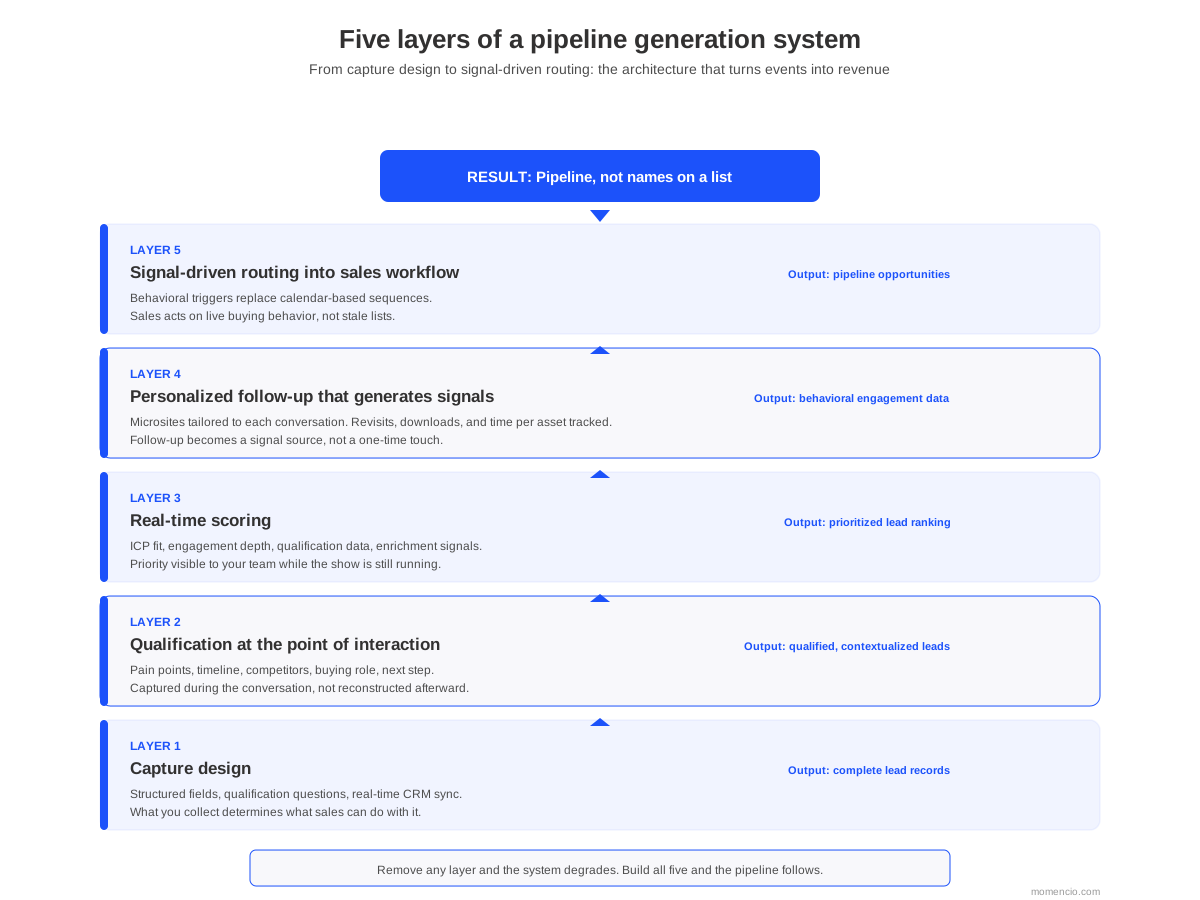
The five layers connect into a continuous cycle. Capture design determines the quality of the raw data. Qualification at the point of interaction adds the context that makes the data actionable. Real-time scoring prioritizes leads while the show is still running. Personalized follow-up generates behavioral signals that compound the booth conversation. Signal-driven routing puts scored, behavior-informed leads into the right sales workflow at the right moment.
Each layer feeds the next. Remove any one of them and the system degrades: capture without qualification produces names. Qualification without scoring produces data nobody acts on. Scoring without personalized follow-up produces a priority list that goes stale. Follow-up without signal tracking produces a one-touch outreach that gets ignored. Signals without routing produces dashboards that nobody checks.
The teams that consistently generate pipeline from events are the ones that have built all five layers, deliberately and in advance. They do not wait until after the show to figure out their process. They design the system before the first badge is scanned, operate it in real time during the event, and let the signals guide their sales team afterward.
The difference between four hundred names on a list and forty pipeline opportunities is not booth design, staffing levels, or marketing budget. It is system architecture. Build the system, and the pipeline follows.
There is a compounding effect that most teams never reach. When you run this system across multiple events, you start to see patterns: which shows produce the highest-quality leads, which qualification questions predict conversion most accurately, which follow-up content generates the most re-engagement, and which accounts keep appearing across events without converting. That cross-event intelligence is where the real leverage lives. It turns a series of disconnected trade show appearances into a unified pipeline generation engine that gets sharper every quarter.
Most event programs are optimized for the wrong output. They produce impressive lead counts and empty pipelines. A system built around these five layers produces fewer leads and more revenue. That trade-off is the entire point.
momencio is the platform built for pipeline generation: structured capture, AI-powered enrichment and scoring, personalized microsites with behavioral tracking, and real-time CRM sync that puts scored leads into your sales workflow while the show is still running. Book a demo to see the system in action.