There is no shortage of articles listing AI tools for event marketers. ChatGPT for email copy. Canva AI for booth graphics. Salesforce Einstein for lead scoring. The tool lists are everywhere. The problem is that tool access has never been the bottleneck. Skill adoption is.
A team that has AI tools and a team that is AI-proficient are two very different things. The first team uses ChatGPT to rewrite a follow-up email template the night before the show. The second team uses AI to research every target account on the attendee list, generate personalized outreach before the event opens, build structured qualification workflows that feed real-time lead scoring, and produce account-specific follow-up content while the booth is still running. The tools are identical. The outcomes are not even close.
The UFI Global Exhibition Barometer reports that 63% of companies in the exhibition industry now use standard AI tools in at least some business functions. But only 17% have AI integrated into their existing systems. The gap between those two numbers is a skills gap, not a technology gap.
This article maps five specific AI skills that change how event professionals operate before, during, and after the show. Each one is learnable, practical, and directly tied to outcomes you can measure: better conversations, richer lead data, faster follow-up, and clearer pipeline attribution.
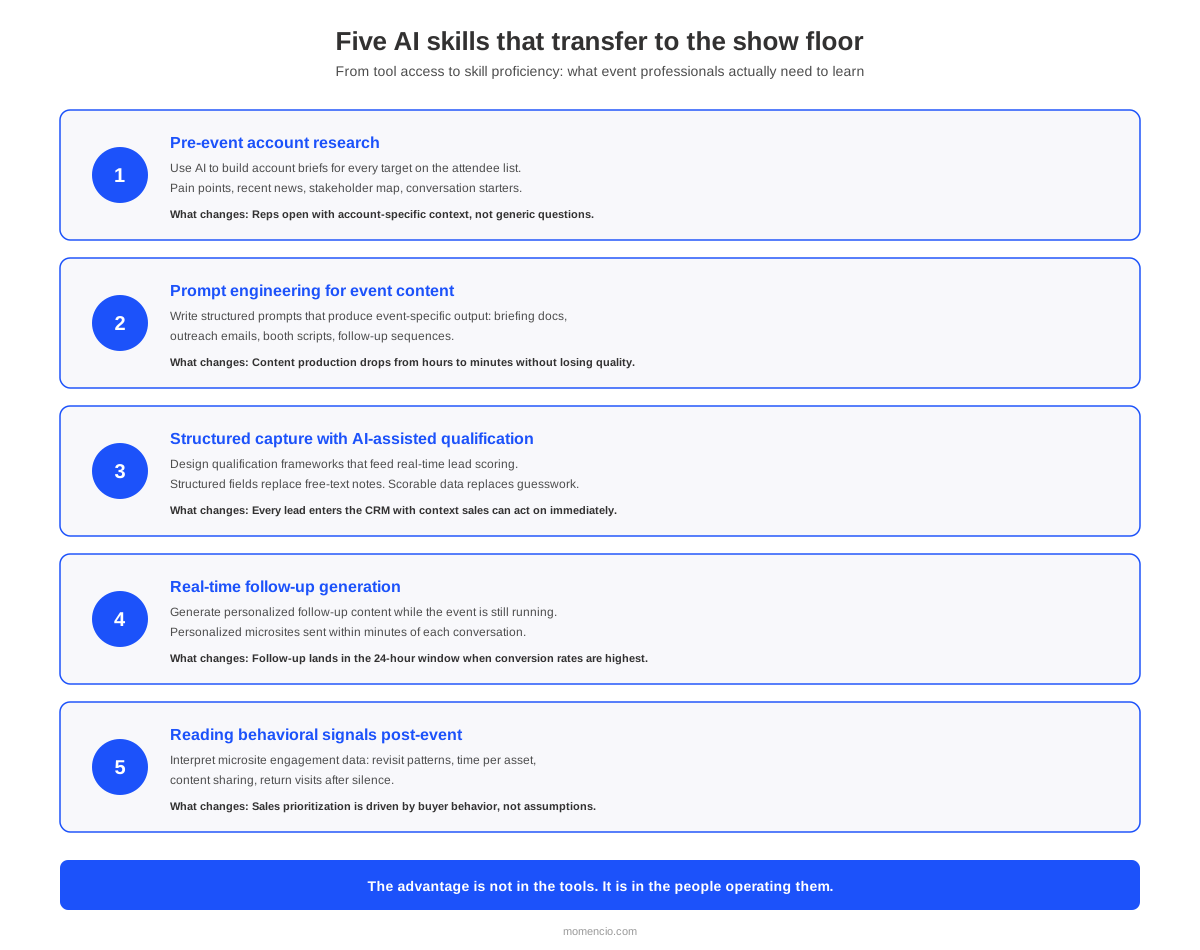
Skill 1: pre-event account research using AI
Most booth teams walk onto the show floor with a list of company names and a vague sense of who might stop by. AI-proficient teams walk in with account-level intelligence on every target: what the company does, what challenges they face, what products they have evaluated recently, who the key stakeholders are, and what talking points will resonate.
The skill here is knowing how to prompt an AI model to produce a useful account brief from publicly available information. This is not about asking “tell me about Company X.” That gives you a Wikipedia summary. The skill is constructing a prompt that extracts the specific context your booth team needs to have a meaningful conversation.
Here is an example of a prompt that does this well:
You are a B2B trade show strategist preparing booth reps for a conversation with [Company Name]. Research this company and produce a one-page account brief covering:1. their core business and annual revenue range, 2. their most likely pain points related to [your product category], 3. any recent news (funding, acquisitions, leadership changes, product launches) from the past 6 months, 4. the job titles most likely to visit our booth and what each role cares about, and 5. two specific conversation starters that reference something real about their business. Keep it under 400 words. Use only verifiable information.
This prompt works because it does four things most generic prompts do not. First, it sets a role (“B2B trade show strategist”) that focuses the output on booth preparation, not general research. Second, it specifies the exact structure of the output so the brief is immediately usable without reformatting. Third, it constrains the scope to your product category, which prevents the AI from producing irrelevant information. Fourth, it sets a word limit and a verification standard, which reduces hallucination risk and keeps the brief actionable.
When you produce these briefs for every Tier 1 account on your attendee list, your reps do not open conversations with “So, what does your company do?” They open with “I saw you expanded into the APAC market last quarter. How is that affecting your event program?” That is a categorically different conversation. It produces categorically different lead quality.
This is also where pre-event intelligence becomes operational. AI-generated account briefs paired with engagement signals from pre-show outreach (who opened the microsite, what assets they spent time on) give your booth team a level of preparation that most competitors cannot match.
Skill 2: prompt engineering for event content
Event marketing requires a high volume of written content produced under tight deadlines: outreach emails, booth scripts, session descriptions, social posts, follow-up sequences, internal briefing documents. AI can produce all of it. But the quality of the output depends entirely on the quality of the prompt. This is the skill most event professionals underestimate.
The difference between a weak prompt and a strong one is specificity. A weak prompt says “write a follow-up email for trade show leads.” The output will be generic, interchangeable, and forgettable. A strong prompt provides context, constraints, and a clear model of what good looks like.
Here is a prompt for generating a personalized follow-up email after a booth conversation:
Write a follow-up email from [Your Name], [Your Title] at [Company], to [Lead Name] at [Lead Company]. We met at [Event Name] on [Date]. During our conversation, they mentioned [specific pain point or interest area]. They asked about [specific product feature or use case]. The tone should be professional but conversational, not salesy. Reference the specific conversation we had. Include one relevant resource link. Keep it under 150 words. Do not use exclamation marks or the phrase "I hope this email finds you well."
This prompt works because it provides the conversation context the AI needs to personalize the output. It specifies the tone, sets a word limit, and includes explicit exclusions (no exclamation marks, no cliched opener). The result reads like a real email from a real person who remembers the conversation, not a mass-generated template.
The broader skill is learning to treat every AI interaction as a structured brief, not a casual request. Include the role, the audience, the context, the constraints, and the format. The more specific the input, the less editing the output requires. Event professionals who develop this skill can produce in thirty minutes what used to take a full afternoon.
Skill 3: structured capture with AI-assisted qualification
The default mode of lead capture at most trade shows is the badge scan followed by a free-text notes field. The badge scan captures identity. The notes field captures whatever the rep remembers to type, usually a few words that mean something to them in the moment and nothing to anyone else a week later.
AI-assisted qualification changes this. With universal lead capture and structured qualification forms, the booth conversation flows through predefined fields: pain points, evaluation timeline, competitors being considered, budget authority, and next steps. The rep is guided through a consistent capture process, and the data enters the system in a format that can be scored, routed, and acted on automatically.
The skill for the event professional is not in configuring the tool. It is in designing the qualification framework before the show. That means answering three questions in advance: What does sales need to know about this lead to prioritize it? What fields in the CRM should this data populate? What engagement signals should trigger an immediate alert versus a standard follow-up sequence?
When AI IntelliSense™ scores leads in real time, it works with whatever data it has. The richer the capture, the more accurate the score. A lead with a badge scan and no notes gets a basic score. A lead with structured qualification data, conversation context, and engagement signals from a product demo gets a score that sales can act on with confidence. The skill is in understanding that what you capture determines what the AI can do with it.
AI can also help you design the qualification framework itself. Before the show, you can use a prompt like this to build your capture template:
I am an event marketer preparing a lead qualification form for a B2B trade show. Our product is (product category). Our sales team needs to know:
1. the prospect's current solution and level of satisfaction,
2. their evaluation timeline,
3. their role in the buying decision,
4. the specific problem driving their evaluation, and (5) their preferred next step (demo, call, content).

Design a qualification form with five fields that a booth rep can complete in under 90 seconds during a conversation. Each field should have 3 to 4 predefined response options plus an open-text fallback.
This prompt works because it constrains the output to a realistic interaction time (90 seconds), which forces the AI to prioritize the most important fields. It also specifies predefined response options, which means the data enters the system in a structured format rather than free text. Structured data is scorable data. Free text is data that sits in a notes field and gets ignored.
Skill 4: real-time follow-up generation during the event
Most exhibitors follow up after the event. The best exhibitors follow up during it.
The traditional timeline looks like this: the show ends on Thursday. The lead list is cleaned on Monday. The follow-up emails go out on Wednesday. By then, nine days have passed. The prospect has spoken to twelve other vendors, returned to their regular workload, and lost whatever urgency they felt at the booth. Research consistently shows that the meaningful conversion window after a trade show is 24 to 48 hours. After that, response rates decline sharply every day.
The AI-proficient event professional compresses this timeline by generating follow-up content while the show is still running. The workflow looks like this: a booth conversation ends, the rep logs structured notes, and within minutes, a personalized LiveMicrosite™ is sent to the prospect. That microsite includes the specific content the prospect engaged with at the booth, tailored to the topics they raised in conversation.
The skill is in speed and specificity. You can use AI to generate the microsite copy, the email that delivers it, and the selection of assets to include. Here is a prompt that demonstrates this:
I just had a booth conversation with [Name], [Title] at [Company] at [Event]. They are currently using [competitor product] and evaluating alternatives because [specific reason]. They were most interested in [feature/capability area]. They asked about [specific question]. Write a short follow-up email (under 100 words) that references this conversation, links to a personalized content page, and suggests a 15-minute call next week. Tone: helpful, specific, zero fluff.
This prompt works because it captures the real conversation, not a generic persona. The output will reference the competitor by context (not by name in the email itself), address the specific interest area, and propose a concrete next step. The prospect receives it while they are still at the event, still thinking about their evaluation, still comparing vendors. That timing advantage is worth more than any amount of polish applied a week later.
Skill 5: reading behavioral signals after the event
The follow-up email is the beginning of the post-event intelligence stream, not the end of it. Once a prospect receives a personalized LiveMicrosite, every subsequent interaction is tracked: which pages they visit, how long they spend on each asset, whether they return after a period of silence, and whether they share content with colleagues.
The skill for the event professional is learning to read these signals and act on them. This is not a passive dashboard-checking exercise. Through IntelliStream™, behavioral events surface in real time. An alert fires when a lead who went quiet three days ago suddenly returns to the microsite, spends eight minutes on the pricing page, and downloads a technical comparison document. That pattern is a buying signal, and the response should be a phone call within the hour, not a scheduled nurture email next Tuesday.
Learning to interpret these signals takes practice. A quick visit to the homepage means something different from a deep dive into the pricing page. A return visit after five days of silence means something different from a visit on the same day the follow-up email was sent. A lead who shares the microsite link with a colleague is at a different stage than one who only views it themselves.
The event dashboards make these patterns visible across your entire lead set. But the skill of interpretation belongs to the event professional, not the dashboard. AI surfaces the signal. The human decides what it means and what to do next. That judgment, trained by experience and informed by data, is the skill that separates event professionals who generate pipeline from those who generate reports.
The skill gap is the strategy gap
These five skills share a common thread. None of them require a background in data science, programming, or machine learning. All of them are learnable by any event professional willing to invest the time. And all of them produce measurable improvements in the three metrics that matter most: lead quality, follow-up speed, and pipeline conversion.
The teams that build these skills will outperform teams with bigger budgets, larger booths, and more expensive tools. Because the advantage is not in the technology. It is in the people operating it. AI does not replace the event professional. It amplifies the ones who know how to use it.
The shift from tool adoption to skill adoption is already happening. The question is whether your team is leading it or watching it.
momencio gives event professionals the platform to put these skills into practice: AI-powered lead capture, real-time engagement scoring, personalized follow-up microsites, and behavioral signal tracking that feeds directly into your CRM. Book a demo to see how the platform supports every skill mapped in this article.