Run far away from anyone who tells you that booth traffic guarantees pipeline. It doesn’t.
This swipe file exists to show you what does.
Inside are 150 proven event marketing tactics used at the most attended B2B trade shows in the world. Each one is tied to a real problem: empty booths, leads that vanish, sales teams without context, pipelines that stall, and campaigns no one can measure.
What follows is not theory. It is a catalogue of practical moves, curated, organized, and ready for you to deploy.
By the time you finish, you will know exactly where events usually fail, what the top 1% do differently, and how to close the gap.
That’s what you can expect from the pages ahead.
When no one shows up
An empty booth is not bad luck. It is bad strategy.
Every trade show promises access to decision makers. Yet most exhibitors end up with aisles full of people who never mattered to begin with. Booth traffic looks good in photos, but a crowd of unqualified visitors does not translate to revenue.
The data proves it. 64% of exhibitors share that attendee quality is the single most important factor in deciding whether to participate in a show. Almost half of attendees only go to one event per year. If you miss them, there is no second chance.
This section contains tactics used by the world’s most attended events to ensure the right people walk into the booth. Not just more people—better people. Tactics that turn random traffic into targeted engagement. Tactics that replace chance with precision.
What follows are plays built on psychological triggers that guarantee relevance: curiosity, fear of missing out, and ease. Each one is designed to solve the real problem behind an empty booth—not lack of interest, but lack of intent-driven attraction.
Read closely. These are the moves that separate crowded booths from profitable ones.
Attract the right attendees to the booth
- 🕵️ Stealth invite campaign
Do not announce everything openly. Run a closed-door teaser campaign with a countdown timer, hinting at a reveal only available at your booth. Curiosity fills the gaps that generic invites never will. - 📋 Executive guest list
Secure a small group of high-value prospects before the event and give them reserved slots for a one-to-one demo or private walkthrough. A booth with exclusivity attracts the right eyes, not just wandering feet. - 📱 Geo-fenced digital ads
Target attendees’ devices as soon as they arrive in the host city. Location-based ads with booth directions cut through the noise and guide serious visitors directly to you. - ⏳ Scarcity-driven RSVP
Send pre-event messages that highlight limited slots for a live demo, private consult, or hands-on test. Scarcity triggers faster response than any generic “visit our booth” line. - 🎟️ VIP-only drop
Offer special content or product previews available only to senior decision makers. Filter entry through job titles or company size so that your team spends time where it matters most. - 🎤 Micro-event inside the event
Host a quick session, live challenge, or lightning talk at scheduled times. It creates a reason to attend your booth at a specific moment, not just by chance. - 🤝 Partner magnet
Align with one or two complementary brands exhibiting nearby and cross-promote. Attendees looking for one solution discover yours as part of a wider story. - 💡 Bold, singular promise
Replace vague booth slogans with one clear benefit that speaks directly to attendee pain. Ambiguity attracts browsers. Specificity attracts buyers.
The goal is not to fill space on the show floor. The goal is to fill your pipeline with the right names. These tactics make sure the people who step into your booth are the ones with the authority to sign a contract.
When everyone scans but no one remembers
A badge scan is not a memory. It is a forgotten interaction waiting to happen.
Most exhibitors confuse the volume of scans with the volume of opportunities. The two are not the same. A badge scan is a contact. A remembered experience is intent.
More than half of attendees forget most booth interactions within twenty-four hours. If all you collect is a scan, you have collected nothing. The only way to win is to turn a brief encounter into a lasting impression that survives the flight home.
This section contains tactics that convert quick interactions into sticky memories. They use emotional triggers like surprise, humor, and personalization to anchor your brand in the mind of the visitor. The goal is simple – when the attendee opens their inbox after the show, yours is the name they remember.
How to turn scans into lasting impressions
- 📸 Personalized proof-of-moment
Instead of a generic photo booth, capture the visitor with your product in context (for example, holding a live dashboard with their company name on it) and deliver that image as part of the follow-up. The visual makes the interaction unforgettable because it ties their identity to your solution. - 🎯 Role-specific demo triggers
Create two-minute demos tailored for different visitor types—finance, marketing, ops—and let them choose. The act of self-selecting reinforces memory because the experience feels built for them. - ✍️ Hand-written recap card
Summarize the conversation on a branded card in real time and hand it to the visitor before they leave. Tangibility plus immediacy builds recall far more effectively than a scan. - 🔗 Follow-up seeded on the spot
Instead of waiting, send the visitor an email or microsite link while they are still standing at the booth. The instant ping associates your brand with speed and relevance. - 🎤 One-line retell strategy
Equip your booth team with a single crafted line that attendees can repeat later when asked “what did you see at the show?”—making your message portable and memorable. - 🎮 Interactive relevance quiz
A fast, two-question touch screen quiz that outputs a tailored recommendation tied to your product. Novelty plus personalization creates stronger memory anchors than a badge swipe.
A scan is a line in a spreadsheet. A remembered interaction is the start of a sales conversation. These plays make sure your brand lives in the mind of the attendee long after the floor has gone quiet.
When sales cannot follow up intelligently
Without context, a lead is not a lead. It is a name in a database.
Every event team knows the frustration. Hundreds of contacts are captured at the booth, yet when sales picks them up, the follow-up is weak, slow, and irrelevant. The problem is not volume—it is intelligence.
Most sales teams do not have the detail they need to move fast: what the prospect asked about, which content they engaged with, or how urgent their need was. Without that context, the outreach feels like a cold call disguised as follow-up.
The data confirms the gap. Only one in five sales reps say they trust the lead information handed to them after events. Deals stall not because prospects lacked interest, but because the first sales conversation failed to build on the booth interaction.
This section contains tactics to bridge that gap. The goal is to make sure sales receives not just a name, but a reason to act—and a clear trigger for how to act.
How to give sales leads they can actually close
- 📊 Send a sales brief that matters
Deliver a short, structured document for each high-value lead that includes booth conversation notes, content engaged with, and next-step recommendations. A rep who knows what was said and what was shown can open the follow-up with authority. - 🔔 Trigger urgency with smart alerts
Use engagement-based rules that notify sales in real time—for example, when a lead reopens the event microsite or shares it with a colleague. Timed alerts turn passive data into active opportunity. - 🗂️ Embed context into the CRM, not a spreadsheet
Sync notes, preferences, and content interactions directly into your CRM. Do not hand sales a list; hand them an account view. A lead inside a workflow gets worked. A lead in a spreadsheet gets lost. - 📝 Capture notes that sales can trust
Equip booth staff with speech-to-text or shorthand tagging tools. A line written at the booth about a specific interest is more powerful than any post-event guesswork. - 📅 Move from follow-up to meeting on the spot
Send calendar invites for short debrief calls before the attendee even leaves the floor. A booked meeting in the diary is worth more than a promise to connect later. - 📈 Score leads by behavior, not by presence
Prioritize sales outreach based on what the lead actually did—content opened, demos watched, microsite revisits—not just that they were scanned. Sales works faster when they know which doors are already half open.
A contact list does not build pipeline. Sales needs context, timing, and triggers. These tactics ensure that when the booth closes, the conversation does not.
When MQLs do not convert
A lead that looks good on paper but never closes is not a lead. It is false confidence.
Marketers celebrate hitting their MQL targets. The dashboard looks green. The pipeline coverage looks healthy. Yet months later, revenue tells a different story. Most of those so-called “marketing qualified leads” never progress past a first call.
The issue is not the concept of MQLs. It is the way they are defined. Too often, the threshold for “qualified” is too low—downloading a piece of content, scanning at a booth, or opening one email. These signals show curiosity, not intent.
When MQLs do not convert, the cost is bigger than wasted ad spend. Sales loses faith in marketing. Leadership questions event ROI. And the cycle of generating more unqualified names continues.
This section shows how to tighten the gap between MQL and revenue, with practical tactics to reframe qualification around actual buying signals.
How to stop false MQLs from entering the pipeline
- 🎯 Raise the qualification bar
Define MQLs based on actions that indicate interest in solving a problem—not just consuming content. For example, visiting pricing pages, re-engaging with microsites, or requesting demos. - 📐 Align with sales on one definition
Sit with sales and agree on what a “qualified” lead looks like. Document it. Make it visible. If marketing and sales use different yardsticks, conversion will always suffer. - 📊 Use engagement depth, not surface activity
Track time spent, repeat visits, and content paths. A five-minute video watched in full says more than five whitepapers downloaded in bulk. - 🚦 Implement behavioral scoring rules
Weight signals based on actual intent. For example, a prospect revisiting the same case study three times should rank higher than someone who quickly clicked a giveaway form. - 🔄 Create a recycle loop for non-converters
Do not throw away MQLs that fail. Route them back into nurture campaigns until they show stronger signals. Yesterday’s non-converter may be tomorrow’s priority. - 📈 Measure MQL quality, not just volume
Track what percentage of MQLs actually move to SQL and opportunity stages. Report on quality conversion, not vanity numbers.
When MQLs do not convert, the problem is not sales execution—it is weak qualification. By redefining what truly counts as a lead, you trade false confidence for actual revenue.
When you cannot prove what worked
If you cannot prove impact, you will lose the budget.
Great events die in post-mortems when no one can show where revenue came from. Photos look good. Anecdotes sound good. Neither survives a CFO review. Proof requires a clear definition of success, instrumentation that captures the right signals, and a single place where marketing and sales see the same truth.
How to prove what worked
- 🎯 Define success the way finance will read it
Lock three numbers before the show: qualified meetings created, opportunities opened, and pipeline influenced. Publish the targets and the measurement method. No drift. - 🧭 Map every interaction to an account
Tie scans, microsite visits, content views, and meetings to company records, not just people. Account-level truth stops double counting and makes attribution credible. - 🔗 Tag every asset and touchpoint
Use QR codes and UTMs on booth screens, handouts, and microsites. One asset, one tag. When a lead engages, the source is unambiguous. - 📄 Capture context at the booth, not later
Add two required fields to every lead record: problem discussed and next action. Context converts. It also proves why a meeting happened. - 📊 Build a revenue board everyone can read
One dashboard that shows meetings booked, opportunities opened, projected value, and closed-won tied to the event. Update daily during the show and weekly for thirty days after. - 🧪 Compare cohorts, not feelings
Create simple A/B cohorts: attendees who received the event microsite versus those who did not; leads with booth notes versus leads without. Report conversion deltas, not stories. - 🕒 Enforce a seven-day attribution window
Attribute opportunities opened within seven days of the event to the event touchpoint. Extend to thirty days for influence. Anything older becomes background noise. - 🏅 Score reps on follow-through
Show, per rep, leads assigned, first-touch speed, meetings scheduled, and opportunity creation rate. Rep scorecards turn “we think” into “we know.” - 🧹 Clean before you report
De-duplicate leads, normalize company names, and merge contacts into accounts before presenting results. Clean data is the difference between trust and doubt.
Attribution is not a slide. It is a system. Put these controls in place and the event stops being a story and starts being a line on the revenue report.
When competitors outspend you
Big budgets buy attention. Smart tactics steal it.
Trade shows are uneven playing fields. Some companies spend millions on mega-booths, prime locations, and endless giveaways. You cannot outspend them. But you can outthink them.
Crowds do not always gather at the biggest booth. They gather where curiosity is sparked, relevance is clear, and value is immediate. This section shows how to win visibility and credibility without matching the budget of your largest competitor.
How to beat bigger budgets with sharper tactics
- 🎨 Use creativity as currency
Replace flashy builds with arresting, low-cost visual hooks—a live sketch artist mapping attendee problems, a bold one-line wall that stops people in their tracks, or a striking countdown clock for a reveal. - 🧩 Host micro-moments inside your booth
Schedule short, high-impact activities (five-minute demos, lightning talks, product challenges). Micro-events create reasons to stop by, while expensive booths rely only on size. - 📢 Borrow reach through partnerships
Partner with complementary vendors or sponsors and cross-promote. A joint draw amplifies your presence without multiplying spend. - 🎁 Design giveaways that travel further
Offer fewer but more thoughtful giveaways—something decision-makers will actually use and remember (not another stress ball). The right item sparks more conversations than piles of cheap swag. - 🕵️ Turn location into strategy
If you are not on the main aisle, create a draw that pulls people to you—geo-fenced notifications, scavenger hunts, or digital teasers pointing directly to your booth. - 💬 Arm your team with sharper hooks
A well-trained team with magnetic openers will outshine a giant booth with passive staff. Positioning your people as experts creates authority no budget can buy.
Money builds a booth. Strategy builds momentum. These plays ensure you can win the floor even when you are standing next to a Goliath.
The event funnel is broken – here’s the data to prove it
The numbers do not lie. The funnel is leaking everywhere.
Everyone feels the cracks in the event funnel. Few can show them. These data points are not opinions—they are the evidence. Each number exposes where events lose value and where opportunity evaporates. This is the foundation the rest of this swipe file is built on.
Data behind the cracks
- 92% of B2B marketers plan to improve post-event follow-up or build year-round engagement.
Source: Forrester
Did you know?
Most teams draft follow-up after the event, when attention is already fading.Apply it
Write and load your post-event sequences before the booth opens. Set triggers to fire within minutes of each interaction.
- 95% of event leaders say performance measurement and ROI tracking are the top priority.
Source: Forrester
Did you know?
Spreadsheet reporting is where credibility goes to die in the boardroom.Apply it
Stand up a live dashboard tied to CRM objects (meetings, opportunities, revenue). Report on it during the show, not weeks later.
- 58% of marketers plan to run more small, owned in-person events—even on constrained budgets.
Source: Forrester
Did you know?
Smaller formats create tighter feedback loops and faster learning.Apply it
Use intimate events to test messaging and demos. Roll only the proven elements into your flagship trade shows.
- 64% of B2B marketing leaders admit they do not trust their own measurement.
Source: Forrester
Did you know?
Doubt vanishes when you compare cohorts, not anecdotes.Apply it
Create two simple cohorts: attendees who received the event microsite versus those who did not. Publish conversion deltas.
- 37% of leads respond within one hour. Companies who respond within two hours are 60× more likely to convert.
Did you know?
Response time is the simplest lever you control and the most neglected.Apply it
Enable Day-Zero automation that sends a personalized recap (and calendar link) while the attendee is still on the floor.
These figures are not decoration. They are the evidence. Treat them as operating rules, and the rest of this playbook stops being advice and starts being an advantage.
Final word
If events are expensive, wasted events are lethal.
This file exists to end waste. Events are the most expensive line item in the marketing budget, and the easiest place for value to vanish. The difference between a trade show that drives pipeline and one that drains budget is not theory—it is execution.
You have seen where the funnel breaks. You have seen how the best fix it. Each section in this file gives you tactics proven to move an event from noise to revenue. Nothing here is decoration. Everything here is usable.
Treat events as revenue campaigns, not logistics exercises. Treat the booth as a sales machine, not a piece of furniture. Treat your data as evidence, not trivia. Do this, and you will not just defend your budget—you will win more of it.
Events give you one stage, one shot, one chance to prove the spend was worth it. Use this file to make sure you do.
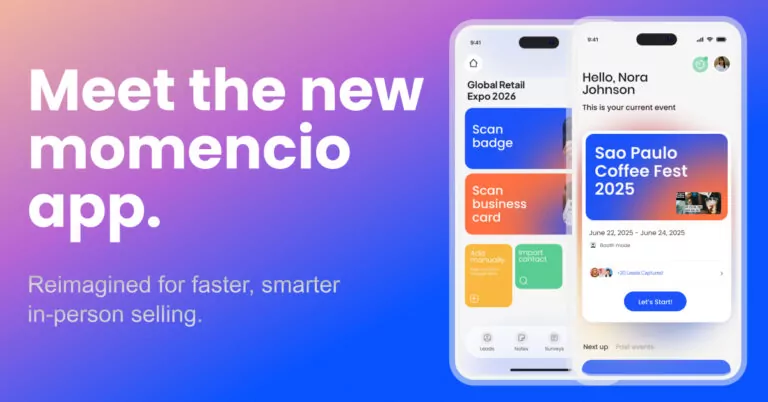
Win with momencio
This playbook gave you the tactics. But tactics alone do not win events. Execution does. And execution depends on timing, intelligence, and proof—three areas where most event teams break down.
That is why momencio exists.
- It captures every interaction in real time.
- It translates moments into intent, so sales knows exactly how to follow up.
- It delivers proof of impact straight into the metrics your leadership care.
Other platforms leave you with spreadsheets and lag. Momencio leaves you with pipeline, proof, and the budget security to do it again.
Events are too expensive to gamble. Do not let your next event be another gamble.
👉 See momencio in action and turn your moments into wins.