In an industry where a single wrong decision can cost millions, banks and financial institutions face a paradox: their customers crave personal connection, yet most marketing happens through impersonal digital channels. While competitors pour budgets into programmatic ads and email campaigns, the savviest financial marketers are rediscovering an old truth—nothing builds trust like a handshake.
Event marketing for banks has evolved from rubber-chicken dinners and golf tournaments into sophisticated revenue engines. For retail banks and non-banking financial companies (NBFCs), in-person events represent the only channel where complex financial products can be explained, trust can be established instantly, and million-dollar relationships can begin with a 15-minute conversation.
But here’s the challenge keeping CMOs awake: most banks cannot prove which closed deals originated from specific events. Without this attribution, event budgets remain vulnerable, and optimization stays guesswork.
The trust equation: Why digital can’t compete with face-to-face
Consider two scenarios:
Scenario A: A business owner receives a targeted LinkedIn ad for commercial lending, clicks through to a landing page, fills out a form, and waits for a callback from an unknown loan officer.
Scenario B: That same business owner attends the Financial Brand Forum, stops by your booth because of an intriguing display about cash flow lending, has a 20-minute conversation with a relationship manager who immediately grasps their industry challenges, and walks away with a business card and genuine confidence that your bank “gets it.”
Which scenario converts?
Research reveals event-based marketing programs in financial services achieve conversion rates 2-35 times higher than traditional direct marketing. This isn’t marginal improvement—it’s an entirely different game.
The reasons are neurological and psychological:
- Face-to-face interaction triggers oxytocin release, the brain chemical associated with trust and bonding
- Body language provides instant credibility assessment that no amount of website copy can replicate
- Real-time objection handling prevents the “I’ll think about it” death spiral
- Shared physical presence creates memorable experiences that email threads never will
When JPMorgan Chase sponsors the Sundance Film Festival and creates exclusive lounges for Sapphire cardholders, they’re not just offering refreshments—they’re engineering trust through experiential immersion. The message: “We understand what matters to you beyond just banking.”
Three critical advantages banks gain from in-person events
1. Relationship compression
What takes 6-8 weeks through digital nurture campaigns can happen in a single trade show conversation. A commercial banking prospect can ask nuanced questions about lending terms, discuss specific business scenarios, assess the banker’s industry knowledge, and determine cultural fit—all before lunch.
Timeline comparison:
→ Digital nurture: 12 touchpoints over 8 weeks to qualify = 56 days
→ Trade show conversation: 15 minutes to qualify = 0.01 days
That 5,600x compression matters when competitors are having the same conversations.
2. Multi-stakeholder simultaneous access
B2B financial decisions involve multiple players: CFOs, CEOs, controllers, board members. Getting them all on separate discovery calls is scheduling hell. Getting them all at your booth during the same conference? Suddenly plausible.
This parallel engagement pattern accelerates deals that would otherwise die in committee.
3. Competitive intelligence goldmine
Events provide unfiltered market research:
- What pain points do prospects mention unprompted?
- Which competitor messages are gaining traction?
- What product features generate excitement vs. polite nods?
- Which price points trigger immediate objections?
This intelligence feeds product development, messaging refinement, and sales enablement in ways surveys and focus groups cannot match.
Problem: The $2.3m attribution black hole
Here’s the scenario playing out at banks nationwide:
Your team attends Money20/20. Relationship managers have 47 substantive booth conversations. Business cards get collected. Some leads are entered into Salesforce (when reps remember). Most conversations get documented as “Attended Money20/20 – follow up needed.”
Nine months later, a $2.3M commercial lending deal closes. The relationship manager vaguely recalls meeting the client at “some conference last year” but can’t confirm which one or what was discussed.
Result: The event budget line item remains unjustified, leadership questions the ROI, and nobody knows whether Money20/20 was worth attending again.
This attribution black hole has three primary causes:
Cause #1: Context evaporation
Business cards capture name and title. They don’t capture: “Mentioned expanding into two new states next quarter, worried about working capital for inventory, currently banks with Regional Bank X, lease expires in 90 days, CEO makes final decision but CFO drives the process.”
When that context disappears, follow-up becomes generic and ineffective.
CAUSE #2: Manual data transfer delays
Even when reps take good notes, leads sit in spreadsheets or notebooks for days/weeks before CRM entry. By then, the prospect has had conversations with three competitors who followed up same-day.
A report found companies with same-day follow-up see 5x higher conversion rates than those waiting a week.
CAUSE #3: Multi-touch attribution complexity
Your prospect’s journey: Attended Money20/20 → Downloaded whitepaper → Attended webinar → Came to regional banking event → Requested proposal → Closed deal
Which touchpoint gets credit? Most CRM systems use last-touch attribution, giving full credit to the final interaction and making early-stage events look ineffective.
Reality: The initial trade show conversation established trust that made all subsequent interactions possible. But your data says the webinar closed the deal.
How modern banks solve attribution: The event intelligence framework
Leading financial institutions are implementing what we call the “Capture-Enrich-Engage-Track-Attribute” (CEETA) framework:
CAPTURE → Real-time structured data collection
Not just contact details—capture intent signals, product interests, timeline, budget authority, current banking relationships, and conversation notes.
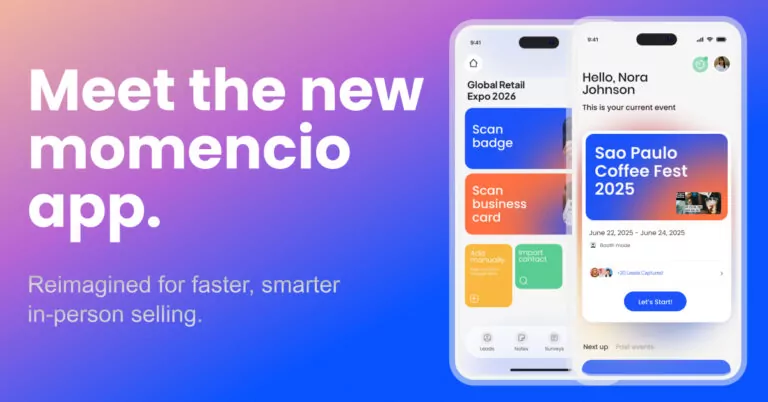
momencio’s lead capture platform
ENRICH → Automated profile completion
Basic badge scan provides: Name, company, title
AI enrichment adds: Business email, direct phone, LinkedIn profile, company size, revenue, funding stage, decision-maker identification, recent company news
This transforms minimal contact info into actionable intelligence.
ENGAGE → Personalized micro-experiences
Generic follow-up: “Thanks for stopping by our booth. Here’s our product brochure.”
Personalized follow-up: “Hi Sarah, great discussing your expansion plans into Texas and Arizona. Here’s a guide specifically about multi-state cash management for growing logistics companies, plus case studies from two companies in your industry that solved similar working capital challenges.”
The difference? One gets deleted. The other gets forwarded to the CFO.
momencio for financial services
TRACK → Behavioral engagement scoring
When your prospect:
- Opens your follow-up email → +5 points
- Visits your rate comparison tool → +15 points
- Downloads your fee schedule → +25 points
- Watches your lending process video → +20 points
- Returns to content 3+ times → +30 points
High engagement scores trigger automated alerts to relationship managers: “Prospect showing strong intent signals—contact within 24 hours.”
Low engagement scores route to nurture campaigns until buying signals emerge.
ATTRIBUTE → Revenue source tracking
momencio’s opportunity pipeline features
→ Total pipeline value by event source
→ Conversion rates by event type
→ Average deal size by event
→ Time-to-close by acquisition channel
→ Revenue forecast by event program
When your CFO asks “What’s the ROI on our trade show program?”—you answer with data, not anecdotes.
The metrics that actually matter: 8 KPIs for banking event marketers
Forget booth traffic counts and brochures distributed. Here are the metrics that prove event value:
1. Cost per qualified lead (CPQL)
Formula: Total event cost ÷ Number of qualified leads
Qualified lead definition for commercial banking:
- Company revenue >$2M annually
- Borrowing need >$500K
- Active evaluation timeline <6 months
- Access to decision-maker confirmed
Benchmark: Best-in-class banks achieve $300-$800 CPQL at major trade shows vs. $1,200-$2,000 CPQL from digital channels.
2. Lead-to-opportunity conversion rate
Formula: (Leads that become CRM opportunities ÷ Total leads captured) × 100
Industry benchmark: 15-25% for well-qualified trade show leads
Red flag: <10% suggests poor qualification or weak follow-up
3. Pipeline velocity ratio
Formula: Average days to close (event leads) ÷ Average days to close (other channels)
Strong performance:
Why: Trust established upfront accelerates later stages
4. Revenue influence (not just attribution)
Beyond “first touch” or “last touch” attribution, measure:
- % of closed deals that had event touchpoint anywhere in journey
- Average deal size: with event touchpoint vs. without
- Win rate: with event touchpoint vs. without
Often reveals: Event-touched deals close at 40-60% higher rates even when events aren’t “first touch.”
5. Relationship depth score
Measures: How many stakeholders from winning accounts were engaged at events
High performers: Engage 2.3 decision-makers per account vs. 1.1 for digital-only
6. Content engagement index
Post-event metric tracking:
- % of leads engaging with follow-up content
- Average time spent with personalized content
- % reaching “high intent” threshold (multiple returns, deep engagement)
Benchmark: >60% engagement rate indicates strong initial conversations and relevant follow-up
7. Net promoter score (NPS) by acquisition channel
Question: “How likely are you to recommend our bank to a colleague?”
Finding: Event-sourced customers often show 15-20 point higher NPS than digital-sourced customers, indicating stronger relationship foundation.
8. Customer lifetime value (CLV) multiplier
Formula: Average CLV (event-sourced customers) ÷ Average CLV (digital-sourced customers)
Pattern: Event relationships often show 1.4-1.8x higher CLV due to:
- Higher initial trust leading to broader product adoption
- More resilient relationships during competitive pressure
- Greater willingness to refer others
Six execution tactics that separate winners from exhibitors
Tactic #1: The 30-day pre-event campaign
Weak approach: Show up and hope for booth traffic
Strong approach:
- Day -30: Email target accounts announcing attendance
- Day -21: LinkedIn campaign targeting conference hashtags
- Day -14: Personalized outreach to high-value prospects offering pre-scheduled meetings
- Day -7: Final reminder with booth location and “book a time” link
Banks using pre-event campaigns fill 60-70% of their meeting calendar before doors open.
Tactic #2: The qualification conversation framework
Replace: “So, what brings you by our booth?” (open-ended time waste)
With structured discovery:
- “What’s your current banking relationship?” (establishes incumbent)
- “What’s working well and what’s frustrating?” (uncovers pain)
- “What’s prompting you to explore alternatives now?” (identifies trigger event)
- “Who besides yourself is involved in this decision?” (maps buying committee)
- “What’s your timeline?” (qualifies urgency)
Document answers in real-time using mobile lead capture. This takes 90 seconds and provides everything needed for effective follow-up.
Tactic #3: The immediate value exchange
Don’t make prospects wait for follow-up to get value.
During booth conversation:
- Pull up relevant calculator and run their numbers on the spot
- Show specific case study matching their industry/situation
- Connect them with a product specialist via text for deeper technical questions
- Schedule their follow-up meeting before they leave the booth
This transforms your booth from “information gathering” to “problem-solving happening now.”
Tactic #4: The 4-hour follow-up rule
Data from event marketing studies shows:
- Same-day follow-up: 35-40% response rates
- 3-day delay: 18-22% response rates
- 7-day delay: 8-12% response rates
Your competitor who follows up Tuesday morning while you wait until “next week” wins.
Implementation: Automated personalized follow-up triggered immediately post-event, with relationship manager copy so they can add personal notes within hours.
Tactic #5: The engagement-triggered escalation
Not all leads deserve immediate sales contact. Use behavioral signals to prioritize:
LOW ENGAGEMENT: Opened email, no further action
→ Enters 6-week nurture campaign with educational content
MODERATE ENGAGEMENT: Opened email, visited one resource, no return visit
→ Relationship manager sends personalized video within 48 hours
HIGH ENGAGEMENT: Multiple content views, downloaded comparison tools, returned 3+ times
→ Immediate phone call from senior banker offering custom consultation
Tactic #6: The post-event feedback loop
Within one week post-event, conduct team debrief:
Questions to answer:
- Which conversations felt most qualified? What patterns emerged?
- Which messaging resonated? Which fell flat?
- What objections did we hear repeatedly?
- Which competitors were mentioned most? What were their value props?
- What questions couldn’t we answer well?
Document insights. Feed them into next event strategy and product/messaging refinement.
Compliance reality: Event marketing in a regulated industry
Unlike SaaS companies or retailers, banks can’t simply “move fast and break things” with event marketing. Financial institutions must balance innovation with regulatory compliance.
Critical compliance considerations:
Data Privacy and Consent Management
→ GDPR, CCPA, and banking-specific regulations require explicit consent for data collection
→ Lead capture systems must document: when consent was obtained, what was consented to, and enable easy opt-out
→ Automated follow-up must honor communication preferences and frequency limits
Audit Trail Requirements
→ Regulators may investigate how customer relationships originated
→ Event intelligence platforms must provide complete records: initial capture timestamp, all content delivered, all engagement events, progression through pipeline
→ CRM integration must maintain this chain of custody
Advertising and Marketing Compliance
→ Product claims made at events must align with approved marketing materials
→ Verbal representations must not contradict written disclosures
→ Promotional offers must comply with fair lending and anti-discrimination laws
Data Security Standards
→ Lead data often contains PII requiring encryption in transit and at rest
→ Mobile devices used for lead capture must meet enterprise security standards
→ Cloud storage must meet financial services certification requirements (SOC 2, ISO 27001)
Record Retention Policies
→ Financial institutions must retain customer communication records for regulatory periods (typically 3-7 years)
→ Event platforms must support compliant archival and retrieval
The ROI calculation model: Proving event value with precision
Here’s the framework banks use to calculate and defend event marketing ROI:
STEP 1: Calculate total event investment
Direct costs:
- Booth space rental: $15,000
- Booth design/build: $8,000
- Sponsorship packages: $25,000
- Lead capture technology: $2,000
- Marketing collateral: $3,000
- Shipping/logistics: $2,500
Indirect costs:
- Staff travel/lodging: $12,000
- Staff time (5 people × 3 days × $500/day): $7,500
- Opportunity cost of time away from normal duties: $5,000
- Pre/post-event marketing campaigns: $4,000
Total investment: $84,000
STEP 2: Calculate revenue attribution
Attribution model options:
First-touch attribution (conservative):
→ 8 closed deals directly attributed to event as first touchpoint
→ Average deal value: $180,000
→ Attributed revenue: $1,440,000
Multi-touch attribution (realistic):
→ 23 closed deals with event in touchpoint journey
→ Event receives 35% attribution weight (one of multiple touches)
→ Total deal value: $4,200,000
→ Attributed revenue: $1,470,000
Pipeline value (forward-looking):
→ 47 qualified opportunities currently in pipeline from event
→ Average deal size: $200,000
→ Pipeline value: $9,400,000
→ Historical close rate: 28%
→ Projected revenue: $2,632,000
STEP 3: Apply ROI formula
Using closed deals (conservative):
ROI = [(Revenue $1,440,000 – Investment $84,000) ÷ Investment $84,000] × 100
ROI = 1,614%
Every dollar invested returned $16.14 in revenue.
STEP 4: Calculate payback period
Formula: Investment ÷ (Monthly attributed revenue)
If event-sourced deals close over 9-month average cycle:
→ $84,000 ÷ ($1,440,000 ÷ 9) = 0.525 months
**Payback period: 16 days** after first deal closes
STEP 5: Benchmark against alternative channels
Comparison analysis:
Event marketing CPQL: $1,787 ($84,000 ÷ 47 qualified leads)
Digital marketing CPQL: $2,340 (from existing campaigns)
Cost advantage: 24% lower acquisition cost via events
Event-sourced deal size: $180,000 average
Digital-sourced deal size: $125,000 average
Deal size advantage: 44% larger deals from event channel
This data transforms “should we do trade shows?” into “how can we do more trade shows?”
Emerging trends: Where event marketing is heading in 2026
The next 24 months will see three major shifts:
TREND 1: AI-powered conversation intelligence
Near future capability:
- Real-time transcription of booth conversations with automatic CRM population
- AI-suggested next questions based on prospect responses
- Competitive mention detection triggering counter-positioning prompts
- Sentiment analysis flagging highly interested prospects for immediate escalation
Banks beta-testing these capabilities report 30-40% improvement in lead quality scoring accuracy.
TREND 2: Hybrid event proliferation
The post-pandemic lesson: Virtual attendance lowers barriers but weakens relationship depth.
The solution: Intentionally hybrid designs where:
- Main event happens in-person (for high-value relationship building)
- Pre-event virtual sessions qualify attendees (boosting booth conversation quality)
- Post-event virtual follow-up sessions nurture relationships year-round (not just at annual conference)
This extends event ROI beyond the 3-day show into continuous engagement model.
TREND 3: Micro-events replacing mega-conferences
Pattern shift: Instead of one $150K investment in massive trade show, banks are running:
- 12 regional executive dinners ($8K each = $96K total)
- 6 industry-specific workshops ($5K each = $30K total)
- Quarterly virtual roundtables (minimal cost)
Total investment: $126K vs. $150K for single show
Result: 4x more touchpoints, deeper relationships, better geographic coverage, and ironically—higher total pipeline generation.
Implementation roadmap: 90-day event marketing transformation
DAYS 1-30: Audit & baseline
Week 1: Map current state
- Document existing lead capture process from booth to CRM
- Identify where context is lost or delays occur
- Calculate current CPQL and conversion rates by event
- Survey sales team on event lead quality perception
Week 2-3: Define success metrics
- Establish target CPQL (based on customer acquisition cost economics)
- Set lead-to-opportunity conversion goals
- Define “qualified lead” criteria specific to your institution
- Create tracking methodology for pipeline attribution
Week 4: Select pilot event
- Choose upcoming mid-sized event (not your biggest investment) for pilot
- Assemble cross-functional team (marketing, sales, ops)
- Secure executive sponsorship for new approach
Days 31-60: implement infrastructure
Week 5-6: Deploy event intelligence platform
- Implement lead capture solution (evaluate momencio for financial services)
- Configure CRM integration
- Build personalized follow-up content library
- Create lead scoring model based on engagement behaviors
Week 7: Train booth teams
- Role-play qualification conversations
- Practice mobile lead capture workflow
- Review compliance requirements
- Establish same-day follow-up accountability
Week 8: Execute pre-event campaign
- Target outreach to high-value prospects attending
- Schedule pre-event meetings
- Build anticipation through social media
- Prepare booth team with prospect research
Days 61-90: execute, measure, optimize
Week 9: Event execution
- Run pilot with new process
- Capture rich lead data with mobile tools
- Trigger automated personalized follow-up within 4 hours
- Monitor engagement in real-time
Week 10-11: Analyze results
- Calculate actual CPQL vs. target
- Measure conversion rates through each funnel stage
- Survey booth team on process improvements
- Gather sales feedback on lead quality
Week 12: Scale decision
- Present ROI analysis to leadership
- Identify what worked and what needs refinement
- Build business case for full rollout to remaining events
- Allocate budget for next fiscal year based on proven results
The banks that implement this transformation see typical results:
→ 40-60% improvement in CPQL
→ 50-80% increase in lead-to-opportunity conversion
→ 2-3x faster time to first meeting
→ 15-25% increase in close rates for event-sourced deals
Final analysis: The competitive moat hiding in plain sight
While your competitors obsess over the next marketing automation feature or AI chatbot, they’re overlooking the highest-ROI channel sitting in front of them: human beings having conversations with other human beings about complex topics that require trust.
Event marketing for banks isn’t a “nice to have” brand awareness play. When executed with modern event intelligence infrastructure, it becomes your most efficient pipeline generation engine.
The financial institutions winning market share in 2025 are those that:
✓ Capture rich context, not just contact info
✓ Follow up in hours, not days
✓ Personalize based on actual conversation content
✓ Track engagement signals and route accordingly
✓ Prove revenue attribution with data
✓ Continuously optimize based on metrics
This isn’t revolutionary. It’s simply applying the rigor you already use for digital marketing to the channel that actually builds trust—face-to-face interaction.
The question isn’t whether event marketing works for banks. Decades of evidence confirm it does.
The question is: Can you prove it?
When you can show your CFO that the $84K trade show investment generated $1.4M in closed revenue within 9 months, your event budget becomes sacred, not vulnerable.
When you can tell your CEO exactly which events produce $200K average deals vs. $120K average deals, your event selection becomes strategic, not habitual.
When your relationship managers can walk into follow-up calls with complete context about booth conversations that happened 6 months ago, your close rates increase 40%.
That’s the difference between event marketing and event intelligence.
Take action: Start with your next event
The perfect time to transform your event marketing was last year. The second-best time is your next scheduled event.
Start here:
- This week: Map your current capture-to-close process and identify the biggest gap
- Next week: Calculate your actual CPQL from your last 3 events
- This month: Implement proper event intelligence infrastructure before your next show
→ Explore how momencio helps financial institutions capture leads, prove ROI, and turn events into predictable revenue engines
The banks that master event intelligence won’t just have better trade show ROI. They’ll have a sustainable competitive advantage in an industry where differentiation is increasingly difficult and trust is everything.