A busy booth can create the impression that an event was a success. The scanner was active. Conversations were happening. Contacts were captured. The lead count looks healthy in the recap deck. But that version of success is often too shallow for revenue teams. Badge scans may show activity, but they do not prove buying intent, sales readiness, or pipeline movement. That is why sales enablement at events has become a much more important conversation than simple lead collection.
The pressure behind this shift is real. In Forrester’s Q1 2024 State of B2B Events Survey, 92% of respondents said they planned to improve post-event attendee follow-up, while 77% said they were working toward year-round attendee engagement. The same Forrester research also emphasized ROI pressure and the growing need to connect event activity to measurable business outcomes.
That matters directly to the audiences in your internal materials. Event planners and field marketers care about maximizing ROI, improving lead engagement, and simplifying follow-up. Sales and marketing professionals want stronger lead nurturing, cleaner handoffs, and tools that help convert interest into revenue. Business development leaders want better visibility into opportunities, better customer intelligence, and a more reliable path from event interaction to pipeline. Those themes are consistent across the persona and audience files you shared.
The problem is not that badge scanning is useless. It is that badge scanning, by itself, solves only the first and easiest part of the workflow. It collects a contact. It does not help a rep understand urgency, qualify fit, personalize follow-up, or move a buyer toward a next step. If a company is attending events regularly, especially with revenue pressure on every show, it needs more than a digital replacement for a business card bowl. It needs a system that supports selling.
That is the core idea behind sales enablement at events. The goal is no longer just to gather names. The goal is to capture context, support better conversations, trigger timely follow-up, sync data into CRM, and help revenue teams act while interest is still fresh. That is the difference between event activity and event impact.
Why badge scanning is no longer enough
Badge scanning still has clear value. It is faster than manual entry, more reliable than handwritten notes, and more scalable than managing a pile of business cards after a trade show. It keeps booths organized and gives teams a way to capture contact details quickly during busy periods. No serious event team wants to go backward from that.
The issue is that event teams often mistake operational convenience for commercial effectiveness. A scan only confirms that a person was present and interacted at some level. It does not reveal why they stopped, what pain point they care about, how serious their timeline is, or whether they belong in a sales sequence, a nurture track, or a disqualification bucket. When that context is missing, sales inherits a list instead of an opportunity set.
That weakness becomes even more expensive when follow-up depends on memory. By the end of a show, reps may have spoken to dozens or hundreds of attendees. Without intent data, quick notes, content history, or qualification signals, post-event outreach becomes generic. Generic outreach creates weak response rates. Weak response rates make the event look less valuable than it actually could have been.
Your internal documents point to that exact gap. The positioning guidance stresses that the market often reduces event tools to lead capture, even though the real need is support for the full journey from event interaction to sale. The persona and keyword files reinforce the same priorities: lead scoring, post-event follow-up, CRM strategies, sales pipeline acceleration, and converting trade show leads into sales.
This is also where internal alignment tends to break down. Marketing celebrates booth traffic and scan volume. Sales looks at the lead list and sees limited context, unclear priority, and too much cleanup work. Both teams walk away with different conclusions about the same event. The deeper problem is not the event itself. It is the lack of an enablement layer between capture and conversion.
A badge scanner captures contact data. It does not create a sales process. That is why treating it as the centerpiece of event strategy is no longer enough.
What sales enablement at events really means
Sales enablement at events means giving event teams and sales teams the structure, context, and tools needed to turn event conversations into revenue actions. It is not just about capturing a lead. It is about helping a rep understand that lead, respond appropriately, and move the relationship forward with less delay and less guesswork.
In practice, that means several things working together.
First, it means better qualification during the interaction. A strong event workflow captures more than a name and company. It captures use case, product interest, urgency, objections, role, fit, and next-step signals. That kind of information changes the quality of every post-show decision.
Second, it means content is available at the moment it is needed. If an attendee asks about a specific integration, industry use case, or deployment concern, the rep should be able to share the most relevant asset immediately instead of promising to send something later and hoping it gets done.
Third, it means follow-up is not delayed by manual cleanup. The best event programs make it easy to send relevant outreach quickly, whether that is done on the floor, shortly after the conversation, or through an automated workflow triggered by the rep’s notes and selections.
Fourth, it means CRM integration is part of the design, not an afterthought. Event data should not be trapped in a side tool or exported into a spreadsheet chain. It should enter the broader revenue system with the right owner, source, context, and status.
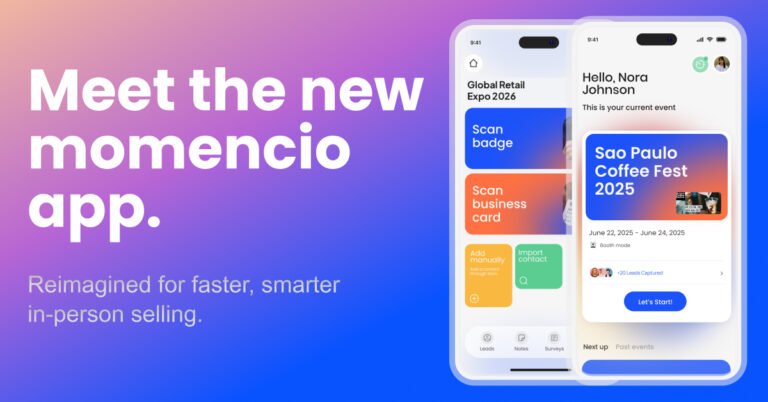
That broader view lines up strongly with the internal momencio positioning materials, which argue that event success depends on covering the whole journey rather than isolating one function such as badge scanning. The platform description emphasizes lead capture, personalized engagement, notes, follow-up, and CRM sync as parts of one connected flow, not separate tasks.
It also aligns with what the market is signaling. Forrester’s 2024 B2B event findings show that event marketers are focused on follow-up, year-round engagement, and proving ROI, which all require stronger coordination between event technology and downstream revenue operations.
So a useful way to define sales enablement at events is this: it is the operational bridge between event engagement and sales execution. Without it, leads are captured. With it, leads are qualified, prioritized, routed, and acted on.
Why speed and context drive post-event conversion
One of the most overlooked truths in event marketing is that timing and relevance matter more than volume. A fast, useful follow-up can create momentum from a five-minute booth conversation. A slow, generic follow-up can erase the value of a high-quality interaction.
Speed matters because buyer attention decays quickly. According to InsideSales, conversion rates can jump more than 8x when lead response happens within the first five minutes instead of later in the day. While that research is broader than events alone, the lesson is highly relevant in a trade show context: the more time passes, the weaker the memory and the lower the urgency.
Context matters because follow-up without specificity sounds the same as every other vendor email. “Great meeting you at the event” is easy to ignore. A message that reflects the real conversation, references the exact need discussed, and includes the right next step is much harder to dismiss.
This is where many event programs fall short. They export leads quickly enough, but not intelligently enough. Sales gets names without buyer signals. Reps know who stopped by, but not why. There is no record of what content was shared, what objections came up, or whether the attendee was evaluating now or later. As a result, follow-up is fast in a technical sense but weak in a commercial sense.
The internal persona files clearly anticipate this challenge. Sales and marketing professionals are described as wanting a platform that does more than capture leads. They want strategic insights, intelligent follow-up, and a more streamlined funnel. Event planners and field marketers are similarly focused on real-time analytics, lead nurturing, and maximizing post-event outcomes.
That combination of speed plus context is where sales enablement at events becomes a real differentiator. It helps teams follow up while interest is still warm and makes the outreach specific enough to feel relevant. That is what moves event contacts closer to opportunity status.
How CRM integration turns event activity into pipeline
Event data only becomes commercially useful when it joins the rest of the revenue system. That is why CRM integration is not a technical nice-to-have. It is one of the biggest factors separating event programs that influence pipeline from those that only generate reports.
If lead data enters CRM late, incompletely, or without context, the sales team starts behind. Ownership is unclear. Prioritization is weak. Notes are missing. Segmentation is inconsistent. Follow-up depends on rep effort rather than system design. The event may have gone well, but the revenue motion after the event becomes fragmented.
Forrester has highlighted this challenge directly. One widely cited data point from its event research is that only 21% of enterprises have fully integrated their event platform into their broader tech stack. That helps explain why so many teams struggle to measure event ROI and activate event data efficiently.
This aligns closely with your internal documentation, which repeatedly centers CRM integration, lead management, and event-to-sales continuity as core needs across target audiences. Business development executives want better pipeline visibility and stronger relationship management. Event marketers want streamlined post-event engagement. Sales teams want fewer disconnected systems and better lead handoff.
A well-integrated workflow changes what teams can do after the event. It allows lead scoring based on real interaction data. It makes routing rules immediate. It helps managers see which event conversations are progressing and which ones are stuck. It connects event influence to opportunity creation and downstream revenue reporting.
That is why sales enablement at events should always include CRM strategy. Without it, the event remains an isolated activity. With it, the event becomes part of pipeline creation.
What high-performing event teams do differently
The strongest teams do not just capture more leads. They design the event around conversion.
They define what a qualified interaction looks like before the show starts. They train booth staff to capture a small set of meaningful data points instead of relying on memory. They prepare role-specific and use-case-specific content in advance. They align with sales on routing rules and follow-up timing. They review event performance using revenue signals, not just traffic numbers.
They also recognize that sales productivity is fragile. HubSpot reported that in 2023, sales professionals spent just two hours a day actually selling and about one hour a day on administrative work. That means every extra manual event task eats into the part of the day that should be spent moving deals forward.
Three practical tips stand out here.
The first is to measure quality, not just quantity. Scan totals are useful, but qualified conversations, high-intent follow-ups, and opportunities influenced are more meaningful.
The second is to make follow-up easier than delay. The right workflow should reduce admin friction so that reps can act immediately.
The third is to treat event content as a selling asset, not a collateral library. Relevant content at the right moment increases the odds that an event conversation turns into a serious next step.
Interesting facts from research
- Forrester’s Q1 2024 State of B2B Events Survey found that 92% of event marketers planned to improve post-event attendee follow-up, and 77% were focused on year-round attendee engagement.
- InsideSales reports that conversion rates can be more than 8x higher when lead response happens within five minutes.
- HubSpot reported that sales professionals were spending only two hours a day selling and around one hour a day on administrative tasks.
Conclusion
Badge scanning still has value, but it should not define event success. The teams that get more from events are the ones that build a full selling workflow around every interaction. They capture context, enable relevant conversations, follow up quickly, sync data into CRM, and measure outcomes that matter to revenue.
That is why sales enablement at events changes everything. It shifts the focus from collecting contacts to creating momentum. It helps event teams prove value in a language sales leaders care about. And it gives companies a better way to turn face-to-face engagement into real pipeline.
FAQs
- What is sales enablement at events?
- It is the process of helping event and sales teams turn event interactions into qualified follow-up, better lead prioritization, and pipeline movement through stronger context, content, workflows, and CRM visibility.
- Is badge scanning still important?
- Yes. It is useful for fast contact capture. It just is not enough on its own to support qualification, prioritization, and conversion.
- Why is post-event follow-up so important?
- Because intent fades quickly. Faster and more relevant follow-up increases the odds that a prospect continues the conversation.
- Why does CRM integration matter for event ROI?
- Because event data needs to become actionable inside the broader revenue process. Without integration, leads stay siloed and reporting stays shallow.
- Who benefits most from this approach?
- Event planners, field marketers, sales teams, and business development leaders all benefit because they all need events to produce measurable business outcomes.
If your current event workflow stops at badge scans, you are only capturing a fraction of the opportunity. momencio helps teams connect lead capture, follow-up, engagement, and CRM visibility into one event-to-revenue process. Book a demo to see how momencio supports a stronger sales enablement strategy before, during, and after every event.