In 2002, the Oakland Athletics were one of the poorest teams in Major League Baseball. They had lost three of their best players to richer clubs and had less than a third of the New York Yankees’ budget to replace them. What happened next is now well documented. But the part that gets summarized too quickly is the specific thing that changed. The A’s did not suddenly acquire better data. Baseball had been generating data for over a century. What changed was the question they were asking. Every other team was asking: who is the best player? The A’s started asking: what actions on the field actually lead to scoring runs? The same data. A different question. A completely different outcome.
B2B event teams are in a version of the same situation. Badge scans, business card captures, CRM records, follow-up emails — the data has been accumulating for years. But most teams are still asking the wrong question. They are asking: how many leads did we get? The question that produces a different outcome is: what did each conversation actually tell us about this buyer, and what should happen next because of it?
That is what an event intelligence playbook is. Not a process for collecting more. A process for making what you collect mean something. This article is that process, organized into six layers — each one a decision your team makes before, during, or after an event that determines whether a conversation becomes pipeline or becomes a cold contact in a spreadsheet.
Layer 1: Design your capture before the event starts
The quality of your event intelligence is decided before a single badge is scanned. Most teams do not think of it this way. They build the capture form the week before the show, load the qualification questions they used last time, and brief the booth staff on the morning of day one. The result is a dataset that reflects what was easy to configure, not what the sales team actually needs.
Designing capture means making three decisions in advance. First: what does a complete lead record look like for your sales team? Not what fields your app supports — what a rep needs to open a record and immediately know what to say. That means conversation context: the problem the prospect mentioned, the buying stage they disclosed, the objection they raised, the timeline they indicated. Second: what content are you presenting at the booth, and are you configuring your system to track which assets each person engaged with? Content engagement is a signal. If you are not logging it at the moment of interaction, you have lost it. Third: what qualification criteria separate a sales-ready conversation from a general interest contact? Those criteria should be built into your qualification questions before the show opens — not inferred from badge scan data after it closes.
The output of this layer is not a lead. It is a lead architecture: a structured record that your platform can score, your reps can act on, and your marketing team can use to personalize follow-up. Everything downstream depends on getting this right.
For context on why the capture layer sits inside a broader intelligence architecture, see the event intelligence stack.
Layer 2: Capture context at the moment of conversation, not after
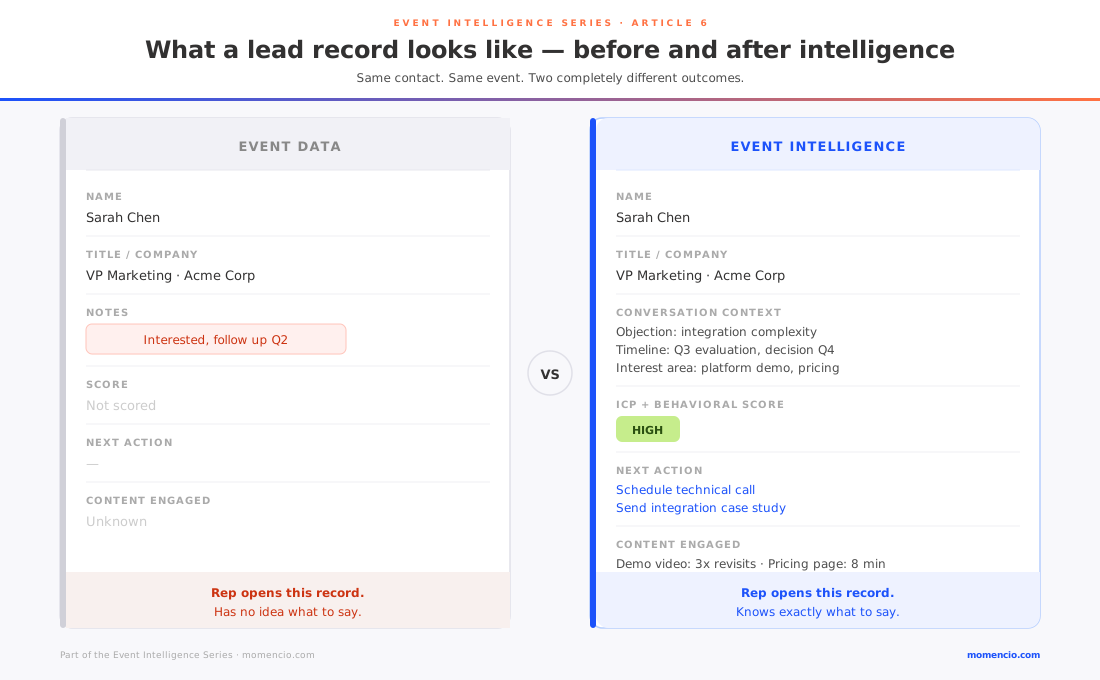
A badge scan is an identity record. It tells you who was standing at your booth. It does not tell you what they said, what worried them, what they were evaluating, or why they stopped. The gap between those two things is the gap between event data and event intelligence.
The only moment you can capture conversation context accurately is during the conversation. Not in the debrief at the end of the day. Not in the hotel room that night. During. Memory degrades fast on a trade show floor — by the time a rep has spoken to forty people, the nuances of conversation three are gone. What remains is a vague sense that someone was interested.
Intelligence-grade capture looks like this: qualification answers logged against the lead record, not stored separately. Voice notes dictated in real time — thirty seconds after the conversation ends, while the rep moves to the next person. Content logged automatically — which assets were presented, which ones the prospect spent time on, which ones prompted questions. Conversation tags applied at the point of interaction: buying stage, objection type, product interest, urgency level.
What it does not look like: a note field that says “interested, follow up Q2.” That is not context. That is a placeholder. It tells a rep nothing about what to say when they call.
The discipline this layer requires is not technical. The platform supports all of it. The discipline is behavioral: training booth staff to treat the capture device as an intelligence tool, not a badge scanner with extra steps. That behavioral shift is the hardest part of building this layer — and the most consequential.
Layer 3: Trigger follow-up before the event ends
The behavioral window — the period in which a prospect is most likely to re-engage with your content — opens the moment the booth conversation ends. Most teams do not act on it until two days after the show closes, when they send a batch follow-up email to everyone on the lead list.
By that point, the prospect has spoken to fifteen other vendors, attended three sessions, flown home, and cleared their inbox. Your follow-up arrives as one of many. It references a conversation they half-remember. It links to a generic landing page or your homepage. It reads like every other follow-up they received.
An intelligence-led process works differently. The personalized follow-up goes out during the event — ideally during the conversation, or immediately after it. The LiveMicrosites™ are built from the content the prospect actually engaged with at the booth, not from a default template. The follow-up email references the specific conversation: the problem they raised, the product area they asked about, the next step they indicated.
This timing decision has a compounding effect. The faster the follow-up lands, the sooner the behavioral tracking begins. Every open, every revisit, every minute spent on a page is a signal. And the earlier those signals start accumulating, the more intelligence your platform has to work with when it scores the lead.
The playbook decision here is not just timing. It is personalization depth. A follow-up that goes out in thirty minutes but links to a generic page is better than a two-day delay — but not by much. The follow-up that goes out in thirty minutes and lands in a microsite built around that specific conversation is the one that re-engages.
Layer 4: Read signals, not your calendar
Post-event follow-up in most B2B organizations is calendar-driven. Day three: check in email. Day seven: share a case study. Day fourteen: try a call. The intervals are not based on any signal from the prospect. They are based on a general theory about what a reasonable follow-up cadence looks like.
The problem with calendar-driven follow-up is that it ignores what the prospect is actually doing. A lead who goes silent for six days and then revisits the microsite on day seven is not a day-seven lead. They are a right-now lead. The signal has fired. The action should follow the signal, not the schedule.
This is what real-time activity tracking makes visible. Through IntelliStream™, every behavioral event is logged and surfaced as it happens: microsite revisits, time spent per asset, content downloads, return visits after a period of silence, engagement with specific pages. Alerts fire when a lead re-engages. The rep does not need to log in and check a dashboard. The intelligence comes to them.
Reading signals rather than following a calendar requires a shift in how follow-up is briefed to the sales team. Instead of a sequence, you are giving reps a set of triggers and the actions that should follow each one. A return visit to the pricing page after four days of silence is a different trigger than a download of a technical datasheet. Each one warrants a different response — and event dashboards make both visible in real time.
This layer is where the gap between event data and event intelligence becomes most concrete. The data — the visit log, the asset engagement record, the time-on-page metric — is the same in both cases. What makes it intelligence is the process that routes it to a rep at the moment it is actionable, with enough context to know what to do with it.
For a deeper look at how this connects to the broader sales function, see event intelligence and sales enablement.
Layer 5: Let behavioral scoring rank your pipeline, not rep intuition
Every rep leaves an event with a mental ranking of the leads they captured. The ones who were warm in the conversation sit at the top. The quiet ones who asked careful questions sit lower. The ones who seemed disengaged are at the bottom.
That ranking is based on in-person energy. It is not based on post-event behavior — which is the only behavior that actually predicts buying intent.
Behavioral scoring through AI IntelliSense™ produces a different ranking. It evaluates each lead against your ICP profile and against the full record of post-event engagement: revisit frequency, time per asset, content depth, return behavior after silence. The rep who seemed enthusiastic at the booth but never opened the follow-up email ranks lower. The prospect who asked three questions and said little, then came back twice and read three case studies, ranks higher. The scoring is based on what people do, not how they presented at the event.
The output is not a number. It is a prioritized action queue — a ranked list of leads with the context a rep needs to act on each one. Which content drove re-engagement. Which objection was raised. What the ICP fit score is. What the suggested next step is.
Deploying this layer well means briefing your sales team on how the scoring works and why the ranking may differ from their own read of the room. That conversation is worth having explicitly. Reps who understand the scoring logic use it. Reps who do not understand it revert to their own intuition — which defeats the purpose.
For context on how lead scoring integrates with event-sourced data, see the full scoring methodology.
Layer 6: Compound intelligence across events
A single event’s intelligence has a shelf life. Six weeks after the show, a scored lead with full conversation context is still useful — but the urgency has faded, the behavioral window has largely closed, and the rep has moved on to new pipeline.
What does not fade is the pattern. An account that engaged at one event, went quiet, and then showed up at a second event three months later is sending a signal that a single-event view will never reveal. They are in a long evaluation cycle. They are researching the category seriously. They are not a cold contact — they are a warm account that has been accumulating evidence.
Compounding intelligence means connecting the data across events rather than treating each one as a fresh start. The same contact touched at two trade shows tells a different story than a new contact at one. The same account represented by three different attendees across a conference season tells a different story still.
This layer is operational, not just strategic. It requires that every event flows into the same CRM structure, that lead records are linked at the account level, and that multi-event engagement is visible in a single view. When it is, the conversations about event ROI measurement change. You are no longer measuring leads generated per event. You are measuring account engagement velocity across a portfolio of events — which is a much stronger proxy for pipeline impact.
Compounding is also where the difference between teams that treat events as lead generation activities and teams that treat them as intelligence programs becomes visible. The first group resets after every show. The second group builds.
The five layers of the intelligence framework that underpin this compounding view are detailed in the five layers of event intelligence.
The full picture: what the playbook actually changes
The six layers in this playbook are not six separate initiatives. They are a single connected process. Layer 1 determines what Layer 2 can capture. Layer 2 determines what Layer 3 can personalize. Layer 3 determines how quickly Layer 4 can begin tracking. Layer 4 feeds Layer 5. Layer 5 informs how Layer 6 compounds.
A team that has Layer 1 right but skips Layer 2 produces structured records with no context. A team with Layer 2 right but delayed Layer 3 loses the behavioral window before it produces enough signal for Layer 4. Each layer depends on the one before it. The playbook is sequential.
The question is not whether your organization can implement all six layers simultaneously. It probably cannot, and does not need to. The question is where you are currently stopping — and what it is costing you. Most teams have Layers 1 and 2 in some form. Very few have Layers 3 through 6 operating consistently. That gap is where the difference between event data and event intelligence lives.
Use the Event Intelligence Gap Map to identify exactly which layers your current process is missing. It surfaces the specific gaps in your playbook — not a generic recommendation, but a precise starting point.
The playbook is a decision, not a platform
The six layers in this article are supported by technology. But they are not determined by it. Every team that runs events has access to some version of universal lead capture, CRM sync, and email follow-up. The technology is not the differentiator.

What differentiates the teams that generate intelligence from the teams that generate data is a set of decisions made before, during, and after every event. The decision to design capture in advance rather than configure it the week of the show. The decision to treat conversation context as a required field rather than a nice-to-have note. The decision to send the follow-up before the day ends rather than in a batch after the show closes. The decision to act on behavioral signals rather than follow a calendar. The decision to trust a scoring model rather than rep memory. The decision to connect events rather than reset after each one.
Those decisions are the playbook. The platform executes them.
The underlying principles behind why event intelligence matters at all — and how it differs from the data most teams are currently collecting — are laid out in the series foundations: what is event intelligence and event intelligence vs. event data. And for the question of who in your organization should own this process, see who owns event intelligence inside a B2B organization.