A first conversation with a buyer is the best chance a seller gets to agree on a next step, and that chance is short. Once the buyer walks away, the conversation starts to compete with their other work, their other suppliers and a full inbox.
The most reliable way to keep it moving is to agree a specific meeting at the natural end of the conversation, before the buyer leaves. This article explains how to book a follow-up meeting: when to ask, how to ask, what to write down and what to do in the hour that follows. It applies wherever a seller meets a buyer face to face, whether that is a customer’s office, a trade show stand, a dealership or a roadshow stop.
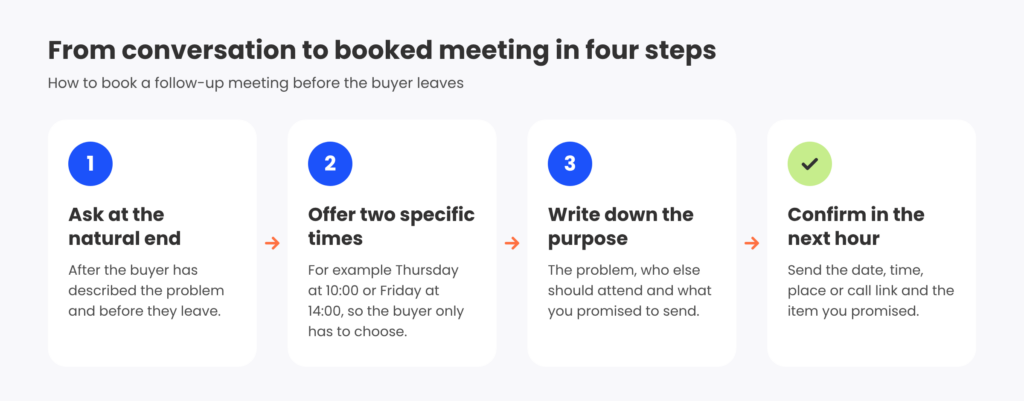
In short: Ask for the follow-up meeting at the natural end of the conversation, once the buyer has described the problem. Offer two specific times, say what the meeting will cover and ask who else should attend. Write the details down and send a confirmation the same day.
Why the meeting should be agreed in person
Two pieces of research explain why a meeting agreed face to face is more likely to happen than one arranged afterwards.
The first is about how requests land. In one study, 45 participants each asked 10 strangers to complete a short survey, using the same script, either face to face or by email. Requests made face to face were 34 times more likely to succeed than the same request sent by email. The researcher put the gap down to trust, which builds in a conversation and does not build in an email. The request in the study was a survey and not a sales meeting, but it shows how much weaker a request becomes when it moves from the conversation to an inbox.
A follow-up email that asks for a meeting is exactly that kind of request. The buyer has to decide, choose a time and reply, and the person who made the case for the meeting is no longer there.
The second piece of research is about plans. A review of 94 independent tests found that people who decided in advance when and where they would act followed through on their goals noticeably more often than people who only intended to. The goals in those tests were things like health and study habits, not sales meetings, but the principle carries over. A meeting with a date and a time is a plan, while “let’s speak soon” is only an intention.
Agreeing the meeting in the conversation also removes the scheduling exchange that would otherwise follow, and the buyer has already said yes before the first email is written.
When to ask for the meeting
The best moment to ask is the natural end of the conversation, after the buyer has said what they need and before they turn to leave. Asking earlier risks cutting across the buyer, and asking much later means the opening has passed.
Four signs show that the conversation has reached that point:
- The buyer has described a problem, a project or a deadline in their own words.
- The buyer asks about price, timing or what happens next.
- The buyer mentions another person who would need to be involved.
- The conversation slows down, or the buyer looks at the time.
If none of these signs appears, the buyer may not be ready, and the better move is to ask one more question about their situation instead of pressing for a date. If the buyer is clearly about to leave, ask anyway and keep the request brief, because a short request at the door is better than no request.
How to ask for the meeting
Three habits make the request easy to accept: offer two specific times, say what the meeting is for and ask who else should be there.
Offer two specific times
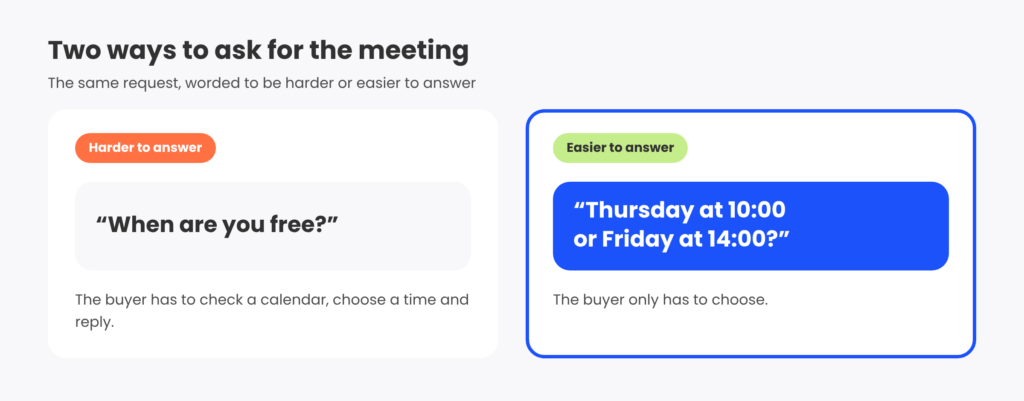
An open question such as “when are you free?” hands the buyer a scheduling task. Two specific options, such as Thursday at 10:00 or Friday at 14:00, are usually easier to answer because the buyer only has to choose. Check both options against your own calendar first, so that the choice is real.
Say what the meeting is for
Tie the meeting to what the buyer has just told you, and give it a length. A request for 20 minutes to go through a problem the buyer described a moment ago is easier to accept than a request for a general catch-up.
Ask who else should attend
Purchases rarely depend on one person. Ask who else needs to hear the answer and offer to include them. Our guide to who else is involved in the decision explains why that name matters later.
Sample wording
The examples below show the same request in three common situations. They are wording to adapt and not a script to repeat.
- At the natural end of the conversation: “It sounds like the handover between your sales and support teams is the main thing to fix. Would a 20-minute call on Thursday morning or Friday afternoon work, so that we can go through it with whoever else needs to be there?”
- When the buyer says to send an email: “Happy to send it. So that I send the right thing, could we also set aside 20 minutes next week? I will send the material before then so that you can read it first.”
- When the buyer cannot give a date: “That makes sense. Could I put a short call in for the week after the launch? We can move it if the date changes.”
What to write down so the meeting has a purpose
A booked meeting is only useful if the person who attends can see why it was booked. Record these five details while the conversation is still fresh.
| What to record | Why it matters |
|---|---|
| Date, time, length and place or call link | Confirms the plan and lets the buyer prepare |
| The problem the buyer described | Gives the meeting an agenda |
| Who else should attend | Makes sure the meeting reaches the people who decide |
| What you promised to send beforehand | Keeps a promise the buyer will remember |
| Who owns the meeting on your side | Makes one person responsible for it happening |
If the buyer declines a date, record the reason and the day on which you will ask again. That note is still useful, because it tells the next person what the buyer said no to and when to try again. Our guide to collecting information from in-person conversations covers how to capture the buyer’s own words.
What to do in the hour after the buyer leaves
The next hour decides whether the agreement made in the conversation turns into a meeting that takes place.
- Send a short confirmation with the date, the time, the place or call link and the one item you promised. A few lines are enough.
- Record the meeting where the whole team can see it, with the details from the table above.
- Brief the colleague who will attend with you, using the buyer’s own words.
- Set a reminder for the day before the meeting, so that the buyer hears from you again before the date.
A confirmation sent the same day also gives the buyer a written record to forward to the colleagues who will join.
What to count
Three numbers show whether the habit is working, and each one becomes available at a different time.
| Number | The question it answers | When you can count it |
|---|---|---|
| Meetings booked, as a share of conversations where the buyer described a need | How often does a good conversation end with a date? | The same day |
| Meetings held, as a share of meetings booked | How many agreed meetings actually take place? | After the meeting dates |
| Meetings that led to a next step | Which meetings moved a deal forward? | Weeks later |
Start with the first number, because it is the earliest sign of whether the team is asking at all. Keep the three records separate. A booked meeting, a held meeting and its outcome are different events, and combining them hides the point at which deals stall. Our guide to connecting field activity to revenue explains how to carry them through to closed deals.
How momencio helps
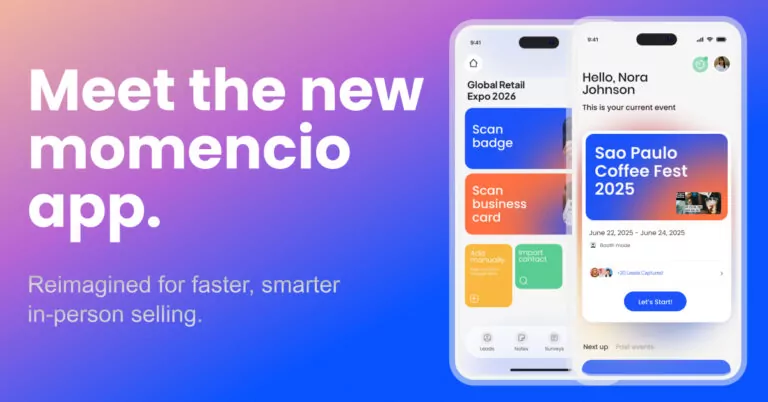
momencio is a Field Revenue Intelligence platform for teams that sell in person. Its redesigned app, available since September 10, 2026, includes several features that support the steps in this article.
- Meeting booking: Representatives can book a meeting directly from momencio while the buyer is still there.
- In-session qualification: Representatives can identify lead quality, apply Quick Tags, capture signals, add notes and take the next action, so the reason for the meeting stays with the contact.
- Live reporting: The live dashboards let teams track leads captured, sessions completed, surveys filled, meetings booked and progress toward sales goals in real time.
- Follow-up made for one buyer: Teams on plans that include LiveMicrosite can send a follow-up page made for that one buyer, with a unique link per lead.
These tools are not limited to events. As the page for sales managers explains, representatives can capture leads at meetings, in showrooms and on field visits using the same workflow.
Frequently asked questions
- When is the best time to book a follow-up meeting?
- Ask at the natural end of the first conversation, after the buyer has described the problem and before they leave. At that point the buyer has just explained why a meeting would be useful, so the request follows from what they said.
- How long should a first follow-up meeting be?
- Twenty minutes is a good starting length. A short request is easier to accept, and the meeting can run longer if both sides want to continue.
- What should I do if the buyer says to email them?
- Agree to send the material, then ask for a short meeting after the buyer has had time to read it, and propose a date. Sending the material first gives the buyer a reason to say yes to the meeting.
- Should I still send an email after the meeting is booked?
- Yes. Send a short confirmation the same day with the date, the time, the place or call link and any item you promised. It gives the buyer a written record that can be forwarded to colleagues.
- How do I know whether the habit is working?
- Count meetings booked as a share of conversations where the buyer described a need. It is the earliest number available, and it shows whether the team is asking at all.
The bottom line
A follow-up meeting is easiest to agree while the buyer is still in front of you. Ask at the natural end of the conversation, offer two specific times, say what the meeting is for, write the details down and confirm them the same day. Then count how often good conversations end with a date, because that number shows whether the habit is spreading through the team.
Want to see how a representative books a meeting from the momencio app before the buyer leaves? Book a demo.