A field conversation can open an opportunity, help an existing deal move forward, or end without a next step. A useful revenue report needs to preserve those differences. Matching a contact to a closed deal establishes a connection; understanding the field team’s contribution takes more work.
Field marketing attribution connects recorded field interactions to opportunities and closed revenue, then assigns credit under a defined set of rules. It gives marketing and sales a shared way to account for their work. Proving that an activity created revenue that would otherwise not exist requires a separate kind of evidence.
For teams working from capture to close, the starting point is a traceable record of the conversation, the buyer’s response and the deal that followed.
Agree on what the revenue number means
Before building a dashboard, agree with sales and revenue operations on the claims each metric supports. An event appearing in a deal’s history and an event receiving a share of its revenue are different measurements.
| Measurement | What it establishes | How to report it |
| Field-linked pipeline | A qualifying field interaction is associated with an opportunity. | Show the qualifying interaction and count each opportunity once in the total. |
| Field-sourced pipeline | The opportunity meets your documented rule for originating through a field activity. | State the source rule and the evidence used to apply it. |
| Attributed closed revenue | A model assigns a share of a won deal’s value to eligible field interactions. | Name the model, reporting window and revenue basis. |
| Incremental revenue | A credible causal analysis estimates revenue added by the activity. | Report the method, uncertainty and scope of the estimate. |
Treat “field-influenced pipeline” as an association metric unless the analysis supports a stronger claim. Decide whether it includes field-sourced opportunities, and make that overlap visible. Adding both figures together can count the same opportunity twice.
For a practical source rule, require a documented link between the field conversation and opportunity creation, with sales confirming the origin. A newly captured contact alone is insufficient: the account may already have an open deal.
Preserve the conversation before handing it over
Start with the information needed to identify the person, understand the interaction and assign the next action. Keep the capture process short enough to complete while the conversation is still fresh.
Record the activity identifier and date, contact and company, rep, buyer’s stated need, qualification outcome, and agreed next step. Where no next step was agreed, record that explicitly. Mark unresolved information as unknown so it can be reviewed later.
With momencio’s universal lead capture, reps can capture contact details and attach notes or tags to the lead record. That creates a place to preserve the context sales will need after the handoff.
Keep seller actions and buyer responses distinguishable. Sending information, receiving a reply and holding a requested meeting are separate events in the record. This is also a useful discipline for field sales activity tracking: a completed seller task should not automatically become evidence that a buyer progressed.
Connect the interaction to the right opportunity
Have revenue operations map the captured fields into the CRM before the program begins. Match the person to the correct contact and company, then have the opportunity owner confirm which deal the interaction concerns.
Preserve a dated activity record alongside the contact. Updating a contact’s latest event field should not erase their earlier interactions. When an account has several opportunities, associate the activity with the relevant deal rather than applying it to every opportunity at that company.
Separate opportunities that existed before the interaction from those created afterward. Keep the stage at the time of the interaction so later reports can show what changed. For implementation detail, use a defined CRM mapping process that preserves context as well as identity.
Check the reporting system’s requirements, too. HubSpot’s revenue attribution requirements include a closed-won deal, an associated contact, and populated amount, create-date and close-date properties. Its native revenue attribution reports require Marketing Hub Enterprise. A synced contact is therefore only part of the reporting setup.
Review unmatched records separately from correctly matched accounts with no opportunity. The first group needs a data check; the second may accurately describe the commercial outcome.
Follow the buyer response through to the outcome
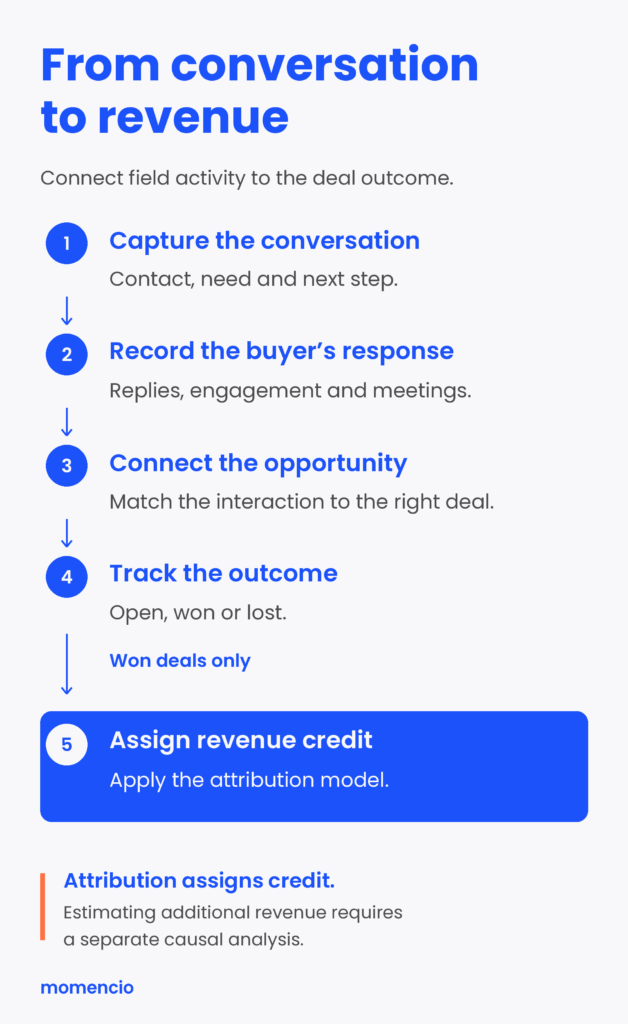
After the handoff, record the owner’s response and the next agreed action. Keep the buyer’s reply or meeting outcome alongside the original need so another rep can understand why the conversation is continuing.
momencio’s LiveMicrosite provides a personalized content page with a unique link per lead and engagement tracking. Those records can help sales see which material received attention and choose a relevant follow-up. A tracked visit is an engagement signal; the opportunity stage should reflect the team’s qualification criteria.
As the deal develops, retain stage-change dates and outcomes, including closed-lost. A report that follows only won deals cannot show how often field-linked opportunities failed to convert.
For open opportunities, report progress as observed: the stage changed, another stakeholder joined, or a next meeting took place. A shorter time to close is a comparison to investigate. The sequence alone does not establish that the field activity accelerated the deal.
Build a report that sales and finance can reconcile
Use field marketing attribution to answer a defined question about a defined group of accounts or opportunities. Keep the inclusion rules visible so the result can be reproduced.
Build the report around these checks:
- Separate newly sourced opportunities from existing opportunities with qualifying field interactions.
- Count distinct opportunity IDs when totaling pipeline across events and field programs.
- Choose one value basis with finance, such as contract value or annual recurring revenue, and use it consistently. A CRM closed-won amount is not automatically recognized revenue.
- State the activity dates, attribution window and outcome cutoff. Compare programs at equivalent ages so older programs do not receive more time to produce wins.
- Report open, won and lost outcomes, alongside unresolved records and known tracking gaps.
If you allocate revenue across interactions, ensure the credits within that allocation reconcile to the deal’s value. Full deal values shown against multiple influencing programs should be labeled as overlapping views.
Choose the attribution model before reviewing which model gives the field team the most credit. Keep it stable for the reporting period; if you change it, show the effect of that change separately from changes in performance. The event-specific mechanics are covered in momencio’s guide to trade show attribution.
Test additional revenue when the decision requires it
Attribution describes credit within the observed buying journey. Incrementality asks what would have happened without the activity. Google’s explanation of conversion lift illustrates the distinction through an advertising experiment comparing treatment and control groups. That tool measures ads; applying the principle to field programs needs its own study design.
For a repeatable field program, work with an analyst to assess whether account-level random assignment is feasible. Define the eligible accounts, intervention, outcome and observation period in advance. Analyze assigned groups, record crossover between them, and check whether the sample can support a useful conclusion.
Scope the claim to the intervention tested. An invitation test estimates the effect of that invitation strategy, not attendance itself. Comparing attendees with nonattendees cannot by itself remove differences in their existing buying interest. Report uncertainty, including an inconclusive result.
Make the connection useful to the field team
The record should help the next conversation as well as the next report. Sales needs to see what the buyer cared about, what information was shared and what happened afterward. Field marketers need to see which conversations became opportunities and where follow-up ended.
momencio supports that workflow through capture, qualification, personalized follow-up and engagement visibility. Its HubSpot integration syncs contacts, activities and notes into the CRM. Revenue operations still needs to verify deal associations and reporting rules so the captured activity can be interpreted correctly.
At the next pipeline review, open the underlying opportunity records alongside the totals. Use the original conversation and subsequent responses to decide what sales should do next, and carry those findings into the next field program.
Frequently asked questions
- What is field marketing attribution?
- Field marketing attribution connects recorded field interactions to opportunities and revenue, then assigns credit using defined rules. It depends on accurate activity records, contact and deal associations, and a stated attribution model and reporting window.
- What is the difference between field-sourced and field-influenced pipeline?
- Field-sourced pipeline meets your documented rule for opportunities originating through field activity. Field-influenced pipeline includes opportunities associated with qualifying field interactions, potentially including existing deals. State whether sourced opportunities are included in the influenced total to prevent double counting.
- What data connects field activity to closed revenue?
- The connection requires a dated field interaction, the correct contact and account, the relevant opportunity, and its final status and value. Conversation context and follow-up records explain the contribution. The reporting system determines which interactions are eligible for revenue credit.
- Does revenue attribution prove that a field activity caused a sale?
- No. Attribution assigns credit to recorded interactions. Establishing causation requires a credible estimate of the outcome without the activity, supported by an appropriate experimental or causal analysis.
- How long should the attribution window be?
- Set the window using your observed sales cycle and the question being measured. Distinguish the period in which interactions qualify for credit from the date when outcomes are reviewed. Compare programs with equivalent follow-up time and continue reporting opportunities that remain open.
- How does momencio support field revenue intelligence?
- momencio captures lead and conversation data, supports personalized follow-up, tracks engagement and syncs information with CRM systems. Connecting those records to opportunities and outcomes gives field and sales teams a basis for action and reporting. Revenue conclusions depend on the underlying data and measurement rules.