Exhibiting takes 40.8% of the average exhibitor’s marketing budget, making it the single largest line item most B2B marketing teams buy, according to CEIR’s 2026 Marketing Spend Decision Report. The same report points to a gap between what event teams track and what their leadership judges them on, with management weighing lead volume and post-show closed deals above everything else.
That gap is where trade show budgets get cut. The show worked, the conversations were good, and nobody could put it on a report that finance would accept.
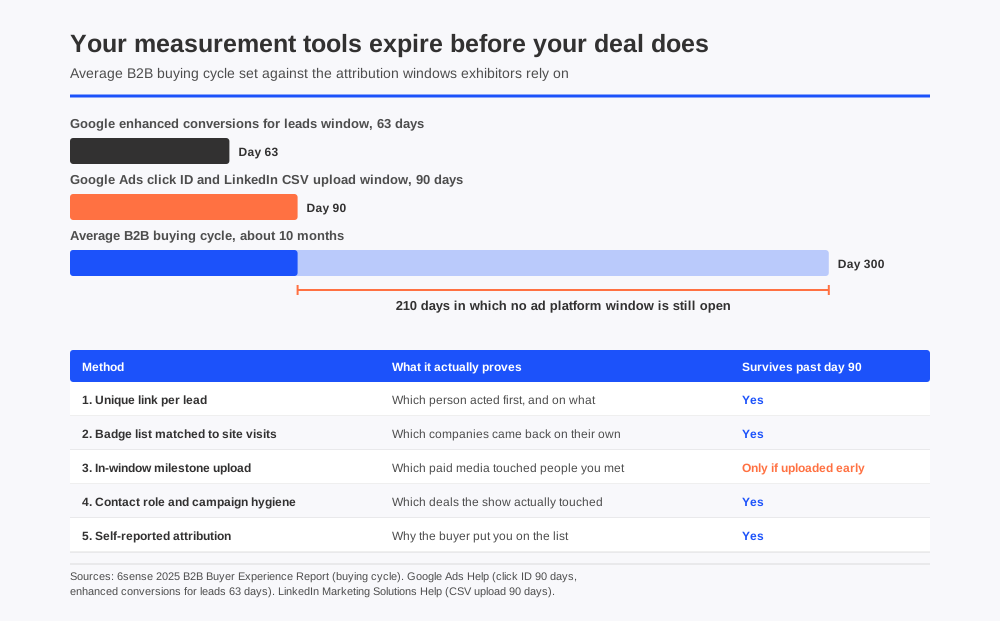
Trade show attribution has a mechanical problem, and booth quality has nothing to do with it. 6sense’s 2025 Buyer Experience Report puts the average B2B buying cycle at roughly ten months. Google Ads keeps a click ID for 90 days and rejects enhanced conversions for leads uploaded more than 63 days after the associated click, while LinkedIn will not process a CSV conversion row dated more than 90 days back. Your measurement tools expire about seven months before your deal does.
Here is the part most teams have backwards. Every other channel in B2B forces you to guess at identity from cookies and IP ranges. A trade show simply hands it to you, in the form of a verified person, an exact timestamp, and a recorded reason they cared.
That identity usually gets thrown away inside the first week after the show. The five methods below put it back, and each one works against a different part of your stack.
Why trade show attribution breaks and the model is rarely the reason
The standard response to a disappointing event report is an argument about attribution models, usually some version of first touch against last touch against full path. That argument is almost always the wrong one to be having, because three things break underneath the model before the model ever gets a chance to be wrong.
The identity gets flattened. A badge scan carries an email, a company, a title, a rep, a timestamp, and often a note about what the person asked. By the time it reaches the CRM it has frequently been reduced to a name and an email address sitting in a list called Show Leads Q3.
The timing does not line up. The deal closes ten months out, and the ad platforms stopped remembering the click after three months.
The CRM plumbing never fires. This one costs teams more revenue credit than the other two combined, and it gets its own section further down.
Fix those three and the model you choose stops mattering very much. Good event ROI measurement is mostly a plumbing exercise wearing a statistics costume.
1. Give every booth conversation its own tracking link
A shared follow-up link tells you that somebody from the show clicked something. A link that belongs to one person tells you that Priya from Acme, who spoke to Dan at 2:40pm on Wednesday about data residency, opened the security overview twice on Friday and came back to it again the following Tuesday.
The first online action after an offline conversation is the most valuable data point in event measurement, because it is the only one you can prove without modeling anything. A unique link per lead makes that first action deterministic. Everything after it is inference, and inference is what CMOs discount.
Event platforms handle this automatically, and it is what LiveMicrosites™ inside momencio are built for, generating a separate trackable link per lead that stays editable after it has been sent.
If you are working with parameters you build by hand, the pattern that survives a CRM import looks like this:
- utm_source is the show itself, never the word “event”
- utm_medium separates a scanned badge from a booked meeting from a session attendee
- utm_campaign matches your CRM campaign name character for character
- utm_content is the rep
- utm_term is the topic of the conversation
That last one is the parameter almost nobody sets, and it is the one that changes budget conversations. It lets you tell your CMO which message earned the revenue rather than only which show did. Two events can produce identical lead counts while only one of them produces conversations about a problem you can actually sell into.
2. Match your badge list against companies already visiting your site
Somewhere between 97 and 98 percent of B2B website visitors leave without filling in a form. Company-level identification tools resolve part of that traffic back to a named business by matching IP ranges against firmographic databases, and Leadfeeder puts the realistic 2026 benchmark at 10 to 40 percent of total traffic, with around 45 percent across its own customer base.
Person-level identification is considerably weaker than the marketing around it suggests. Realistic match rates sit in the 5 to 20 percent range against advertised figures of 40 to 70 percent, and remote work has eroded IP matching further.
The method is a join, and it takes an afternoon. Export the email domains from your badge scans, pull the list of companies your identification tool saw on the site in the 30, 60 and 90 days after the show, and match the two on domain.
What you get is a return rate, meaning the share of companies you met at the booth that came back to your website without anyone asking them to. This is coverage evidence rather than credit assignment, and presenting it as the latter will get you caught. It answers the question a CMO actually asks first, which is whether the room was full of the right companies.
Run the same join across the 90 days before the show and you have a baseline. A company that never visited before the show and visited four times after it is a very different story from one that was already researching you and would have shown up anyway.
State the match rate on the slide. A number presented as complete when it covers a third of your traffic will be believed once and doubted forever afterward.
3. Upload the milestone that fits inside the attribution window
Almost everyone who tries to close the loop with paid media uploads closed-won deals, and in B2B that rarely works. The reason is arithmetic rather than technique.
Google Ads keeps a click ID for 90 days. Enhanced conversions for leads rejects anything uploaded more than 63 days after the associated click. LinkedIn’s manual CSV upload will not process a row dated more than 90 days back. Against a ten-month average buying cycle, most closed-won deals are already outside the window on the day they close.
Google’s own documentation says what to do about it, which is that when the conversion happens after 90 days you should upload a different conversion event that happens inside 90 days.
So upload the earlier milestone instead. Qualified meeting booked, opportunity created, or first sales-accepted conversation all work. Give each one a value based on your historical conversion rate to revenue and send those.
Two useful things follow. The ad platforms start optimizing toward people who behave like the ones you met and qualified rather than toward form fills, and you and the demand generation team finally argue over one number instead of two.
A few details decide whether this works at all:
- LinkedIn hashes emails with SHA-256 and recommends lowercasing them first to improve match rates. Its Conversions API is explicitly built to cover leads collected in person at an event.
- Conversion category selection matters more than most people realize. Most LinkedIn categories carry a 90-day window, while Lead, Qualified Lead, Purchase and Submit Application extend to 365 days.
- Starting June 15, 2026, Google moved offline conversion imports and enhanced conversions for leads onto the Data Manager API and blocked the older Google Ads API path.
Be careful about the claim you attach to this. What it demonstrates is that paid media reached the people you met at the show, which is a narrower thing than the show having caused the revenue. A CMO who catches you blurring those two will discount everything else on the page.
4. Fix the contact role before you argue about the attribution model
If your trade show campaign reports close to zero influenced revenue in Salesforce, the attribution model is probably innocent.
Customizable Campaign Influence works by scanning active campaigns for members who also hold a contact role on an open opportunity. No contact role means no influence record. The person you met at the booth can sit inside that campaign indefinitely, and if nobody added them as a contact role on the deal, the campaign shows nothing at all.
Two further details quietly destroy event reporting.
Influence records stop being created once the opportunity closes. If your badge scans reach the CRM three weeks after the show and a deal closed in the meantime, that deal will never carry the show’s influence, no matter what model you apply afterward.
Campaign influence counts every campaign member regardless of their member status. A badge you scanned and never spoke to weighs exactly the same as a booked meeting until you build a custom model that weights campaign types differently. Custom models let you say that an in-person meeting should outweigh an email click, which is closer to how the deal actually happened.
HubSpot carries its own version of the same trap. Revenue attribution requires the deal to be associated with at least one influenced contact, and the report lives in Marketing Hub Enterprise rather than the tiers below it.
The fixes are unglamorous and they work:
- Sync badge scans into the CRM campaign during the show rather than the week after
- Make contact role creation a stage gate, so a deal cannot reach proposal with the field empty
- Keep one campaign name for the whole show and use member status to separate scanned, spoke to, meeting booked and demo requested
- Build a custom influence model that weights in-person campaign types above digital ones
Getting CRM mapping right before the show is worth more than any reporting work you do after it, because none of this is recoverable retrospectively.
5. Ask the buyer how they found you, and ask twice
Refine Labs published a study across 21.5 million dollars of closed-won revenue in which customers self-reported 53 percent of that revenue to podcasts while attribution software credited podcasts with nothing at all. Hold the exact split loosely, since it comes from one company’s dataset. The size of the mismatch is the finding that travels.
Two placements do the work, and most teams only use one.
On the form. Use an open text field rather than a dropdown. Dropdowns push people into categories you invented, and an answer of “Event” tells you nothing about which event or which conversation inside it.
At the deal stage. Ask a separate question on a qualification call and record it in its own CRM field. Something close to “what made you put us on the list in the first place” works better than asking how they heard about you, because it points at cause rather than at the most recent touch.
The two answers capture different things. The form response leans heavily toward whatever happened most recently, while the deal-stage response is closer to what actually moved the account, because the buyer has had time to think and is talking to a person rather than a form.
Both are noisy. People write “Google” when a colleague sent them a link. Treat self-reported data as a directional check on your tracked data, and when the two disagree sharply on a particular show, that is the show worth investigating rather than the number worth arguing about.
This also feeds your lead scoring in a way that pure behavioral data cannot, because a buyer telling you why they showed up is a stronger signal than a page view.
The test that would actually settle the trade show ROI argument
None of the five methods above prove causation. They prove coverage, timing and connection, which is usually enough to hold a budget through a review. Proving that a show creates revenue that would not otherwise exist takes something else, and almost nobody runs it.
Skip a show. Take one you have exhibited at for three years running, sit out a single cycle, and measure what happens to pipeline from that show’s audience segment over the following twelve months. The stronger version is an account-matched holdout with hard suppression, where the control accounts are excluded from every related campaign rather than only the one being tested.
The honest warning is that B2B conversions are rare and slow, so these tests often come back inconclusive because of sample size rather than because the channel failed. Work out whether the test can reach significance before you commit to it, based on how often those accounts convert today and how many you can put on each side of the split.
That is a large thing to propose to a CMO. It is also the only version of this conversation where you stop defending the budget and start setting it.
Common questions about trade show attribution
- What is trade show attribution?
- Trade show attribution is the practice of connecting an in-person event interaction, usually a badge scan or a booked meeting, to the pipeline and revenue that follows it. It differs from digital attribution because the first touch happens offline, so the connection has to be created deliberately rather than captured by a tracking pixel.
- Why do trade show leads show no revenue in Salesforce?
- The most common cause is a missing contact role. Salesforce Customizable Campaign Influence only creates an influence record when a campaign member also holds a contact role on an open opportunity, and influence records stop being created once the opportunity closes. Late badge sync and missing contact roles produce empty event reports far more often than the attribution model does.
- How long should the attribution window be for a trade show?
- Match it to your actual sales cycle rather than to your ad platform limits. With average B2B buying cycles running around ten months, a 30-day or 90-day window will systematically understate event performance. Report leading indicators early and pull the revenue number at 180 days or later.
- Can you upload closed-won event deals to LinkedIn and Google Ads?
- Usually not, because the deals close outside the platform windows. Google keeps a click ID for 90 days and enhanced conversions for leads rejects uploads more than 63 days after the click, while LinkedIn CSV uploads reject rows older than 90 days. Upload an earlier milestone such as opportunity created and assign it a value based on your historical close rate.
- What is the difference between event-sourced and event-influenced pipeline?
- Event-sourced means the event created the opportunity and no pipeline existed before it. Event-influenced means the event appears somewhere in the path of an opportunity that may already have existed. Influenced is always the larger number, so lead with sourced when you are talking to finance and offer influenced as context.
- Do you need attribution software to measure trade show revenue?
- No. A unique link per lead, a clean CRM campaign with contact roles filled in, and a self-reported field on your demo form will answer more questions than most attribution platforms do. Software helps once those three are working, and it cannot compensate for their absence.