
Your team is already collecting first-party intent data. Nobody in your organization is counting it.
Every guide on the subject says the same thing. First-party intent means website visits, content downloads, email opens, ad clicks, product usage. Behavior your own digital properties can observe. Then each guide names the same ceiling: this only shows you people who already found you. Then each one recommends the same fix, which is to buy data from somebody else.
That fix skips over something obvious. A rep sitting across from a buyer, hearing what they are trying to solve and what their timeline looks like, is collecting a signal no pixel will ever produce. It comes directly from your audience, through your own relationship, with nobody in the middle. That is the definition of first-party data. It just does not arrive through a browser, so nothing in your stack records it.
What first-party intent data actually means
That directness is what makes first-party data more accurate and more legally defensible than anything you rent. But notice what the definition does not say. It does not say the data must be digital. It does not say it must be passive. It does not say a person cannot be the one collecting it.
A prospect who tells your rep they are replacing a system in Q1 has given you a first-party signal. It came from your audience, through your relationship, with no third party involved. By the category’s own standard it qualifies. It simply never enters the systems where intent is measured.
The definition narrowed to whatever a pixel could see
This happened for a practical reason rather than a philosophical one. The tools that popularized intent data were built to read web behavior, because web behavior is what software could observe at scale in 2015. The definition then hardened around the collection method rather than around the principle.
The most telling evidence comes from inside the category. Bombora, which runs the largest B2B intent cooperative in the market, lists offline event participation and insights from sales conversations among first-party intent sources on its own definition page. The biggest name in intent data concedes that these signals exist and count. It then moves on, because there is no obvious way to collect them at scale.
That concession is the whole opening. The category agrees the surface is real. Nobody has built the workflow.
A conversation is a first-party source
Gartner’s widely cited finding is that B2B buyers spend roughly 17% of the purchase journey meeting with potential suppliers. This number is usually used to argue that most buying happens invisibly, so you need digital tracking to see it.
Read it the other way. That 17% is the only stretch of the journey where a buyer is talking to a human being, answering questions, reacting to what they hear, and telling you things they will never type into a search bar. It is the highest-signal window in the entire process, and it is the one window that almost no revenue team instruments.
The dark funnel argument makes the same point from a different direction. Research popularized by Chris Walker found that the large majority of revenue came through channels that attribution software credited with nothing, including peer conversations and recommendations made in rooms no tracking pixel will ever enter.
Everyone agrees these conversations drive revenue. Almost nobody captures what happens inside them.
Why buying more third-party data does not fix this
The standard recommendation, buying third-party data, solves a different problem than the one you have here. It finds accounts researching your category before they know you exist, which is genuinely useful at the top of the funnel.
It does not help with a person who has already met you. It also carries the noise problem every vendor acknowledges, because a company reading about your category might be a buyer, a competitor, a journalist, or somebody studying for a certification. Surge scores tell you something is happening at an account. They rarely tell you who, or why, or whether the interest is real.
The person your rep spoke to last Tuesday has none of those ambiguities. You know their name, their role, their company, and what they said they were trying to solve. Buying a signal about their employer, from a vendor, at a monthly cost, when you already have a better signal sitting in a notebook, is an odd way to solve the problem.
What an in-person conversation actually produces
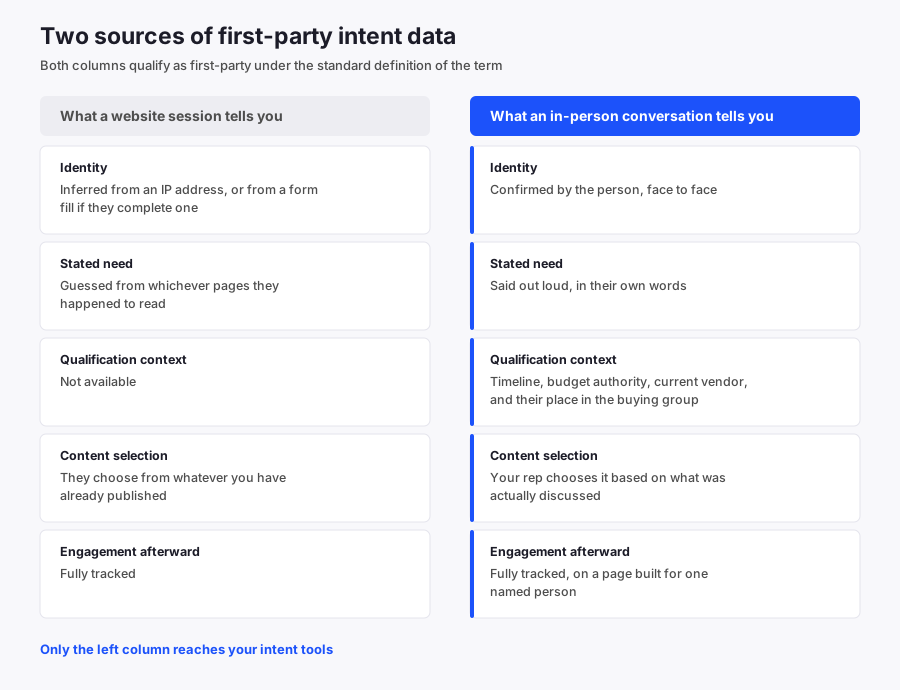
Broken into its parts, a single meeting generates more usable signal than most digital sessions. It starts with identity, meaning a confirmed name, role, and company given willingly rather than inferred from an IP address. Then comes stated need, which is the problem described in the buyer’s own words, and no digital source produces that.
Underneath both sits qualification context. Timeline, budget authority, incumbent vendor, and where the person fits in the buying group. Reps hear this constantly and it rarely survives the trip back to the CRM.
There is a fourth signal that gets overlooked because it comes from your own side. What the rep chose to send afterward is itself data, since the selection encodes what the rep understood the person to care about.
Then there is what happens after the meeting. What the person opened, how long they spent, what they came back to, and who else at their company looked at it. This part is fully trackable and behaves exactly like the website signals your stack already knows how to score.
That last one is the bridge. Once a rep sends something specific to a specific person, everything after that is measurable in the same way a web session is. The conversation supplies the context. The follow-up supplies the behavior.
Making conversation signals structured enough to act on
The reason this data does not reach your systems is not that reps are careless. It is that the capture method fights them. Typing notes into a CRM field during or after a meeting is slow, and free-text notes cannot be scored or routed even when they get written.
Three things have to be true for conversation signals to become real intent data.
Capture has to take seconds, not minutes, and it has to work in the room rather than at the end of the day. Voice notes that transcribe automatically clear this bar. Long forms do not.
The output has to be structured. A scoring model cannot read a paragraph. It can read a field. What gets captured needs to land in consistent places so it can be compared across leads and across reps.
The follow-up has to be trackable at the individual level. A generic link tells you nothing. A unique destination built for one person tells you what they opened, what they returned to, and when they went quiet.
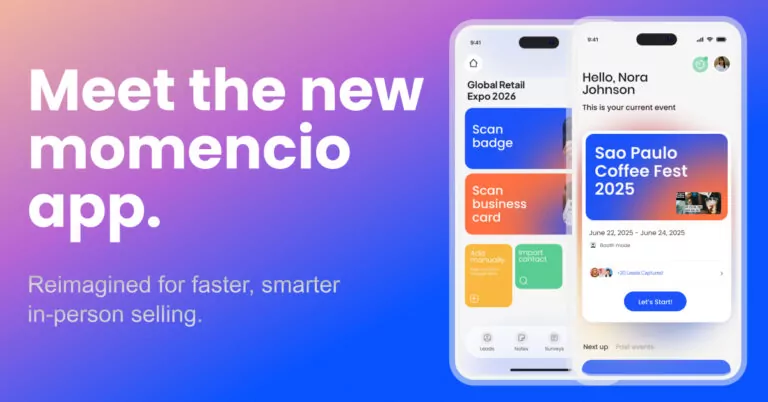
This is the workflow momencio is built around. A rep captures the contact and adds voice notes that transcribe and attach to the record. LiveMicrosite generates a follow-up page specific to that person, holding the content the conversation actually called for, editable afterward without resending anything. IntelliStream then tracks opens, views, downloads, and return visits on that page. AI IntelliSense reads the combination of stated context and observed behavior and assigns an intent level, an urgency flag, and a next action, then syncs the whole record to Salesforce or HubSpot.
The result is a first-party intent signal that started with a person talking to a person.
Where this sits next to the intent tools you already run
This is an additional source rather than a replacement. Third-party intent still finds accounts you have never met. Website intent still tells you when a known account starts reading your pricing page.
Conversation intent covers the segment neither one reaches, which is people who have met you, told you what they need, and have not yet done anything online that your systems can see. For teams doing meaningful field selling, that segment is often the highest-value one in the pipeline and the least visible.
Practically, it should feed the same lead scoring model as everything else. A stated Q1 timeline should carry weight. Three return visits to a pricing page inside a personalized follow-up should carry weight. Both belong in the same score, routed through the same CRM workflow, rather than sitting in a separate system nobody opens.
Where to start
Take the last twenty meetings your field team ran and ask what survived. In most organizations the answer is a name, a company, and a follow-up email that went out three days later with a generic attachment.
Everything else the buyer said is gone. That is not a data problem or a tooling budget problem. It is a capture problem, and it is the largest untouched source of first-party intent most B2B companies own.
The signals are already being generated. The only question is whether anything records them.