Your sales enablement stack is well-built. Content is organized. Playbooks are current. Outreach sequences are loaded. But when a rep returns from a trade show and sits down to follow up, the enablement system gets almost nothing useful. The CRM record says “interested, follow up Q2.” That is not context. It is a placeholder. The intelligence generated in that booth conversation — the objection raised, the timeline disclosed, the content the prospect asked about — was never captured in a form the enablement system could act on. That is the gap this article addresses.
It is worth stating clearly: this is about in-person events — trade shows, conferences, executive dinners, field activations. Not webinars. Not virtual conferences. The in-person environment is where the highest-quality buyer signals are generated, and it is the channel most consistently underserved by the modern GTM stack.
What sales enablement actually runs on
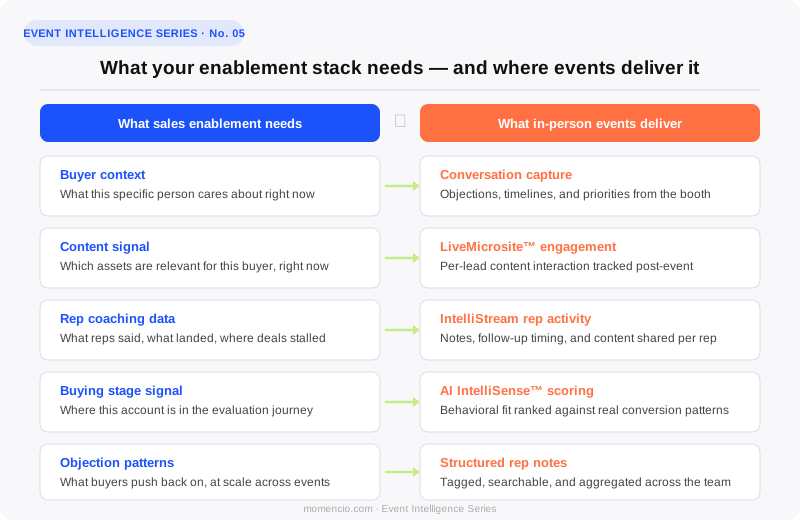
Strip away the platforms and the playbooks, and sales enablement depends on three inputs: buyer context (what this specific person cares about right now), content signal (which assets are relevant to where they are in the buying journey), and coaching data (what the rep said, what landed, where the conversation stalled). Without all three, enablement is working from assumptions.
In-person events generate all three simultaneously — in real conversations, tied to confirmed identities, at the moment of highest engagement. No other channel in your GTM stack does this. Web analytics give you anonymous behavior. Intent data gives you inferred interest. Email engagement gives you opens and clicks, delayed and decontextualized. An in-person event gives you a known contact telling a rep exactly what they need, what they object to, and when they plan to buy. The signal quality is not comparable. The problem is that almost none of it makes it back to the enablement system in a usable form. As covered in the first article in this series, this is the difference between event data and event intelligence.
The three connections your enablement program is missing
When in-person event intelligence is processed correctly — rather than summarized in a post-show spreadsheet — it feeds the enablement function in three specific ways.
Outreach personalization
A rep following up with genuine event intelligence does not need to guess the angle. They know the objection that was raised at the booth. They know the buying timeline the prospect disclosed. They know which product area drove the longest conversation. The follow-up writes itself from the record. LiveMicrosites™ extend this further: each prospect receives a personalized content experience tied to what was discussed in person, and every subsequent interaction with that microsite — what they revisited, what they ignored — feeds back into the lead record as a live content signal.
Content recommendation
Enablement platforms spend significant effort trying to surface which content is relevant for a given buyer at a given stage. AI IntelliSense™ generates exactly that signal from in-person event data — evaluating each lead across behavioral dimensions including content engagement depth, return visit frequency, ICP alignment, and behavioral similarity to past converters. This is not inferred from anonymous web traffic. It is built from first-party data tied to a known contact in a real buying conversation. The content recommendation that results is more reliable than almost anything else in the stack.
Rep coaching
Most managers have no visibility into what actually happened at the booth. IntelliStream changes that. Rep notes, conversation tags, qualification patterns, follow-up timing, and content shared are all captured and visible. Which reps logged structured context? Which ones wrote “interested” and moved on? Which follow-ups went out within 24 hours and which sat for a week? That is a coaching conversation — and the data is available the moment the event ends, not reconstructed weeks later from memory.
Why this link stays broken
Two structural problems keep this connection from forming. The first is ownership. As the fourth article in this series covers in detail, event intelligence typically sits with field marketing or event operations — not with the sales enablement function. The data is captured in one system, handed off to CRM, and by the time enablement sees it, the context has been stripped out. The lead arrives as a contact record, not an intelligence record.
The second problem is format. Event data and event intelligence are not the same thing — and enablement platforms are built to receive intelligence, not raw data. A badge scan with a name and email attached is not actionable for enablement. A structured record with buying stage, objection type, content engaged, and follow-up priority is. The five-layer framework makes clear that most teams never get past the first layer of capture. Layers three through five — scoring, sequencing, and compounding — are where the enablement-ready output is actually produced.
The diagnostic question
Open a CRM record from your last in-person event. Without any briefing, could your sales rep tell you what to say on the follow-up call, which content to send, and why now is the right moment to reach out? If the answer is no, the event generated data, not intelligence — and the enablement program never had a chance to use it.
The fix does not require a new platform. It requires a decision to treat in-person event intelligence as a first-class input to the enablement workflow — captured in structured form, processed through a behavioral intelligence layer, and delivered to the rep as context, not as a contact list. The GTM stack already has the receiving end. The missing piece is the source.