
Renting lead scanners for 2–3 events? Manageable. Running 12+ events a year? The math turns against you faster than most event marketers realize.
The cost model nobody talks about before the contract
Every exhibitor knows the booth space fee. Most know the drayage. Almost nobody runs the numbers on lead retrieval until the invoice arrives. Then they pay it, file it under “event costs,” and do the same thing at the next show.
That habit gets expensive at scale. A single event-based scanner rental runs between $200 and $500 per device, with full lead retrieval system costs landing at $500–$1,000 per show for a standard multi-person booth team. That figure does not include the hidden drag: setup time, inconsistent data quality, post-event CSV wrangling, and follow-ups that arrive too late to matter.
For teams attending 12, 15, or 20+ events a year, these line items compound into a material budget problem — one with a clean, calculable solution.
What rental really costs: the full picture
The direct rental fee is only the starting point. Consider what a typical event lead retrieval rental package actually involves:
| Cost component | Per-event cost (est.) | Annual cost at 15 events |
| Scanner rental (2–3 devices) | $500–$1,000 | $7,500–$15,000 |
| Per-license fees (app-based) | $250–$500 per seat | $3,750–$7,500 (3 seats) |
| CRM integration setup | $0–$300 (manual hours) | $0–$4,500 |
| Post-event data cleaning | 2–4 hours staff time | 30–60 hours annually |
| Delayed follow-up cost (est.) | Varies / untracked | Significant pipeline leakage |
The range above reflects real market pricing as of 2025. Physical handheld scanner rentals sit at the upper end; BYOD app-based licenses like Cvent LeadCapture start around $250 per seat per event. Teams running 3+ booth staff across 15 events are routinely spending $15,000–$25,000 annually on lead retrieval alone, before accounting for the operational overhead.
| Key figure
Industry research from Trade Show Labs and Event Tech Live (2025–26) confirms lead retrieval rental costs range from $200–$500 per device per event, with full system costs reaching $500–$1,000 per show for exhibitor teams. |
The tipping point: where owned beats rented
The financial crossover is not a hypothesis — it is arithmetic. An owned event intelligence platform priced at an annual license of $5,000–$8,000 covers unlimited events, unlimited users, and carries no per-scan or per-device fees.
Run the comparison across event volume:
| Annual events | Rental cost (est.) | Owned platform cost | Savings with owned |
| 2–3 events | $1,000–$3,000 | $5,000–$8,000 | Rental wins here |
| 6–8 events | $3,000–$8,000 | $5,000–$8,000 | Near breakeven |
| 10–12 events | $5,000–$12,000 | $5,000–$8,000 | $0–$4,000 saved |
| 15–20 events | $7,500–$20,000 | $5,000–$8,000 | $2,500–$12,000 saved |
| 20+ events | $10,000–$25,000+ | $5,000–$8,000 | $5,000–$17,000+ saved |
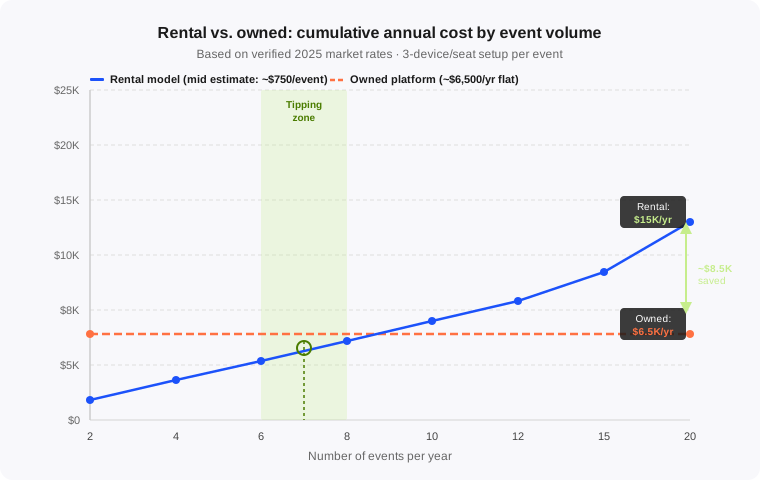
The tipping point arrives at roughly 6–8 events per year. Beyond that threshold, every additional event on the rental model is pure cost that an owned platform has already absorbed. For teams running 15–20 events annually, the annual savings comfortably exceed the platform license fee itself.
What rental scanners cost beyond the invoice
Direct cost is only half the argument. Rental-based lead retrieval carries a set of structural limitations that owned, integrated platforms eliminate entirely.
Data inconsistency across shows
Rental systems are event-specific. Each show delivers a different CSV format, different field names, different qualification frameworks. Sales teams spend hours reconciling post-event data rather than acting on it. That reconciliation time is real budget — it just never appears on the line item.
CRM sync delays
Most rental scanners export leads to a spreadsheet. Getting those leads into Salesforce, HubSpot, or Dynamics requires a manual import step, which typically happens days after the event. Research consistently shows lead response time has a direct impact on conversion: the longer the delay, the colder the lead. Rental workflows are structurally slow.
No cross-event intelligence
When your lead capture tool changes at every show, there is no cumulative engagement picture. You cannot see that a prospect visited your booth at three separate events over two years. You cannot score based on sustained interest. Owned platforms with persistent data architecture turn that pattern into a pipeline signal. Rental systems cannot.
Zero content delivery at the booth
A rental scanner captures contact information. That is all it does. An integrated lead intelligence platform like momencio enables your booth team to deliver tailored content to each prospect during the conversation, track which materials each contact engaged with, and trigger personalized follow-up sequences automatically — all from the same workflow.
| Consider this
A team that attends 15 events per year and relies on manual post-event data entry is spending an estimated 30–60 hours annually on data cleaning alone — before a single follow-up email is sent. |
The honest guide: when renting still makes sense
Not every team should move to an owned platform immediately. Rentals are a rational choice when:
- Your team attends 5 or fewer events annually and has no plans to scale the program
- Events are one-off or pilot initiatives with no defined recurring strategy
- Lead capture is genuinely a secondary objective, with brand presence as the primary goal
For everyone else — teams with a defined event calendar, a CRM they need to feed, sales reps who need to follow up with context, and executives who want to see event ROI in a dashboard — the rental model is costing more than the alternative.
How momencio changes the economics
momencio operates as a unified event intelligence platform — not a scanner rental replacement, but a fundamentally different approach to what lead capture should do. On a single annual license, it covers:
- Universal lead capture via AI EdgeCapture — works independently of event badge APIs, so it functions at every show without organizer integration dependencies
- Real-time CRM sync to Salesforce, HubSpot, Microsoft Dynamics, Marketo, and 30+ additional integrations
- In-booth content delivery, allowing reps to share tailored materials and track engagement per contact
- AI IntelliSense, which surfaces follow-up recommendations and lead scoring from conversation signals
- Event dashboards that give marketing and sales leadership a live view of pipeline contribution across the entire event program
For teams running 10+ events annually, the platform effectively pays for itself in the first quarter. For teams running 20+ events, the annual saving often exceeds the license cost entirely.
See how momencio’s AI EdgeCapture eliminates event API dependency
Running the number for your event program
The calculation is straightforward. Take your annual event count, multiply by your current per-event scanner cost (typically $500–$1,000 for a standard setup), add an honest estimate of post-event data reconciliation hours at your team’s average hourly rate, and compare that total to an annual platform license.
For most teams doing 8+ events a year, the result is unambiguous.
Event lead capture is not a commodity. It is either a cost center or a revenue engine, depending on how the infrastructure is built. Rental models are optimized for cost centers. Owned platforms are built for pipeline.
See what your event program should cost
Book a demo to walk through the rental-to-owned comparison for your specific event calendar.