Every B2B team that exhibits at events believes they’re capturing intelligence. They scan badges. They collect names. They feed contacts into a CRM. They send a follow-up email on Monday morning.
Then they wonder why, despite spending $50,000 on a booth, the pipeline from the event barely covers the cost of the carpet.
The problem is not effort. It’s not budget. It’s architecture.
Event intelligence is not a single thing you either have or don’t. It is a layered discipline — five distinct levels of insight, each building on the one beneath it. Most companies operate permanently at Layer 1. A few reach Layer 2 or 3. The teams that consistently convert events into measurable revenue have built, deliberately or not, all five.
This article maps those five layers. It names what each one captures, what it enables, and where most teams fall short. If you read nothing else from this series, read this — because the gap between your current event performance and your potential event performance almost certainly lives somewhere in the layers you haven’t built yet.
Why layered thinking changes how you approach events
Before defining the layers, it’s worth understanding why this framing matters.
Most event technology is sold as a point solution. A badge scanner. A lead capture app. A follow-up email tool. A CRM integration. Each vendor solves one piece of the puzzle and presents it as the whole.
The result is a fragmented stack where data exists but doesn’t connect — where you know someone visited your booth but not what they were interested in, where you have a contact in your CRM but no record of how the conversation went, where you track email open rates but have no idea whether that lead is closer to buying or further away than they were at the show.
Layered intelligence is different. It recognizes that each data type has a distinct function in the sales cycle — that knowing who is at your booth (identity) is not the same as knowing what they did (behavior), which is not the same as knowing how they responded (engagement), which is not the same as knowing what their actions signal about buying stage (intent), which is not the same as knowing how this compares to every interaction that came before (trajectory).
When you collapse all of this into “leads captured,” you lose the signal. When you separate it into layers, you gain a system.
Layer 1: Identity intelligence — who is here
What it captures: Name, title, company, contact details, firmographics.
What it enables: Contact creation, list building, basic segmentation.
Where most companies stop: Here.
Identity intelligence is the foundation of every event program. You need to know who walked into your booth. That part is not in dispute. What is in dispute is whether identity intelligence alone constitutes a strategy.
A badge scan tells you someone was there. It tells you their name, their employer, and — if you’re lucky — their job title as registered with the event. What it does not tell you is whether they are a buyer, a researcher, a competitor, a student, or someone who stopped at your booth because you had better candy than the company next door.
Most teams treat the badge scan as the capture event. It isn’t. It’s the beginning of the capture event.
The moment you complete the scan, the most important questions are still unanswered: Why did they stop? What are they evaluating? What’s driving the conversation? What problem are they trying to solve? When are they making a decision?
Without answers to those questions, a badge scan is just a name on a list. And lists don’t generate revenue. Intelligence does.
What layer 1 looks like — and what it misses
You exhibit at a major industry trade show. Your team scans 400 badges over two days. On Monday, marketing uploads the list to the CRM and triggers a generic nurture sequence. By Wednesday, the open rate is 18%. No one knows which of those 400 people is worth calling.
The miss is not in the process. It’s in the premise — that 400 contacts is a pipeline. It’s a directory. Without context, everyone on that list looks the same.
Layer 2: Behavioral intelligence — what happened at the booth
What it captures: Content shown during the conversation, structured rep notes (interests, objections, key challenges), demo engagement, materials shared, questions asked, real-time lead scoring updates.
What it enables: Lead qualification, sales context, post-event conversation continuity, CRM records that reflect what actually happened.
Where most companies stop: Rep memory. Conversation context evaporates within 48 hours, and the CRM receives a contact record with no interaction history attached.
Behavioral intelligence is the first layer that begins to answer the question a sales rep actually needs answered: what does this person care about?
It captures the specifics of the in-person interaction — which product they asked about, which demo they watched, which objections they raised, which collateral they requested, how long they stayed, whether they asked to bring in a colleague. These are not soft signals. They are the raw material of a qualified opportunity.
The challenge is that behavioral intelligence is difficult to capture systematically. It lives in the moment, in the noise of a busy show floor, in conversations that move fast and feel too organic to interrupt with a form. Most teams rely on their reps to log notes after the fact — which means the quality of behavioral capture is entirely dependent on the memory, discipline, and consistency of the individual rep. That is not a system. It is a lottery.
momencio’s AI IntelliSense™ is the behavioral intelligence engine. It evaluates every captured lead across six dimensions in real time: true engagement scoring, intent classification by action, ICP fit ranking, urgency signals, strategic role and deal influence, and smart next-step alerts. Reps can log structured voice notes during the conversation — interests, objections, buying signals — without breaking the flow of dialogue. Every piece of context syncs directly to the lead record before the prospect leaves the floor.
The difference layer 2 makes in the sales handoff
A rep who logs behavioral context — “asked specifically about CRM integration with Salesforce, currently evaluating Vendor X, decision in Q1, CFO involved in the final call” — gives the sales team a running start. A rep who logs nothing gives them a cold call.
Consider two outcomes from the same event. In the first, your rep meets a VP of Operations who spends 14 minutes at the booth, watches the full platform demo, asks three specific questions about workflow automation, and requests a case study. That interaction is captured in structured notes, tagged to her contact record, and scored as a high-priority lead before she leaves the floor. In the second, your rep has the same conversation, logs nothing, and uploads a badge scan. On Monday, both outcomes look identical in the CRM. Only one is actually an opportunity.
Layer 3: Engagement intelligence — how they responded after the event
What it captures: Asset-level content engagement (time on page, scroll depth, return visits, content shares), individual lead activity on personalized follow-up microsites, rep alert triggers when a lead re-engages at peak interest.
What it enables: Post-event lead scoring updates, sales trigger notifications at the right moment, content optimization, nurture sequencing based on actual behavior not schedule.
Where most companies stop: Open rates and click rates — with zero visibility into what happened after the click.
The event ends. The contact returns to their office. The follow-up email lands. What happens next is either invisible or misread.
Most teams track opens and clicks as the measure of post-event engagement. But an email open is not intent. A click is not intent. What matters is what happens after the click — which specific asset they spent time on, whether they returned to the microsite, whether they shared a document with a colleague, whether they viewed the pricing page or the implementation guide three times.
These behaviors tell you exactly where someone is in their evaluation. A contact who spends eight minutes on the CRM integration case study is in a fundamentally different buying stage than a contact who opens the email and closes it in four seconds. Treating them identically — as “engaged” because they opened — is a category error that costs pipeline every month.
LiveMicrosites™ from momencio are purpose-built for engagement intelligence. Within minutes of capture, each lead receives a personalized microsite containing exactly the content relevant to their booth conversation. Every interaction — scroll depth, time on asset, return visits, shares — generates a real-time signal. The moment a lead re-engages at peak interest, the relevant rep receives an alert. Not a weekly report. An immediate trigger.
Engagement data as a sales trigger, not a reporting metric
This is the layer where most companies make their biggest mistake: they treat engagement data as a reporting metric rather than a sales trigger. The moment a lead returns to their microsite four days after the event and spends fifteen minutes on your ROI calculator, that is not a data point for the marketing team’s dashboard. That is an immediate trigger for a sales call.
In practice, Layer 3 looks like this: your follow-up sequence triggers a personalized LiveMicrosite for each lead, containing content matched to the specific conversation they had at your booth. Over the next 72 hours, you receive real-time notifications as leads engage — one revisits three times and shares the integration guide with a colleague, one spends time on the pricing overview, one hasn’t opened anything. Your sales team now has three distinct next actions, not one generic sequence.
Layer 4: Intent intelligence — where they are in the buying journey
What it captures: Behavioral patterns interpreted against buying stage — early exploration, active evaluation, decision-ready. Sequential question patterns, content depth signals, ICP fit scoring, deal-influence identification.
What it enables: Accurate sales prioritization based on genuine buying signals (not gut feel), pipeline forecasting, ABM targeting, rep focus decisions.
Where most companies stop: They have data at Layers 1–3 but no analytical layer that translates behavior into buying stage. Every lead looks the same on paper.
Layers 1 through 3 generate data. Layer 4 generates meaning.
Intent intelligence asks a specific question of all the data beneath it: based on everything we know about how this person has behaved — at the event, in follow-up, with content — where are they in their buying process?
This is where lead scoring lives in its most sophisticated form. Not the basic “gave us their business card = 10 points, opened an email = 5 points” model that most CRMs default to. AI IntelliSense™ analyzes conversation depth, qualification signals, behavioral patterns, and buying committee engagement to identify genuine buyer intent. A prospect who asked detailed pricing questions, requested a technical demo, and mentioned a Q1 implementation timeline gets flagged as high-intent — even if they only downloaded one asset. A prospect who browsed casually and accepted collateral politely does not.
The distinction between observation and interpretation
The distinction between Layer 3 and Layer 4 is the difference between observation and interpretation. Layer 3 tells you someone spent time on your pricing page. Layer 4 tells you, in the context of everything else they’ve done, whether that signals a buyer who is ready for a commercial conversation or a prospect who is still orienting themselves.
Intent intelligence also allows teams to identify the leads who are not signaling intent — and make deliberate decisions about whether to invest sales resources in them or route them to long-cycle nurture instead.
This is where event ROI measurement starts to become defensible to leadership. Not “we captured 400 leads,” but “of the 400 leads captured, 47 are in active evaluation, 112 are in early-stage exploration, and 241 have shown no post-event intent activity.” Your event debrief no longer starts with lead volume. It starts with a segmented breakdown by buying stage.
Layer 5: Trajectory intelligence — patterns across time and events
What it captures: Cross-event behavioral patterns, account history across the full relationship timeline, account-level trend analysis, rep performance benchmarks, program-level ROI by event.
What it enables: Long-cycle relationship management, account escalation detection, strategic event planning, rep coaching, budget justification to leadership.
Where most companies stop: No institutional memory. Every event starts from zero.
Layer 5 is the layer that separates event programs from event strategy.
Most teams treat each event as an isolated campaign. They set up, capture leads, follow up, and move on. The contacts from the last show sit in the CRM. The learnings from the last show sit nowhere. The decisions about which events to attend next year are made on the basis of attendance numbers and booth traffic estimates, not on the evidence of what actually converted.
Trajectory intelligence changes this by introducing a longitudinal dimension. It asks: how does this event compare to previous events for this account? How does this lead’s current behavior compare to leads who eventually converted? Is this rep producing consistently better or worse post-event outcomes than peers? Is this event producing diminishing returns compared to last year?
What trajectory intelligence enables at the program level
These questions can only be answered with historical data that has been structured and preserved across event cycles. They are also precisely the questions that connect event investment to business strategy.
At the account level, trajectory intelligence surfaces contacts who have appeared across multiple events without converting — and flags whether their engagement pattern is accelerating (a signal to escalate) or stagnating (a signal to re-evaluate).
At the program level, it answers the question every VP of Marketing eventually faces from Finance: which events are actually working? momencio’s event dashboards track pipeline attribution, rep performance, and content effectiveness across your entire event program history — not just the last show.
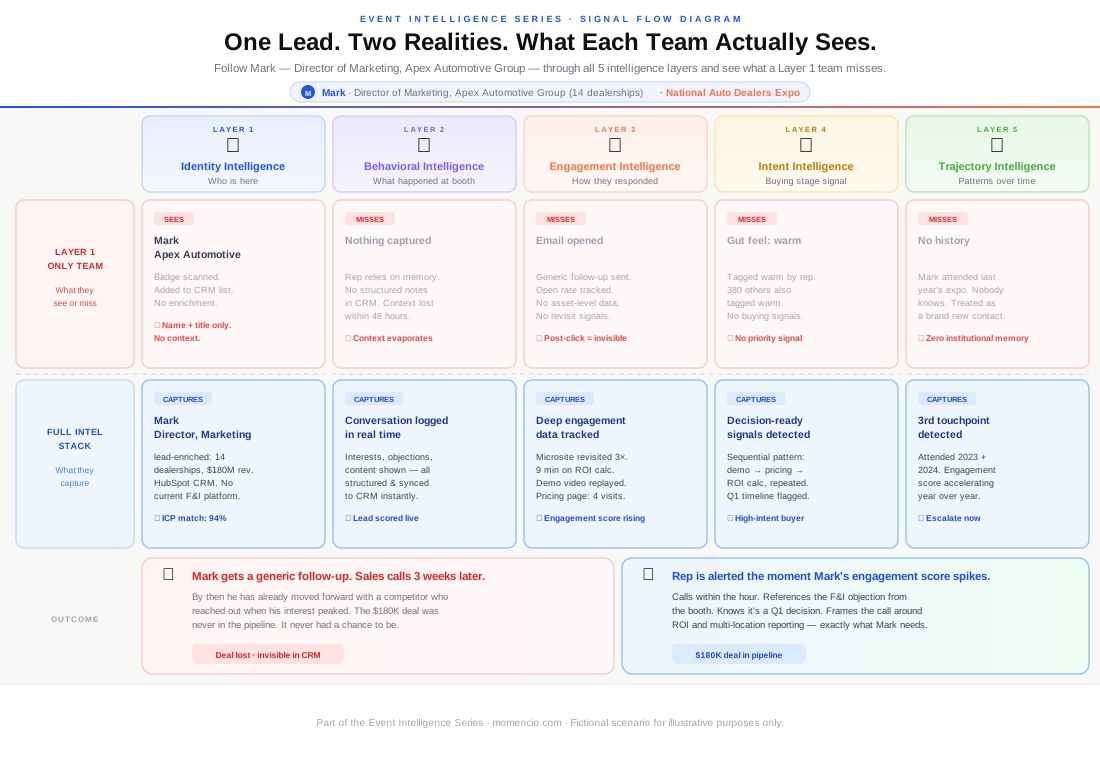
Here’s what the difference looks like in practice — one lead, five layers, two completely different outcomes.
The compounding problem: why stopping at layer 1 is more expensive than you think
It is tempting to read through these five layers and conclude that Layers 4 and 5 are nice-to-haves — sophisticated additions to a base that already functions adequately at Layer 1 or 2. This framing is incorrect, and it’s costing you revenue in a way that’s very hard to see from inside the organization.
The reason is that event investment is not additive. It is multiplicative. The return on a $50,000 trade show booth is not determined by how many leads you capture. It is determined by the quality of intelligence you build from that capture — and that quality degrades at each layer you skip.
At each layer, you are not adding more data. You are multiplying the signal value of the data you already have. This is why two companies can attend the same trade show, spend the same booth budget, and capture a similar number of leads — and one company generates a 4x pipeline outcome. The difference is almost never the booth size, the swag quality, or the number of staff. The difference is the depth of intelligence they build from the interactions they have.
Discover which layers you actually have
Before investing in new tools or expanding your event program, it’s worth honestly assessing which layers you currently operate at — and more importantly, what each gap is costing you in pipeline terms.
How momencio is built around all five layers
Most event technology platforms are optimized for Layer 1. Some have extended into Layer 2 or parts of Layer 3. Very few are architecturally designed to support all five.
momencio is built around the full stack.
Universal lead capture handles Layer 1 — ensuring every contact is captured, enriched, and verified regardless of the event’s badge system or API availability. AI EdgeCapture™ enriches leads with verified business emails, LinkedIn profiles, and firmographic data in real time.
AI IntelliSense™ handles Layers 2 and 4 — capturing structured behavioral signals during booth interactions via voice notes and content tracking, then evaluating every lead across six intelligence dimensions (engagement depth, intent classification, ICP fit, urgency, strategic influence, and smart action alerts) to surface who is ready to buy.
LiveMicrosites™ handle Layer 3 — delivering personalized post-event follow-up that tracks individual engagement at asset level, surfaces real-time rep alerts, and continuously updates lead scores based on post-event behavior.
Event dashboards handle Layer 5 — tracking pipeline attribution, rep performance, and content effectiveness across your entire event program history, not just the last show.
The result is an event intelligence platform that doesn’t just capture who was there. It builds a complete picture of who is ready to buy — and ensures that picture is in the hands of your sales team before the event floor carpet has been rolled up.
What this means for how you run your next event
The five-layer framework is not a product pitch. It is a diagnostic lens.
You can apply it to your current event program regardless of what technology you use. Ask yourself, honestly, which layers you have genuinely built — not which tools you own, but which signals you are actually capturing, storing, and acting on.
In most cases, the answer is not “we need a bigger booth.” The answer is “we need to go one layer deeper.”
The intelligence from your last ten events is already there — in the conversations your reps had, the content your leads engaged with, the signals your contacts have been sending since they walked away from the booth. You just don’t have the architecture to see it yet.
That’s what the rest of this series is built to help you build.
This article is part of the Event Intelligence Series — a structured framework for B2B revenue teams who want to turn events from cost centers into pipeline engines.