Marketing owns the event. Sales owns the follow-up. Nobody owns the intelligence layer in between. That is not a resource problem. It is a structural one — and it is costing B2B revenue teams more than they realize.
The consequences are familiar, even if their root cause is not. Leads return to a microsite days after an event and trigger no alert because no one defined who should receive it. A sales rep opens a CRM record and finds a name, a company, and a job title — but no context about what the person asked, what they engaged with, or what they need next. A RevOps leader runs post-event attribution and discovers the data is too incomplete to tell them which events actually produced pipeline.
None of this happens because people are not doing their jobs. It happens because the job of owning event intelligence has never been formally assigned to anyone.
Event intelligence does not fail at the technology layer. It fails at the organizational layer — because the structure that should govern it does not exist in most B2B companies.
This article maps that structural gap. It identifies where accountability breaks down, why each function believes someone else owns the problem, and what a shared ownership model for event intelligence actually looks like.
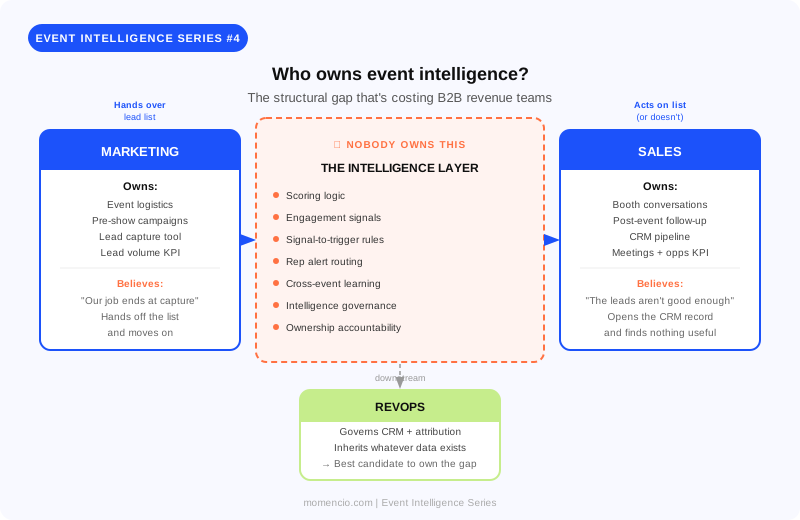
The organizational map of a typical B2B event program
Before diagnosing the problem, it helps to see how most B2B companies currently divide responsibility for events. The breakdown looks roughly like this:
Marketing plans the event, manages logistics, selects and deploys the lead capture tool, and owns pre-show promotional activity. They define the goal — usually a lead volume number — and measure success against it. After the event, they upload the lead list to the CRM and trigger a nurture sequence.
Sales attends the event, runs booth conversations, and owns post-event follow-up. Their success metric is meetings booked and opportunities created. They depend on the lead list marketing hands over, and they act on it — or do not — according to their own judgment about which leads are worth calling.
RevOps manages the CRM, governs attribution reporting, and occasionally reviews event data in the context of pipeline analysis. They are downstream of both teams and rarely involved in event execution.
This model has a logic to it. Marketing knows events. Sales knows buyers. RevOps knows data. But the model has a critical gap. None of these three functions owns the layer that sits between raw capture and sales action — the layer where contact data becomes behavioral signal, where signal becomes lead score, where lead score becomes a trigger for the right conversation at the right moment.
That layer is event intelligence. And in most organizations, it belongs to no one.
Why each function believes someone else owns the problem
The ownership gap persists not because it is invisible, but because each function has a reasonable story for why it is not their problem.
Marketing’s story: our job ends at capture
Marketing’s accountability is typically measured in lead volume. They define success as a number of scans, contacts captured, or MQLs generated. Once the lead list is uploaded and the nurture sequence is live, the event is considered complete.
The intelligence that should sit between capture and nurture — the scoring logic, the behavioral signals from LiveMicrosites™, the context that makes follow-up relevant — is not part of the MQL definition. So marketing does not pursue it. They hand over a list and move on to the next event.
Sales story: we need better leads, not better data
Sales sees the post-event list and finds it inadequate. Names without context. Companies without buying signals. Contacts they cannot qualify from what is in the CRM record. Their response is predictable: they call the obvious ones, ignore the rest, and tell marketing the leads were not good enough.
What they are actually describing is an intelligence deficit. But they frame it as a lead quality problem. The distinction matters because a lead quality problem points back to marketing, while an intelligence deficit points to a structural gap that neither team is currently filling.
Sales is right that the data is inadequate. They are wrong about who is responsible for fixing it.
RevOps’s story: we govern systems, not strategy
RevOps is closest to the intelligence layer — they manage the CRM, the attribution model, and the data architecture. But their mandate is typically operational: keep the systems clean, ensure data integrity, produce the reports leadership needs.
They are rarely asked to define how event signals should be captured, scored, or acted on. That feels like a strategic conversation between marketing and sales. So they stay in their lane, inherit whatever data those two teams produce, and try to make sense of it in the attribution report.
| Only 35% of B2B companies have a formal RevOps function. In organizations that do, RevOps is increasingly being asked to govern AI and automation logic across GTM teams — but event intelligence governance is almost never part of their mandate. |
The intelligence gap: what falls through the crack
The organizational structure described above creates a specific, predictable gap. It is not in lead capture — marketing handles that. It is not in CRM data entry — RevOps handles that. It is not in follow-up execution — sales handles that.
The gap is in the processing layer between capture and action: the decisions about what signals matter, how they should be weighted, who should act on them, and when.
Article #2 in this series, The five layers of event intelligence, mapped this processing layer in detail. Most companies operate at Layer 1 — contact capture — and occasionally reach Layer 2 with structured rep notes. Layers 3 through 5 — engagement intelligence, lead scoring as a sales trigger, and cross-event learning — are almost entirely unoccupied. Not because the tools are not available, but because no one owns the decisions that would make those layers operational.
Specifically, no one owns:
- The definition of what constitutes a sales-ready signal from an event
- The rule set that determines which rep receives which alert, and when
- The standard for how quickly a rep should act on an engagement trigger versus a cold contact
- The review cycle that evaluates whether the lead scoring model from the last event is producing the right outputs
- The governance process that ensures intelligence compounds across events rather than resetting after each one
These are not technical problems. They are ownership problems. And they remain unsolved because they sit in the crack between the three functions that together run the event program.
What each persona currently owns, thinks they own, and does not own
The table below makes the gap concrete. It is not an indictment of any individual function. It is a structural map — the kind that has to be drawn before anything can change.
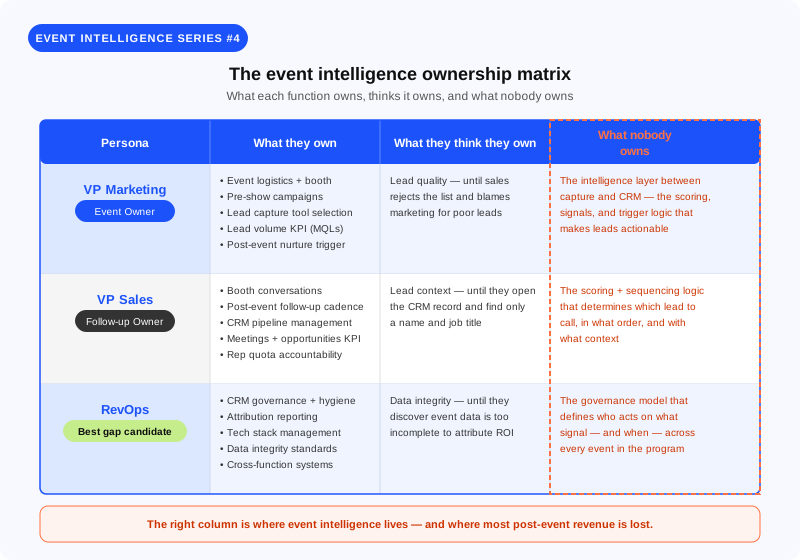
The right column — what nobody owns — is where event intelligence lives. It is also where most post-event revenue is lost.
Why this is not a smarketing alignment problem
The instinct when confronted with a marketing-sales gap is to prescribe alignment: get the teams in a room, agree on definitions, build a shared SLA, and move on. That instinct is not wrong, but it is insufficient for this specific problem.
Smarketing alignment addresses the handoff — the moment when a lead moves from marketing’s responsibility to sales’s responsibility. It improves communication at the boundary between two functions.
The event intelligence gap is not at the handoff. It is before the handoff. It is in the processing layer where raw event data is supposed to become intelligence — and that processing layer has no owner, no process, and no accountability structure. Aligning marketing and sales on the handoff does not create an owner for the layer that precedes it.
This is why organizations with strong smarketing alignment still struggle with event ROI. They have improved the exchange of leads at the boundary. They have not solved the deeper structural problem: who is responsible for turning event data into the intelligence that makes those leads worth exchanging in the first place.
| Companies with strong marketing-sales alignment achieve 208% more marketing revenue than those without it — but alignment at the handoff does not substitute for ownership of the intelligence layer that precedes it. |
What a shared revenue function for event intelligence looks like
Treating event intelligence as a shared revenue function — rather than a marketing task or a sales enablement activity — requires three structural decisions.
Decision 1: Appoint an intelligence owner
This does not require a new hire. It requires a formal assignment. In most B2B organizations, the best candidate is RevOps — specifically because they already govern the systems through which event intelligence flows, and because their cross-functional mandate positions them to define standards without taking sides in the marketing-sales dynamic.
The intelligence owner is responsible for defining what signals matter, establishing the scoring rules, configuring the trigger logic, and reviewing whether the system is producing the intended outputs. They do not capture leads. They do not run follow-up. They govern the layer between those two activities.
Decision 2: Define the intelligence handoff, not just the lead handoff
The standard smarketing SLA defines what a qualified lead looks like when it moves from marketing to sales. A revenue function SLA goes further: it defines what an intelligence-enriched lead looks like — what context it must carry, what score it must have, what behavioral signals should be attached before a rep is expected to act on it.
This definition is what makes the event ROI measurement conversation possible. Without it, marketing and sales are measuring different things and calling them by the same name.
Decision 3: Make event intelligence visible in the CRM
Intelligence that lives in a separate platform, a PDF report, or a spreadsheet is not operationalized intelligence. It is data. For event intelligence to drive revenue behavior, it has to be present in the record a rep opens at the moment they decide whether to act.
This means structured rep notes synced to the CRM. It means AI IntelliSense™ scores attached to the lead record, not buried in a dashboard. It means engagement signals — microsite revisit frequency, time per asset, return visit patterns — surfaced in the context where sales decisions are made.
Visibility in the CRM is the difference between intelligence that informs and intelligence that activates.
The role momencio plays in closing the ownership gap
Platform alone cannot solve a structural problem. But the right platform can make a shared ownership model operationally possible in a way that a fragmented stack cannot.
momencio is built around the premise that event intelligence should be a continuous, structured layer — not a post-event export. Universal lead capture captures contact data and behavioral context in the same motion. AI IntelliSense™ scores leads in real time, based on engagement patterns rather than contact completeness. LiveMicrosites™ generate post-event behavioral signals — scroll depth, asset dwell time, return visit frequency — that a rep can act on without waiting for a weekly report.
The event dashboards close the governance loop: marketing sees program-level performance, RevOps sees attribution data, and sales sees individual lead records that carry full conversation context. Everyone operates from the same intelligence, in the same system, at the moment they need it.
That is the structural condition for shared ownership. It does not eliminate the need for organizational decisions. But it removes the technical excuse for not making them.
The conversation that needs to happen
If you are a VP of Marketing reading this, the question to ask is not whether your events are producing enough leads. It is whether the intelligence that should accompany those leads is being captured, processed, and handed over in a form that gives sales any real basis for action.
If you are a VP of Sales reading this, the question to ask is not whether marketing is sending you better leads. It is whether the follow-up infrastructure your team operates from is actually built for intelligence-driven engagement — or whether it is a volume play wearing the language of qualification.
If you are a RevOps leader reading this, the question is whether event intelligence governance is part of your mandate. If it is not, it should be. The data architecture that governs everything else in your GTM motion is incomplete without it.
Article #1 in this series defined what event intelligence is. Article #2 mapped the five layers of event intelligence and showed where most teams sit. Article #3 diagnosed why event data and event intelligence are not the same thing. This article has identified who needs to own the layer that the data should become.
The gap is structural. The fix is structural. And the conversation starts with someone in the room deciding — formally, explicitly — that this is their responsibility.
| The intelligence layer between event capture and sales action is not a gap in your tech stack. It is a gap in your org chart. Fill it. |
See how momencio closes the intelligence gap
momencio is the only event intelligence platform that captures behavioral signals, scores leads in real time, and delivers full context to sales — all within a single system. If your post-event process is producing lead lists instead of lead intelligence, it is worth seeing what is possible.