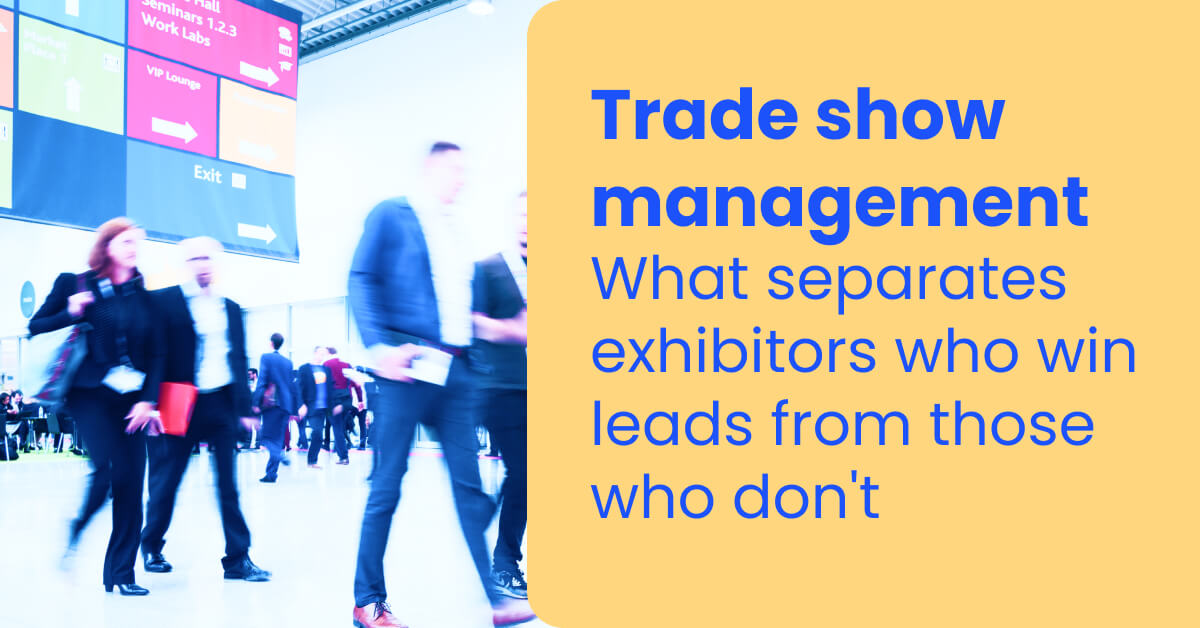
Most companies treat trade shows like a logistics problem. Book the booth. Ship the display. Show up. Scan badges. Go home.
And then they wonder why the pipeline number never moves.
The problem isn’t the trade show. It’s the management — specifically, the absence of a connected system across the three phases that actually determine outcomes: what happens before you arrive, what happens on the floor, and what happens in the 48 hours after you leave.
Our B2B Event Intelligence Report found that 94% of marketers say their company fails to convert event leads into pipeline. That’s not a show quality problem. Shows work — 81% of attendees have buying authority, and well-run exhibitors consistently report 4:1 returns on event investment. The gap is between attendance and conversion, and it lives entirely in how companies manage the process around the event.
This guide covers that process in full — the decisions, the sequencing, and the specific execution choices that determine whether your next trade show generates pipeline or just receipts.
What trade show management actually means
Trade show management is the process of planning, coordinating, and executing your company’s trade show participation in a way that’s tied to measurable business outcomes — before, during, and after the event.
That last part matters. Most companies only manage the obvious parts: booth logistics, staff scheduling, and hotel bookings. They treat the show floor as the finish line when it’s actually the starting gun.
True trade show management covers three phases:
Pre-show: Show selection, goal-setting, booth design, pre-event marketing, lead qualification criteria, staff training, and content preparation. This is where 80% of your outcomes are determined — before a single badge is scanned.
On-site: Lead capture, attendee engagement, real-time qualification, content delivery, team coordination, and daily debriefs. This phase is about execution quality and data integrity.
Post-show: Lead follow-up, CRM integration, ROI reporting, pipeline tracking, and iterative improvement. This is where most teams fail — not from lack of effort, but from lack of speed and context.
The execution gaps that kill trade show ROI almost always occur because companies treat these phases as separate activities rather than a single connected system. Your follow-up is only as strong as the context your team captured on the floor. Your on-site performance is only as strong as the goals and qualification criteria you defined before you arrived.

The four gaps that most trade show content never addresses
Before building a system, you need to understand what breaks. These are the four failure patterns we see most consistently across B2B exhibitors — and what’s actually behind each one.
Gap 1: No one owns the full funnel
Marketing handles the booth. Sales handles conversations. Operations handles logistics. Finance handles the invoice. But no single person owns the journey from prospect encounter to closed revenue.
This fragmentation creates silent handoff failures. Marketing hands a lead list to sales. Sales doesn’t have the conversation context. Follow-up is generic. Pipeline attribution is guesswork. No one knows which show actually worked.
The fix isn’t better coordination between teams. It’s assigning a Trade Show Revenue Owner — one person accountable for pipeline outcomes across all three phases, not just event execution.
Gap 2: Lead capture stops at the badge scan
A badge scan gives you a name and a company. It tells you nothing about what that person cared about, what they asked, how long they stayed at your booth, what content they engaged with, or whether they’re remotely qualified.
Without that context, follow-up is forced to be generic. Generic follow-up — “great to meet you at the show” with a product brochure attached — converts at a fraction of personalized outreach that references the specific conversation.
The data from our 2025 B2B Event Intelligence Report reinforces this: exhibitors who capture behavioral context alongside contact data report significantly higher lead-to-meeting conversion rates than those relying on badge scans alone. The gap isn’t in lead volume. It’s in lead intelligence.
Gap 3: The 48-hour follow-up window gets missed
50% of trade show buyers choose the vendor that responds first with relevant information. The optimal follow-up window is 24–48 hours. Yet 40% of exhibitors wait three to five days after a show before reaching out — by which point the emotional momentum from the booth conversation has dissipated and a competitor who moved faster has already booked the meeting.
The reason most teams miss this window isn’t laziness. It’s that their follow-up infrastructure isn’t built before the show. They land home, spend two days entering leads into the CRM, then spend another day writing emails. By day five, the opportunity has cooled.
Gap 4: ROI is measured in scans, not pipeline
A lead is a badge scan. Pipeline is a qualified conversation that moves toward revenue. If your trade show success metric is “number of leads collected,” you’re measuring activity and calling it outcomes.
The 2025 B2B Event Intelligence Report found that a significant percentage of exhibitors still report success primarily through lead count rather than pipeline attribution. This is a measurement problem that compounds into a budget problem: shows that look successful by lead count but produce no pipeline continue to get funded, while the structural gaps — in capture quality, follow-up speed, and CRM integration — go unaddressed.
Part 1: Trade show strategy — choosing shows worth managing
Your trade show management system can only perform as well as the shows you apply it to. Picking the wrong show — even with perfect execution — is an expensive mistake that can’t be fixed after the fact.
How to evaluate a show before committing
Most exhibitors make this decision based on industry reputation, competitor presence, or the size of the badge number the show organizer quotes. None of those are good criteria on their own.
Before signing an exhibitor contract, ask for — and verify — the following:
Attendee composition: What percentage of attendees match your ICP by job title, company size, and industry? Ask for last year’s attendee breakdown, not a projected estimate. Some shows attract your exact buyers. Others attract your buyers’ direct reports, which looks similar but converts very differently.
Decision-maker density: 81% of trade show attendees have some form of buying authority, but that figure spans a wide range — from final budget authority to departmental influence to procurement involvement. The distinction matters for how you staff your booth and structure your conversations.
Show trajectory: Is attendance growing, flat, or declining? A declining show almost always means a declining audience quality. Organizers rarely advertise this. Check the last three years’ attendance figures independently.
Past exhibitor validation: Talk to two or three companies that exhibited last year. Ask specifically about pipeline outcomes and lead quality, not booth traffic or brand impressions. If exhibitors from your category aren’t returning, find out why before assuming you’re different.
Competitive presence: If your key competitors are there, the audience is almost certainly relevant. If they’re not, that’s not automatically an opportunity — it may be a signal.
Setting goals that actually govern decisions
Every show needs numeric objectives set before registration, not after. Not because goal-setting is a best practice to check off, but because your goals determine everything downstream: booth size, staffing, content, qualification criteria, and success metrics.
Useful trade show goals are specific enough to track in real time during the event. Examples: 40 qualified conversations with director-level or above contacts, 12 product demos delivered, 8 meetings booked for the following two weeks, 5 existing accounts deepened with QBR scheduling.
Vague goals — “increase visibility,” “generate leads,” “strengthen relationships” — aren’t goals. They’re activities with no measurement attached. Teams running on vague goals have no way to know if the show is working until they’re back in the office with a list they can’t use.
Part 2: Pre-show planning — the 90 days that determine everything
The difference between a high-performing trade show and a chaotic one is almost entirely determined before the show opens. Most of the meaningful execution decisions — qualification criteria, follow-up sequences, staff roles, content assets — need to be locked in weeks before you ship the booth.
The 90-day pre-show timeline
90–60 days out: This is strategy and commitment phase. Finalize booth space, size, and location. Define the ICP criteria for lead qualification at this specific show — not a generic ICP, but the specific personas and qualification signals you’ll use on this floor with this audience. Set your numeric KPIs. Assign your Trade Show Revenue Owner. Begin pre-show outreach to existing accounts and high-priority targets who are registered.
60–30 days out: This is the build phase. Submit booth design and graphics. Confirm staff roles and training schedule. Set up your lead capture platform and test CRM integration before you need it on a show floor. Develop qualification scripts and conversation frameworks for booth staff. Schedule pre-show meetings with high-priority contacts already attending.
30 days to show day: This is the launch phase. Ship booth materials. Finalize your follow-up sequences for each lead tier — these should be written, approved, and ready to send before you leave for the show, not after. Run staff training: product messaging, qualification questions, lead capture protocol. Launch pre-show marketing.
One principle that cuts across all three windows: anything that can be decided, written, or built before the show should be. Every decision you’re making on the show floor or in the airport lounge on the way home is a decision that was made too late.
Budgeting: The number most exhibitors get wrong
First-time exhibitors routinely underestimate total event investment by 25–40%. The mistake is budgeting for the obvious line items — booth space, travel, hotel — and missing the costs that compound.
A realistic allocation model: exhibit space rental at 30–35% of total budget, booth design and build at 25–30%, staff travel and lodging at 15–20%, shipping and I&D at 10–15%, and marketing collateral and giveaways at 10–15%.
Installation and dismantling (I&D) is the most consistently underbudgeted line. The cost can run 20–40% higher than initial quotes when overtime charges, rush handling fees, and last-minute service orders are factored in. Build a 20–30% contingency into your first show at any venue, and adjust based on actual cost data going forward.
When evaluating booth options, calculate total cost of ownership across 12–24 months. A custom build costs more upfront but amortizes favorably across multiple shows. Turnkey rentals reduce design costs but compound over time. The right answer depends on your show frequency and how much your brand or product story is likely to change.
Pre-show marketing: Arrive with meetings already booked
The highest-performing trade show teams arrive with a packed calendar. They use the show as an execution mechanism for conversations they’ve already scheduled — not as a fishing expedition for whoever happens to walk by.
Pre-event promotion increases booth traffic by an average of 82% and improves lead quality and quantity by 37%. Yet most exhibitors show up with no pre-booked meetings and no pre-warmed audience.
The mechanics are straightforward. Use the event’s attendee list or your own database to identify who’s attending. Run a two-to-three-part email sequence in the four weeks before the show: announce your presence, establish what attendees will get from visiting (a specific demo, new research, a product preview), and offer a reason to schedule a time. Mirror this on LinkedIn with personalized outreach to target account contacts.
The goal isn’t blanketing everyone. It’s converting your highest-priority targets from “might see you on the floor” to “has a meeting on the calendar.”
Part 3: On-site execution — what actually determines lead quality
You can plan perfectly and still underperform on the floor. On-site execution is where strategy converts to data — and that data is what your post-show team has to work with.
Booth staffing: Roles that prevent the most common failure modes
Most booth staffing failures come from one of two patterns: too many people doing everything at once (clustered, intimidating, disorganized), or too few people with unclear responsibilities (important conversations not captured, technology not monitored).
The structure that consistently performs best assigns three distinct functions:
Engagers work the perimeter — actively initiating conversations with passing traffic, qualifying quickly using your show-specific ICP criteria, and routing qualified prospects to the right team member. They don’t demo. They qualify and hand off.
Demonstrators run the deeper conversations: product demos, solution walkthroughs, and technical discussions with qualified prospects. They should be your best closers and most fluent product communicators. Research consistently shows that sales staff — not senior leadership or marketing generalists — are the most effective booth representatives.
Lead managers own the data layer: ensuring every interaction gets captured with full context, monitoring CRM sync, tracking daily performance against your goal numbers, and flagging gaps in real time.
Brief all three roles before setup day. The morning of the show is too late.
The qualification conversation: Three questions in two minutes
Every booth conversation has a short qualification window before the attendee moves on. Your staff should be able to answer three questions within the first two minutes of any conversation:
What’s the person’s current challenge in your solution category? Do they have budget authority or access to it? Is there a near-term opportunity — an active project, a renewal, an evaluation already in progress?
Write a one-page conversation guide that maps these three questions to natural, non-interrogating opening lines. The goal isn’t a structured interview — it’s an efficient 90-second read that tells your staff whether to invest 20 more minutes or politely close and move on.
Capturing more than the badge scan
The badge scan is the starting point of lead capture, not the end point. What you record immediately after each conversation is what determines whether your follow-up is generic or genuinely relevant.
After each interaction, your staff should log: the prospect’s stated challenge, what content or demo was shown, their qualification tier (hot/warm/cold), and any specific follow-up commitments made. This takes 60–90 seconds and produces a fundamentally different follow-up outcome than a bare badge scan with no context attached.
momencio’s event intelligence platform makes this real-time: conversation notes, content engagement signals, and behavioral data are captured at the point of interaction and synced to the CRM automatically. Each lead also receives a personalized microsite during the booth conversation — keeping your brand relevant while they’re still on the show floor and giving them a reason to engage before they’ve left the building.
Daily debriefs: The 20-minute practice most teams skip
Every evening of the show, run a 20-minute structured debrief with your full booth team. Cover four things: leads captured vs. daily goal, which conversations had the most energy and why, what’s not working that needs to change tomorrow, and which three to five leads should receive same-night follow-up before anyone goes to dinner.
Teams that debrief daily consistently outperform those that don’t. The mechanism is simple: daily debriefs turn the show into a learning environment rather than a static execution. The adjustments you make after day one — to your opening questions, your demo flow, your booth position, your staffing balance — are the marginal improvements that compound across three or four show days.
Teams that don’t debrief repeat the same mistakes every day and have no institutional memory to carry into the next show.
Part 4: Post-show — where ROI is won or lost
The show floor creates the opportunity. Post-show execution is where you convert it — or quietly hand it to a competitor who moved faster.
The 48-hour rule: Why timing beats quality every time
Your first follow-up must go out within 24–48 hours of the interaction. Not after you’ve organized your notes. Not after you’ve landed home and recovered from the show. Within 48 hours.
The mechanism behind this is straightforward: trade show conversations have an emotional and contextual half-life. The prospect remembers talking to you, remembers the challenge they shared, remembers being interested. That memory is most accessible and most actionable in the 48 hours after the conversation. After 72 hours, interest drops measurably. After a week, most prospects have moved on mentally — and a competitor who followed up while the event was still fresh has already booked the meeting.
Build your follow-up sequences before the show. Walk in with Tier 1, Tier 2, and Tier 3 templates already written, reviewed, and ready to send with conversation-specific variables filled in. The teams that hit the 48-hour window do it because the infrastructure was in place before they arrived, not because they worked all night after the show.
Lead tiering and follow-up sequencing
Not every lead warrants the same cadence. The three-tier model:
Tier 1 (Hot): Qualified conversations with active near-term opportunities. Personal email within 24 hours referencing the specific conversation — what they shared, what you showed them, what you discussed as a next step. Phone outreach or LinkedIn message within 48 hours. Goal: first meeting booked within five business days.
Tier 2 (Warm): Right persona, right company, no immediate opportunity. Two to three personalized emails over two weeks, each anchored to content relevant to what they expressed interest in at the booth. Not a sales sequence — an authority-building one.
Tier 3 (Cold): Badge scans with thin or no conversation context. These enter a top-of-funnel nurture sequence. Lower immediate priority, but don’t discard — 3–6 month purchase cycles mean some of these become active buyers long after the show.
CRM integration: The data silo that silently kills follow-up
One of the most consistent ROI killers in trade show management is the gap between event lead data and CRM data. When leads live in a CSV from the event organizer, follow-up slows down, context gets lost, and sales teams work from incomplete information — often without realizing how much is missing.
Connect your lead capture platform directly to your CRM so every lead — with behavioral data, conversation context, and content engagement history — flows automatically into the pipeline from the show floor. No manual exports, no re-entry, no data degradation between capture and outreach.
momencio’s real-time CRM sync means that by the time your team lands from the show, every lead is already in the system: enriched with LinkedIn profile and firmographic data, tiered by qualification level, and assigned to the right rep.
What to actually measure post-show
Post-show reporting should answer five questions, not one:
How many qualified conversations converted to first meetings — and at what rate? What’s the total pipeline value attributed to this event, and how is it progressing through the funnel? What was the cost per qualified opportunity, and how does it compare to your other acquisition channels? Which content — demos, leave-behinds, microsites — drove the most post-show engagement? Did the event accelerate any existing deals already in the pipeline?
The shift from counting leads to tracking pipeline attribution is the single biggest measurement upgrade most exhibitors can make. For a detailed framework, see our guide on mastering trade show ROI.
Part 5: Technology — the stack that connects the three phases
Modern trade show management requires a technology layer that connects pre-show strategy with on-site execution with post-show follow-up. Without it, you’re running three disconnected processes that each appear to function while silently failing to compound.
The core stack:
Lead capture and enrichment platform: The foundation of the whole system. This captures contact data, enriches it with firmographic and behavioral intelligence, and feeds it into your CRM in real time. The difference between a basic lead retrieval tool and a platform like momencio is the difference between a contact list and an intelligence file: behavioral signals, conversation context, content engagement, real-time enrichment — the data your follow-up team actually needs.
CRM: Your system of record. Everything from the event flows here automatically. The moment event data lives in a separate spreadsheet, you’ve broken the attribution chain.
Marketing automation: Enables personalized, tiered follow-up sequences triggered by lead tier and engagement behavior. The best post-show outreach feels like a continuation of the booth conversation, not a new marketing campaign — and that’s only achievable when your automation is fed by event intelligence, not manual data entry.
Analytics: Connects event activity to pipeline outcomes across your full show program. The value of event analytics isn’t in per-event reporting — it’s in the ability to compare shows over time, identify which events produce disproportionate pipeline, and optimize your calendar accordingly.
When evaluating lead retrieval options, the criteria that matter most: real-time CRM sync with no manual steps, behavioral and contextual data capture beyond contact information, offline functionality (show floor Wi-Fi is reliably unreliable), and cross-event analytics that aggregate performance across your show program.
Part 6: Managing a multi-show program
If your company exhibits at more than a handful of shows per year, individual event management isn’t sufficient. You need a program-level approach — one that standardizes execution, aggregates intelligence, and improves with each iteration.
Build a repeatable playbook
The most valuable asset in a multi-show program is a documented execution playbook that travels with your team to every event. It should cover: ICP qualification criteria, booth conversation frameworks, lead capture protocol, daily debrief structure, follow-up sequence templates, and ROI reporting standards.
Standardization is what makes improvement possible. If every show is run differently, you can’t compare performance, you can’t identify what’s working, and you can’t systematically get better. The playbook is the mechanism that converts show-level learning into program-level improvement.
Build aggregate lead intelligence
One of the most underused advantages of multi-show programs is cumulative contact data. When you capture leads consistently across all your events using the same platform and the same qualification criteria, you build a database of event-qualified contacts with purchase intent signals attached.
Over time, you can identify accounts that appear at multiple shows — high-intent signals worth escalating to account-level strategy. You can track which content resonates with which audience segments. You can measure which shows produce the highest pipeline-to-attendance ratios and build your annual calendar around those findings.
Benchmark relentlessly
After every show, run a structured 30-day post-mortem against your pre-defined KPIs. Compare cost per qualified opportunity across events. Track lead-to-pipeline conversion rates by show. Identify the two or three events in your program that produce disproportionate returns and double investment in those. Retire events that consistently underperform relative to alternatives.
The best-performing B2B trade show programs aren’t just well-executed — they’re in a continuous feedback loop that makes each show more efficient than the last.
The mistakes that cost experienced exhibitors the most
These aren’t beginner errors. They’re the patterns that persist in teams that think they have their process figured out.
Assuming ICP overlap without verifying. “Our buyers attend this show” is a hypothesis, not a fact. Audience composition at major shows shifts over time. The attendee profile that made a show worthwhile three years ago may have changed. Validate before you commit, every cycle.
Bringing senior leadership to the floor instead of closers. Seniority at the booth doesn’t produce results. Sales staff — people who qualify quickly, demo fluently, and read buying signals — are consistently the highest-performing booth representatives. Reserve your leadership for relationship meetings with specific high-value accounts, not floor coverage.
Using giveaways as a substitute for qualification. A high-traffic booth built around a popular giveaway generates a long list of contacts who are there for the giveaway. Use incentives strategically — as a reason to have a qualifying conversation, not as a replacement for one.
Treating competitor presence as a threat to minimize. When your competitors are at a show, treat it as intelligence gathering. Talk to people at their booth as an attendee. Note their messaging, their demo approach, their talking points. The objections your prospects raise that reference your competitors are the clearest signal you’ll get about how you’re being positioned.
No post-show debrief within 72 hours. The institutional knowledge from a show — what messaging landed, what objections came up repeatedly, which competitor was most prominently mentioned, what audience characteristics you didn’t anticipate — is worth capturing immediately. After 72 hours, memory degrades. After a week, it’s largely gone.
Is your trade show process actually working? [Free Diagnostic Tool]
Most trade show teams assume their process is functional. The 2025 B2B Event Intelligence Report data suggests otherwise — the gap between what teams believe they’re doing and what their pipeline numbers reflect is significant, and it’s consistent across company sizes and show types.
DIAGNOSE YOUR TRADE SHOW READINESS: If you want to know where your process is actually breaking down — not in theory, but specifically, across the three phases of pre-show, on-site, and post-show — take the [Trade Show Readiness Diagnostic →]. It’s 18 questions, takes about three minutes, and gives you a scored breakdown of your current process with specific gaps identified.
The diagnostic doesn’t ask you to implement anything. It tells you what’s broken and what it’s costing you. What you do with that information is up to you.
Frequently asked questions
- What is trade show management?
- Trade show management is the end-to-end process of planning, executing, and measuring your company’s trade show participation — from show selection and pre-show strategy through on-site execution and post-show follow-up — with the explicit goal of generating measurable pipeline and revenue outcomes.
- How do you measure trade show ROI?
- Start with pipeline attribution: how many qualified conversations became first meetings, how many became active opportunities, and what’s the total pipeline value generated. Then calculate cost per qualified opportunity and compare it to your other acquisition channels. For a full framework, see our guide to mastering trade show ROI.
- What’s the difference between a lead retrieval system and a lead capture platform?
- A lead retrieval system — typically provided by the event organizer — gives you basic badge scan capability: a name, a company, an email. A lead capture platform goes further: capturing behavioral and contextual data alongside contact information, enriching leads in real time with firmographic data, enabling personalized content delivery during the conversation, and syncing to your CRM automatically. The difference in follow-up quality is significant.
- How far in advance should you start planning a trade show?
- For major shows, 90–120 days. This timeline is necessary to execute pre-show marketing effectively, secure preferred booth location and services before deadlines, complete booth design and production without rush charges, and run staff training with enough time to iterate. For smaller regional events, 60 days is workable if your playbook is already in place.
- What should your trade show follow-up look like?
- Fast, tiered, and specific to the conversation. Tier 1 leads (hot, active opportunities) receive a personal email within 24 hours that references the specific conversation — the challenge they shared, the demo you showed, the next step you discussed. Tier 2 and 3 leads enter tiered nurture sequences. The single most important variable is speed: a timely generic email outperforms a delayed personalized one.
- How do you build a trade show budget?
- Exhibit space typically runs 30–35% of total budget, booth design and build 25–30%, staff travel and lodging 15–20%, shipping and I&D 10–15%, and marketing and collateral 10–15%. First-time exhibitors at a new venue should add a 20–30% contingency — I&D costs in particular routinely run higher than initial estimates.
- How do you handle trade show leads when sales and marketing use different systems?
- The short answer: connect them. Your lead capture platform should sync directly to your CRM, not produce a CSV that someone manually imports three days after the show. If your event leads live in a separate system from your sales pipeline, you’ve broken attribution, slowed follow-up, and created manual work that compounds with every show. See how integrated lead capture works with CRM.
Conclusion: Trade show management is a system, not a series of events
The companies generating consistent pipeline from trade shows aren’t the ones with the largest booths or the most aggressive giveaways. They’re the ones who’ve built a repeatable, connected system across all three phases — and who treat each show as a data point in an improving program rather than a standalone expense.
That system requires clear ownership, defined qualification criteria, behavioral intelligence capture on the floor, follow-up infrastructure built before the show opens, and measurement that tracks pipeline rather than lead count.
Trade shows work when the management around them works. The data is unambiguous on that point. What fails — consistently, predictably, and expensively — is showing up without a system and hoping execution fills the gap.
If you want to see how momencio connects the pre-show, on-site, and post-show layers into a single event intelligence platform — from AI lead enrichment and real-time CRM sync to personalized microsites and cross-event analytics — explore what momencio does for B2B sales teams at events.