
Exhibiting at a trade show in another country adds work that a home-market show does not have. Your team may need travel authorizations, your booth needs customs paperwork, the contacts you collect fall under local privacy rules, and the show floor sits in a different time zone from your sales team. Each of these has its own deadline, and the longest ones begin months before the show.
This guide covers that work in the order you will meet it and finishes with how to bring every conversation home with its context intact. It is part of the Going to events series, which covers everything from the first plan to the last follow-up.
The order of the work
The table below shows the stages. The exhibitor manual from the organizer sets the exact deadlines for your show, so request it as early as you can.
| Stage | What to do |
| When you choose the show | Ask the organizer for the exhibitor manual, last year’s visitor numbers by country and job role, and an explanation of how visitor consent and badge scanning work. |
| When travel is booked | Check the entry rules for every traveler and confirm what each person will do on the stand. |
| Before the booth ships | Agree on shipping with the organizer’s freight forwarder and arrange the customs paperwork, such as an ATA Carnet. |
| Before you fly | Translate your booth headline and one-page summary, brief the team on local customs, and test your lead capture offline. |
| At the show | Capture each contact with a note, the preferred language and the way the person agreed to be contacted, and review the day’s results from the home office. |
| After the show | Send follow-up at the start of each contact’s working day, using the name order the person uses. |
Choose a show where your buyers will be
Start with the organizer’s numbers. Ask for last year’s visitor count by country and job role and for a list of past exhibitors, then compare both with where your current customers are. The U.S. International Trade Administration publishes Country Commercial Guides that describe market conditions, import rules and business customs for markets around the world, and your own government’s export agency may offer something similar.
A show abroad adds costs that a home-market show does not have, so project the return before you commit the budget and include shipping, customs, travel and interpreters in the figure.
Check entry rules for every traveler
Entry rules depend on the traveler’s passport, the destination and what the person will do there. Check the official government page for each combination when you choose the show. Some destinations ask visa-free visitors to apply online for a travel authorization before departure, and many require a passport that stays valid for a set period after arrival.
What your team does on the stand matters as much as the passport. The UK, for example, allows visitors to promote their business at a trade fair and bars them from selling. If your booth staff will take orders or sign sales on the stand, find out whether the destination permits that on a visitor entry or whether the person needs a different permission.
Ship the booth and materials with the right paperwork
Many exhibitors use an ATA Carnet for this. It is an international customs document that lets goods enter a country free of duties and taxes for up to one year, and more than 80 countries and territories use it for goods that travel to exhibitions. Settle these points with your freight forwarder and your carnet issuer:
- Which items go on the carnet. Brochures, swag and samples that you give away or sell stay in the host country, so they may need to be kept off the list and shipped under their own arrangement.
- Whether your destination accepts carnets. If it does not, ask the forwarder which temporary import procedure applies.
- Which format applies. The carnet system is moving to a digital version, which began in June 2026 in the European Union, Norway, Switzerland and the United Kingdom, so ask your issuer what your destination expects.
- Which devices travel with the team. List the tablets and demo units that your team carries so that the paperwork matches what goes through the airport.
Learn the privacy rules for the contacts you collect
Scanning a badge or accepting a business card means collecting personal data, and many countries regulate that. The European Union’s General Data Protection Regulation (GDPR) is the best-known example. Where you rely on someone’s consent to keep their details, Article 7 says you must be able to show that the person gave it, and the person can withdraw it at any time.
Before the show, ask the organizer how visitors agree to share their details at registration and what a badge scan means for you. Then decide how your team will record when and where each contact was captured, how long you will keep the details, and how you will handle an opt-out request. This article gives a general overview, so review the plan with your privacy or legal lead.
Prepare for names, languages and business cards
Names are written in different orders around the world. Family names come first in China, Japan, Korea and Hungary, and many Spanish-speaking people have two family names. A follow-up email that greets someone by the wrong part of their name weakens a good conversation, so ask visitors how they would like to be addressed and record the answer with the contact.
Business card customs vary by country as well. The business travel section of each Country Commercial Guide covers local protocol such as business cards, gifts and dress.
Plan language support for the stand. Bring a team member who speaks the local language or ask the organizer about interpreters, and translate your booth headline and a one-page summary. The preparation you would do for any booth team still applies, with language added to the list, and our guide to booth staff training covers what the team should know before the floor opens.
Plan for connectivity and the time difference
Exhibition halls are crowded, and a capture tool that needs a live connection can lose conversations when the network slows down. Choose a tool that works offline. momencio’s universal lead capture saves badges, business cards and notes on the device and syncs them when it reconnects.
Your home team works in a different time zone, so decide before the show who reviews each day’s contacts and when. Live dashboards let managers at home see lead volume and rep activity while the show is still running.
Bring every lead home with its full context
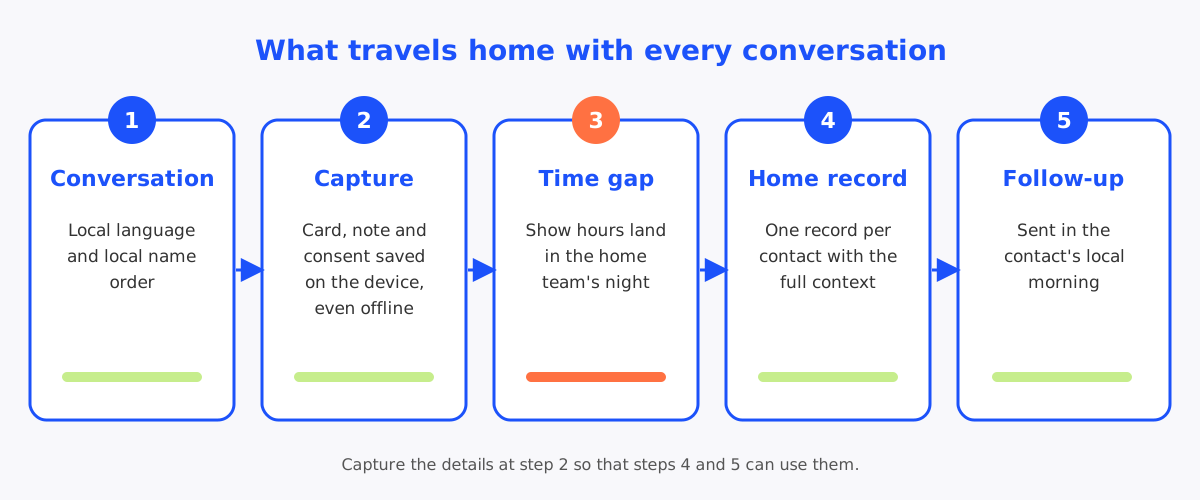
A show abroad gives you a short window with people you may not meet again soon, so the record of each conversation is the part worth protecting. The diagram shows what has to travel with each conversation, and the table lists what to record for every contact.
| Detail to record | Why it matters abroad |
| A photo of the card or badge | It keeps the name and title as written, in the original script and order. |
| How the person likes to be addressed | It prevents the wrong greeting in your first email. |
| Preferred language | It lets you follow up in the language the person chose in the conversation. |
| Country and time zone | It tells you when to send the follow-up and which colleague covers that region. |
| What the person asked and the agreed next step | It gives whoever follows up the full story, including colleagues who were not at the show. |
| How the person agreed to be contacted | It gives you the record that privacy rules can require. |
momencio is a Field Revenue Intelligence platform for teams that sell in person, and events are where many of those conversations begin. Reps scan a badge or a business card, add a typed or spoken note and a tag, and the record syncs to the CRM (the system where your sales team tracks contacts). momencio works with or without the organizer’s own lead retrieval system, so the capture process stays the same from show to show, and it includes controls for data retention, consent management and opt-outs that support the records described above.
For the follow-up itself, read how to turn booth notes into follow-up emails and how long an event lead is worth chasing.
Measure the show against your home-market events
Record the extra costs of the trip so the comparison is fair: shipping, customs fees, travel, interpreters and the days the team spent away. Then compare your cost per qualified lead with the same figure from your home-market shows, using one method for every show so the results can be compared.
Frequently asked questions
- Do I need a visa to exhibit at a trade show in another country?
- It depends on your passport, the destination and what you will do at the show. Many destinations allow short business visits without a visa, and some ask visa-free visitors to apply online for a travel authorization first. Some countries also limit what visitors may do at a trade fair, such as selling on the stand. Check the official government page for each traveler when you choose the show.
- What is an ATA Carnet?
- An ATA Carnet is an international customs document that lets goods enter participating countries free of duties and taxes for up to one year. Exhibitors use it for booth materials, commercial samples and equipment that return home after the show, and more than 80 countries and territories use it.
- Can I scan badges and collect business cards at a show in another country?
- Yes. Scanning badges and collecting cards is a normal part of exhibiting, and many organizers explain at registration how visitors agree to share their details. Privacy laws differ by country, and in the European Union the GDPR requires you to be able to show consent where you rely on it. Ask the organizer how consent works and record when and where you captured each contact.
- How do I follow up with leads in a different time zone?
- Record each contact’s country and time zone when you capture the person, and send the first email so that it arrives at the start of the contact’s working day. Decide before the show which colleague covers each region, so that every lead has a named owner.
See how momencio carries conversations home
If you are planning a show in another country, book a demo to see how momencio captures each conversation, keeps its context and carries it home to your CRM and beyond.