
Look at who is going to your next show.
There is probably one person who has worked twenty of these. There is someone from sales who was free that week. There is a product specialist flown in for two days because a customer asked for a technical answer last year. Possibly a founder who will appear on day two and leave after lunch.
Most of them have never worked a booth together. Several have never met. They will be introduced somewhere between the badge desk and the setup crew, and forty minutes later the floor opens.
Almost everything written about booth teams assumes something else entirely. It assumes a standing team that runs shows regularly, has shared habits, and needs training rather than introductions. That advice is fine and it does not describe your situation.
This is about the other version, where the team is assembled rather than built, and the only preparation window you have is the week before.
Why the team you send is never the team you would pick
Booth rosters are built from availability, not suitability. Somebody has a customer visit that week. Somebody else is closing quarter. The person who is genuinely best at this is at another show.
So the roster fills with people who each have a piece of what the booth needs and no shared sense of how to combine it. The technical specialist can answer anything and will not qualify. The senior seller qualifies instantly and cannot answer the integration question. The marketer knows the messaging and has never handled an objection out loud.
That mix is workable. What breaks it is the assumption that people will sort it out on the floor, which they will not, because the floor is loud and fast and nobody wants to interrupt a colleague mid sentence to renegotiate roles.
A team that has not agreed anything in advance does not improvise well together. It defaults to whatever each person did at their last show, and those defaults contradict each other.
The fix is not training. There is no time for training. The fix is agreement, and it takes about forty minutes on a call the week before.

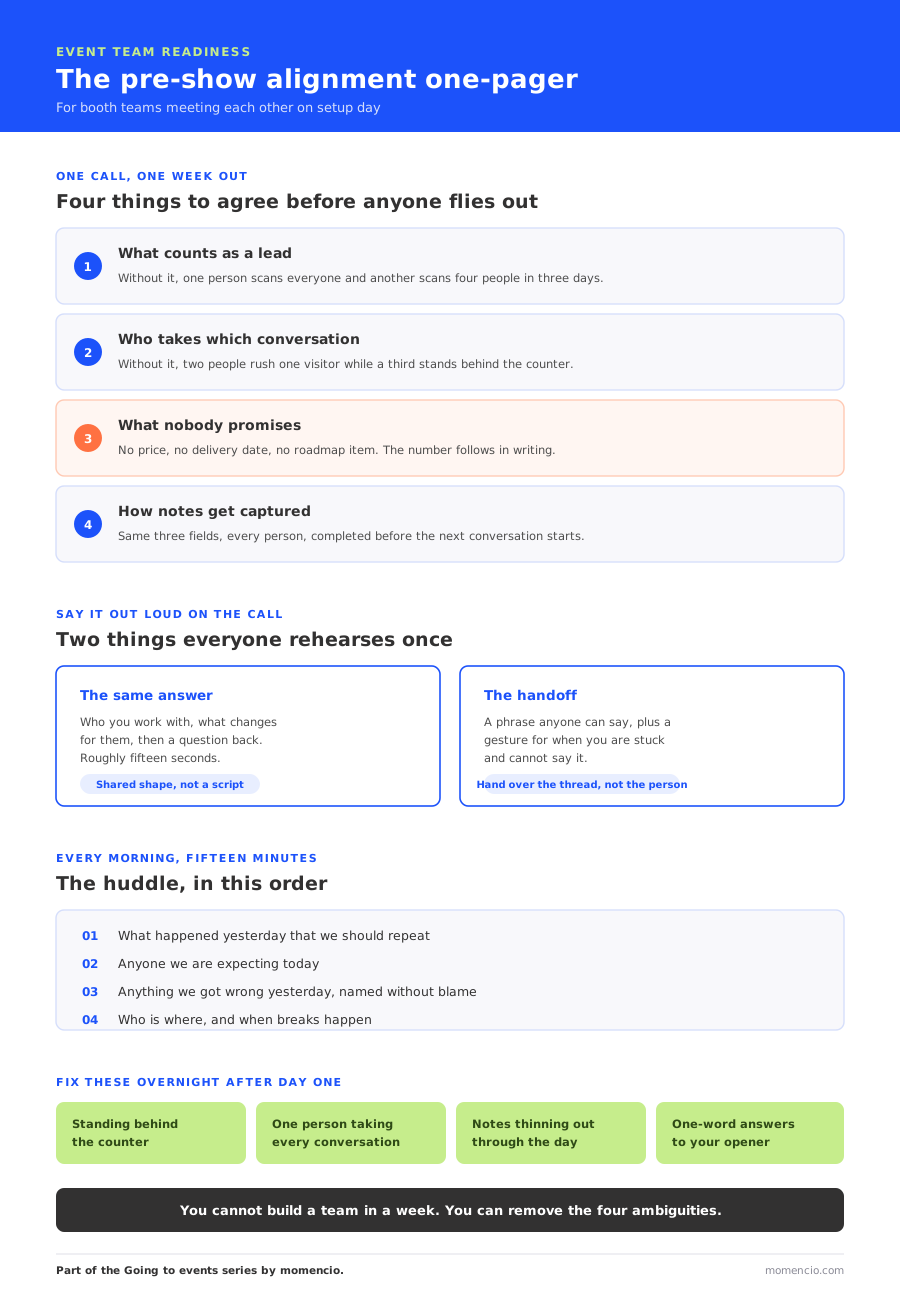
Four things to agree before anyone flies out
These are the four that cause visible problems on the floor when they are left open. Everything else can genuinely be worked out in the moment.
| Agreement | What goes wrong without it | What the decision sounds like |
| What counts as a lead | One person scans everyone who slows down. Another scans four people in three days. Your numbers mean nothing. | We capture anyone who asks a question about how it works. We do not capture anyone who takes a pen. |
| Who takes which conversation | Two people rush the same visitor while a third stands behind the counter. It reads as chaos from the aisle. | Priya takes anything technical. I take pricing. Whoever is free greets, then routes. |
| What nobody promises | Someone commits to a date or a discount to keep a conversation alive. It surfaces six weeks later as a stalled deal. | Nobody quotes a price, a delivery date, or a roadmap item. The answer is that I will get you the exact number. |
| How notes get captured | Three people use three formats. Two write nothing and promise to remember. Nobody remembers. | Everyone captures the same three fields before the next conversation starts. |
Run this as one call with everyone on it, not as a document. The point is that each person hears the others agree, because that is what makes it stick when someone is tired on day two.
A note on the third one
The promise rule is the one people push back on, usually with a version of the argument that they need flexibility to keep a good conversation moving.
The counter is worth saying out loud on the call. A promise made at a booth is remembered precisely by the person who received it and vaguely by the person who made it. It resurfaces in a procurement conversation months later, framed as something your company committed to, and by then nobody can reconstruct what was actually said.
Say the number will follow in writing. It costs you nothing in the conversation and it removes an entire category of later problem.

Everyone should give the same answer to what do you do
This is the failure that unfamiliar teams never notice and visitors always do.
Across three days, five people will be asked the same opening question several hundred times. On an assembled team they give five different answers. The seller describes outcomes. The product specialist describes architecture. The marketer recites the website. The founder describes where the company is going, which is a different company from the one currently being sold.
None of those answers is wrong. The problem is that a visitor who talks to two of your people hears two companies, and the one thing a booth is supposed to establish is that you are a serious, coherent organization.
Fix it with one sentence agreed on the call and said out loud by each person until it sounds natural in their own voice. Not a script to recite word for word, because forced language is worse than inconsistent language. A shared shape.
The shape that works: who you work with, what changes for them, and then a question back. Roughly fifteen seconds. The question at the end matters as much as the description, because it converts a statement into a conversation and stops the visitor from nodding and walking away.
Test it on the call by having each person say it once. You will hear immediately whether the group is describing the same company. If two people hesitate over the same word, change the word.
One caution: Resist the urge to write this as positioning. The version that works at a booth is plainer than anything in your marketing, because the person hearing it is standing up, holding a coffee, and deciding within a few seconds whether to keep listening.
Who handles it when someone senior walks up
This is the moment mixed teams handle worst, and it happens at every show.
Somebody visibly senior stops at the booth. They have three or four minutes and no patience for a discovery sequence. Whoever is nearest either freezes and hands them a brochure, or launches into a pitch calibrated for a manager.
Decide in advance who takes that conversation. Usually it is the most senior person present, not the most technical, because the exchange is about credibility and relevance rather than detail.
Give the other people a specific instruction: bring that person over rather than trying to hold the conversation. The instruction needs to be that blunt, because otherwise nobody wants to look like they are handing off something they could not manage.
Agree the opening line as well. Something short that names who you work with and what changes for them, then a question. Two sentences. Written down, so the person delivering it is not composing under pressure.
How to hand off a conversation without it turning awkward
Handoffs are where unfamiliar teams look most obviously unfamiliar. Someone realizes they are out of depth, and the transition either happens smoothly or the visitor watches two colleagues negotiate in front of them.
Two things prevent it.
- Agree a phrase. Something plain that any of you can say without it sounding like an escalation. Let me bring in Sam, this is exactly the thing he handles. Practice it once on the call so it does not sound rehearsed on the floor.
- Agree a physical signal for when someone is stuck and cannot say the phrase. Booth conversations get trapped. A small gesture that means come and take this is more useful than any amount of preparation, and it only works if everyone knows it in advance.
The receiving person should also know what to do with the handoff. They pick up the thread rather than restarting, which means the person handing over says one sentence of context out loud in front of the visitor. He is looking at replacing a system that does not talk to their CRM. Now Sam starts from there rather than from the beginning.
Visitors read a clean handoff as competence. They read a messy one as a company that does not talk internally, which is a strange thing to demonstrate at your own booth.
The fifteen minute morning huddle
Every morning, before the doors open, get the group together for a quarter of an hour. Not a rally, a working session with four items on it.
Four items, in this order.
- What happened yesterday that we should repeat. Specific things, such as a question that landed or a phrase that made people stop.
- Anyone we are expecting today. Meetings booked, accounts we know are walking the floor, anyone who said they would come back.
- Anything we got wrong yesterday. Named without blame, because on day one it is almost always a process problem rather than a person problem.
- Who is where, and when breaks happen. Coverage is a coordination problem and it is solved in two minutes if you actually say it out loud.
On day one this feels unnecessary because nothing has happened yet. Run it anyway with items two and four. It establishes the habit before you need it, and by day two you will need it.
What you can still fix between day one and day two
Day one is diagnostic whether you plan it that way or not. An unfamiliar team always gets a few things wrong on the first morning, and most of them are correctable overnight.
Watch for four specific things and fix them that evening.
- People standing behind the counter rather than at the edge of the booth. Easiest fix available and it changes traffic noticeably.
- The same person taking every conversation while the others watch. Usually a confidence problem rather than an eagerness problem, and it is solved by assigning the quieter people a specific role rather than telling them to jump in.
- Notes getting thinner as the day goes on. Predictable, and the fix is a hard rule that the record is completed before the next conversation begins.
- The opening question not working. If people are answering it in one word, it is the wrong question. Change it that night rather than persisting for two more days.
Debrief for ten minutes at the end of day one, while it is still fresh and while there is still a day two to apply it to. A team that adjusts on day one usually finishes the show performing like a team that had worked together before.

The short version
You cannot build a team in a week. You can remove the four ambiguities that make an unfamiliar team look unfamiliar, which is a much smaller job and produces most of the benefit.
That means one call the week before, an agreed phrase and signal for handoffs, a named person for senior visitors, fifteen minutes every morning, and a real debrief at the end of day one.
None of that requires anyone to have worked together before. It just requires someone to decide it in advance, and that person is usually you.
Frequently asked questions
- How far ahead should the alignment call happen?
- Roughly a week out. Earlier and people forget, later and you cannot change the roster or the collateral if the call surfaces a gap. A week gives you time to act on what comes up.
- What if some of the team cannot make the call?
- Record it and require them to watch it before travel. The agreements matter more than the attendance, though someone who has not heard the others agree is more likely to revert to their own defaults under pressure.
- Should the most experienced person run the booth?
- They should run the coordination, which is not the same as taking the most conversations. The most experienced person is usually most valuable watching the floor, spotting who is stuck, and rebalancing coverage.
- How do we handle someone who is genuinely bad at this?
- Give them a role that does not require them to open conversations. Managing the record keeping, handling scheduled meetings, or supporting demos are all real contributions. Forcing a reluctant person to work the aisle produces worse results than letting them do something useful.
- Does any of this change for a smaller show?
- The four agreements matter more, not less. On a small stand with two people there is nowhere to hide a coordination problem, and every visitor sees it.
- What if the founder shows up unannounced?
- Brief them like anyone else, in two minutes, on the way in. Tell them what counts as a lead, what nobody is promising, and who to hand a technical question to. Senior people generally follow the rules when someone bothers to state them.