
Salesforce reports that only 35% of sales professionals completely trust the accuracy of their organization’s data. For field sales leaders that number carries a specific weight, because the data underneath most field forecasts is the data field reps enter about themselves.
Field sales activity tracking produces one kind of record. Check-ins, visit logs, mileage, call notes, and next steps all originate with the person being measured. The buyer contributes nothing. A rep can complete every required field for an entire quarter without a single customer taking any action at all, and the dashboard will report a productive territory.
That is the structural problem. Activity tracking measures seller effort with real precision. It has no instrument for buyer response.
What field sales activity tracking actually captures
The category covers four record types. Location verification confirms a rep reached an account, usually through a GPS-stamped check-in. Visit logging captures what happened, as structured notes, a photo, or a voice memo converted to text. Route and time data show how the working day was spent. Attribution ties those visits back to open opportunities in the CRM.
These features solved a real problem. Before location verification existed, a territory manager had no reliable way to confirm coverage, and a rep working hard in a difficult patch had no way to prove it. Activity tracking settled that argument, and the tools that built it deserve credit for settling it.
The difficulty begins when the same data is asked to do a second job. Coverage data became forecast data. Nobody decided this deliberately. It happened because activity was the only field-level number available, and quarterly reviews needed something to point at.
Seller-generated data does not fail randomly
Every field sales team knows its activity data is imperfect. Far fewer teams account for the direction of the error.
Logging discipline is not evenly distributed across a quarter or across a team. It falls hardest in the weeks when reps are busiest, which are the weeks closest to quarter end. It falls hardest on the reps carrying the most live opportunities, because those reps have the least administrative time. Salesforce puts the average seller at roughly 40 percent of the week spent actually selling, with the balance absorbed by admin, internal meetings, and data entry. Every additional required field pushes that number further down.
The result is a dataset that under-reports your strongest reps during your most important weeks. Those gaps are not random noise. They cluster exactly where the stakes are highest. A forecast built on that record does not carry a wide margin of error in both directions. It carries a predictable bias in one.
A verified visit is not a verified outcome
Consider two reps who each log twenty visits in a quarter. One closes four deals and the other closes none. Activity tracking records an identical quarter for both, because every event it can observe was identical. What separated them happened after each rep walked out, in the buyer’s own time, on the buyer’s own device.
Activity metrics have no denominator. They count what the seller did. They cannot count what came back. A check-in confirms attendance at a location and nothing past it, and attendance has never been the variable that predicts revenue.
Four buyer-generated signals field teams can measure instead
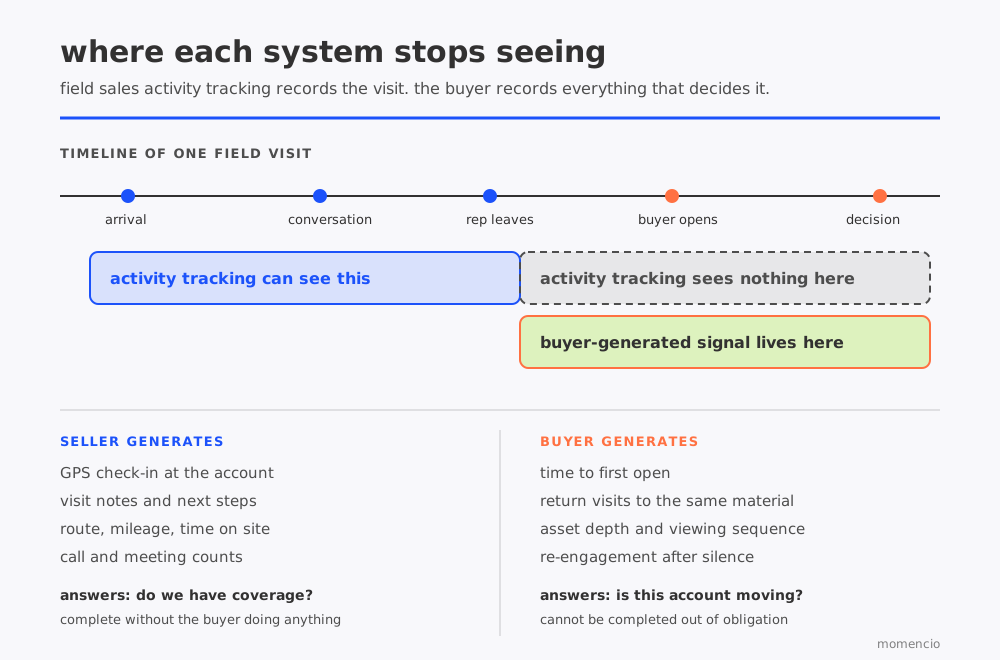
Buyer-generated data has one property that seller-generated data can never have. The buyer produces it voluntarily, which means it cannot be completed out of obligation and cannot be inflated by a rep under quota pressure. Any engagement tracking that records what the buyer does after a meeting produces this class of data automatically.
Time to first open
Measure the hours between sending material and the buyer first opening it. Inside twenty-four hours, the conversation was still live in the buyer’s mind. Past seventy-two hours, the material was filed rather than read, whatever the meeting felt like at the time.
Treat this as a relative measure. Benchmark it against your own account history rather than an external standard, because response speed varies enormously by industry and by seniority. What matters is the direction of travel within a single account across repeat visits.
Return visits to the same material
A first open can be courtesy. A second visit three days later is something else. Return behavior separates politeness from process, and it is the cleanest intent signal available to a field rep.
The action it points to is specific. A return visit tells you the buyer was thinking about your solution within the last hour, which makes it the strongest available trigger for an unscheduled call. Reps who work return-visit alerts reach buyers mid-consideration rather than mid-inbox.
Asset depth and sequence
Which assets the buyer opened matters less than the order in which they opened them. A buyer who reviews an overview and then a pricing page sits at a different stage from one who reads two implementation case studies and stops.
Record the sequence rather than the count. Sequence tells you which question the buyer is currently trying to answer, and that tells the rep what the next conversation needs to contain.
Re-engagement after silence
A contact who goes quiet for two weeks and then returns to your material is producing the most valuable signal in field selling. Silence followed by renewed attention usually indicates that an internal discussion took place, one the rep was not part of and would otherwise never hear about.
In accounts where a rep meets one contact but six people decide, this is often the only visibility available into the internal process. Reps who capture contacts at conferences and industry meetings rather than at their own premises depend on it almost entirely. Treat a re-engagement event as a higher-priority trigger than any first open.

Running both systems without adding rep workload
None of this argues for removing activity tracking. It argues for narrowing the question you ask it to answer.
Activity data answers a capacity question. Do we have enough coverage across the territory? Is a rep under-visiting a segment? Is the team’s call volume sustainable through a full year? For questions of that shape, seller-generated data is the correct instrument and nothing else will substitute for it.
Buyer-generated data answers a pipeline question. Which accounts are actually moving, and which have gone cold behind a friendly meeting? Activity data cannot answer this at any useful level of accuracy, because the events it observes stop at the door.
The dividing rule is short enough to apply inside a review meeting. Any metric a rep can complete without the buyer doing anything is a capacity metric rather than a pipeline metric. Use capacity metrics for planning and response metrics for forecasting.
The workload point matters as much as the accuracy point. Buyer-generated signals cost the rep nothing after the first send. When a rep shares material through a tracked page instead of an email attachment, every open, revisit, and asset view records itself. Platforms built for in-person selling, including momencio’s field sales app, capture the contact and enrich the record on the spot, then track what the buyer does with the material afterward without asking the rep to log anything.
A test to run before your next forecast
Pull closed-won and closed-lost accounts from the last four quarters and compare the median visit count for each group.
If those two medians sit within roughly fifteen percent of each other, visit volume is not predictive in your business. Any forecast weighted on activity is weighted on a number that does not separate the outcomes you care about. Most field organizations running this test for the first time find the gap smaller than they expected.
Then run the second half. For the deals that closed, find the date of the buyer’s last engagement with material you sent, and compare it against the date of your rep’s next logged action. In most teams the buyer signal arrives several days ahead of the rep’s response. That interval is the window your current reporting cannot see, and it is where competitive losses are quietly decided.
Frequently asked questions
- What is field sales activity tracking?
- Field sales activity tracking is the practice of recording what outside sales reps do during the working day, including GPS-verified check-ins at customer sites, visit notes, route and mileage data, and call logs. The data is generated by the rep rather than the customer, which makes it accurate for measuring territory coverage and unreliable for predicting deal outcomes.
- Is field sales activity tracking worth it?
- It is worth it for capacity planning, territory coverage analysis, and coaching newer reps on call rhythm. It is a poor basis for forecasting, because it records seller effort rather than buyer response, and logging discipline drops fastest among the busiest reps at quarter end.
- What should field sales teams measure instead of activity?
- Measure signals the buyer generates: time to first open on material sent after a meeting, return visits to that material, the sequence of assets viewed, and re-engagement after a period of silence. None of these can be completed by a rep out of obligation, which is precisely what makes them reliable.
- Does GPS tracking improve field sales performance?
- GPS verification improves the accuracy of coverage reporting and removes disputes about where reps spent their time. Evidence that it improves conversion is thin, because location data describes where a conversation happened rather than what the buyer did once it ended.
- How do you measure field sales performance without tracking reps?
- Attach a tracked digital page to every piece of material a rep shares, then measure the buyer’s behavior on it. Engagement depth, revisit frequency, and the interval between the meeting and the first open give managers a performance picture that requires no rep data entry and no location monitoring.