
You know that moment at a trade show when you’re standing there, badge scanner in hand, smiling at yet another polite “send me some info” guy?
Yeah. That’s the exact second most reps waste thousands in travel, booth fees, and bar tabs… and walk away with a spreadsheet full of contacts that sales will quietly ghost by Tuesday.
It is common knowledge that trade shows are not dead, if anything, trade shows might just be the biggest thing in the age of AI avatars taking over the digital screens. Having said that trade shows are just being played wrong by 90% of the people working them.
The buyers are still there, the real ones. Recent research data shows 81% of attendees have actual buying authority and 72% of exhibitors list lead gen as their #1 reason for showing up. These aren’t tire-kickers scrolling LinkedIn in their pajamas. They flew in, they’re on expense accounts, and they’re actively hunting solutions.
But here’s what separates the reps who crush quota from the ones who just collect swag: the elite closers don’t hunt for more names. They hunt for context—the exact pain, the budget reality, the hidden stakeholders, and the next-step commitment—while the conversation is still warm and the buyer is standing right in front of them.
Because you’re a sales rep. You already know how to read a room, build instant rapport, and spot a real opportunity from thirty feet away. You don’t need another generic “run better demos” checklist.
You need an unfair edge that turns those five-minute booth chats into pipeline that actually moves.
That’s exactly what these 9 ways to generate better trade show leads deliver. No fluff. No recycled booth-traffic advice. Just the tactics the smartest reps are quietly using to leave the show with qualified opportunities instead of a pile of business cards.
9 ways to generate better trade show leads
A lead should answer five questions before the person walks away.
- What problem are they dealing with.
- How is it hurting them.
- Why does it matter now.
- Who else gets pulled into the decision.
- What next step did they agree to.
If you do not have those answers, you only have a contact record, not a lead who can potentially convert to a customer tomorrow. Sales can still work with a contact record, but the odds drop drastically and the effort that goes into cleanup grows exponentially.
1. Ask for the problem before you ask for the scan
EXHIBITOR has made this point for years in its qualification guidance. Strong booth conversations start with the buyer’s current problem, not with a product tour. Ask what is slowing the team down. Ask what they came to the show hoping to fix. Ask what happens if the issue stays in place for six more months.
This is straight Gap Selling logic. Problems create movement. Interest becomes useful when it connects to a problem with cost and urgency. When a rep starts with the problem, the follow-up later has something to hold on to. When a rep starts with the pitch, the conversation turns into booth theater.
2. Turn your giveaway into a second qualification event
Most swag attracts people who want swag. That is predictable. It also bloats your lead count with weak intent.
One of the more useful ideas showing up in marketer communities is to make the giveaway happen in two steps. A custom item with later pickup, such as on-site engraving, gives the attendee a reason to return. That second stop gives your team another chance to qualify, introduce a second rep, or lock in a next step. Some teams also reserve better gifts for people who complete a short diagnostic or meet a qualification threshold.
This move is worth using because it creates more time with the right people. Time raises lead quality.
3. Replace the booth demo with a three-minute benchmark
A standard booth demo flatters the product. A short benchmark exposes the buyer’s gap.
That benchmark can be a cost-of-delay calculator, a readiness score, or a five-question check that shows where the current process breaks. Gartner’s guidance on the B2B buying journey points to the same need from the buyer side. Buyers want tailored recommendations, clarity on benefits, and a clear next step. A short benchmark gives you all three.
This is also where a clean lead capture process matters. The benchmark result, the problem discussed, and the next step have to stay together after the event or the value disappears.
4. Capture one memory cue during every serious conversation
Trade shows overload memory. Buyers meet too many vendors, hear too many pitches, and come home to too many emails. Your follow-up competes with all of that.
Research on the picture-superiority effect shows that people remember visual information better than words alone. Research on self-generated cues shows that recall improves when the cue connects to the person’s own experience. So every serious booth conversation should end with one cue the buyer can recognize later.
That cue can be a photo of the benchmark result, a short recap written in the buyer’s own language, or a tailored follow-up page with only the assets tied to that problem. The point is recall. If the buyer cannot place your conversation when your email arrives, your follow-up starts cold.
5. Make the buyer choose the next step before they leave
Weak follow-up usually starts with a weak next step. Reps ask whether they can send more information. Buyers say yes. Nothing moves.
Behavioral research on planning prompts shows that people follow through more often when they form a concrete plan. The booth is the best place to do that because the problem still feels fresh. Ask what would help them move this forward. Then pin it down while they are still there. Send the ROI model. Share pricing ranges. Bring in the operations lead. Book twenty minutes next Thursday.
A narrow follow-up page helps because it keeps the next step focused. LiveMicrosites™ fit this use case when the rep wants to send only the few items that match the conversation.
6. Split your follow-up by heat within 24 hours
Harvard Business Review reported that firms that tried to contact leads within an hour were nearly seven times more likely to qualify them than firms that waited longer. Trade show leads are not identical to web leads, but the lesson still lands. Waiting days for spreadsheet cleanup wastes the best window you have.
Practitioner threads add the nuance that ranking articles often miss. Hot leads deserve same-day or next-morning follow-up tied to the promised next step. Warm leads need a thoughtful note while the booth interaction still feels familiar. Cooler leads can move into a slower sequence. Route by heat, not by spreadsheet order. A field marketers playbook workflow that forces hot, warm, and cold scoring on the floor will beat almost any clever email sequence built after the event.
7. Expand one booth visitor into the buying group
One badge rarely equals one clean path to a deal. Forrester’s Buyers’ Journey Survey, 2025 found that 73% of purchases involve three or more departments, with an average of 13 people inside the buyer’s organization and nine from outside involved in the decision. Gartner reported in 2025 that 74% of B2B buyer teams show unhealthy conflict during the decision process.
That changes the booth job. Reps should ask who else needs to weigh in. They should ask where deals like this usually stall. They should ask which stakeholder will care most about cost, risk, integration, or timing. One of the fastest ways to generate more sales leads at trade shows is to turn one contact into access to the rest of the buying group.
8. Work the floor for trigger language before prospects reach you
One of the smartest pieces of sales-community advice sounds obvious after you hear it. Walk the floor. Visit competitor booths. Sit near the right sessions. Listen to how prospects describe their problems when no one is feeding them your positioning.
EXHIBITOR’s recon guidance supports the same move. Watch what attendees ask, what they take, and how long they stay. Those details tell you what matters this week, not what mattered in the slide deck your team wrote months ago.
This matters because booth openers land harder when they mirror buyer language. If you hear the same complaint three times in one morning, rewrite your opener that afternoon.
9. Score the conversation by sales value and judge the show by pipeline
Badge count is a weak success metric because it trains the booth to chase volume. The score from the floor should reflect sales value. Did the rep uncover a real problem. Did they capture impact. Did they find urgency. Did they identify other stakeholders. Did they secure a next step.
That is why simple hot, warm, cold scoring still works. Community discussions around trade show follow-up keep landing on the same point. Perfect follow-up cannot rescue weak qualification. Once the show ends, judge performance by qualified conversations, next meetings booked, buying groups identified, opportunities created, and pipeline influenced. An event ROI calculator helps because it forces the team to connect booth activity to money, not applause.
The teams that win trade shows leave with sales context
They leave with diagnosed problems, memory cues, planned next steps, and enough context for sales to act while the conversation still has heat. That takes more discipline than most ranking articles ask for. It also produces leads that matter.
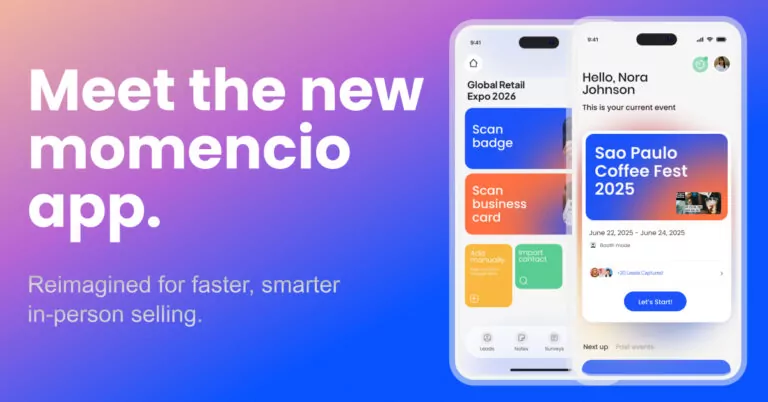
For teams that want to tighten the gap between booth conversation and follow-through, momencio for event and field marketers is most useful where the process usually breaks for event and field marketers after the scan and before the opportunity.
Ready to stop leaving money on the show floor? Book a quick demo with momencio and see how it closes the gap between booth conversation and closed-won deals.