
Most post-show debriefs arrive at the same conclusion: the booth looked great, the product was solid, and the pipeline didn’t reflect either. The gap between a well-designed stand and a high-performing one is almost never the booth itself. It’s the people staffing it and what they were — or weren’t — prepared to do.
Trade show floors are high-noise, high-distraction environments where reps have approximately 90 seconds to identify whether a visitor is worth a 20-minute conversation or a polite handoff. Making that call consistently, across two or three days, requires preparation that goes well beyond product knowledge. It requires a shared framework for qualification, a clear system for capturing and recording leads, and the kind of physical and mental readiness that doesn’t happen by accident.
This guide covers what event managers need to give their booth teams before the floor opens — and what the teams themselves need to internalize before they step on.
Why staff preparation determines show performance more than anything else
There is a persistent assumption in event marketing that the booth does the selling. Spend enough on design, load the screen with the right demo, and leads will follow. The data doesn’t support it.
92% of trade show attendees say their primary reason for attending is to see new products and meet potential vendors — which means they arrive already open to conversation. The qualification bottleneck is rarely interest. It’s the quality of the interaction that follows.
A skilled booth rep turns a curious passerby into a qualified discovery call. An underprepared one takes a badge scan, hands over a brochure, and lets genuine intent walk away unrecognized. At a show where a single enterprise deal justifies the entire budget, that difference is not marginal.
Preparation doesn’t mean scripting every interaction. It means equipping your team with enough shared context — about the audience, the objectives, the qualification criteria, and the capture process — that they can navigate unpredictable conversations without breaking down.
Defining roles before the floor opens
One of the most common causes of booth underperformance is role ambiguity. When everyone is responsible for everything, the result is that difficult moments — a complex technical question, a senior executive stopping by, a qualification conversation that’s gone sideways — get handled inconsistently.
Assign roles explicitly before the show, not during it. A functional trade show team typically needs three capabilities covered.
The qualifier is the person whose primary job is to engage passersby, run the initial conversation, and determine whether a visitor meets the criteria for a deeper discussion. This role requires strong interpersonal skills and a sharp instinct for reading buying signals. It is not the same as knowing the product inside out.
The subject matter expert handles the conversations the qualifier escalates — the technical deep-dives, the procurement questions, the competitive comparisons. Not every booth needs a dedicated SME, but every team needs a designated answer for “who do I hand this off to when the conversation goes deep.”
The lead capture owner makes sure every significant interaction results in a structured record. In teams where everyone is responsible for logging leads, the gaps predictably appear during the busiest hours — which is precisely when the highest-quality leads are on the floor. Assigning this responsibility clearly prevents it.
For smaller teams, one person will cover multiple roles. The point is not headcount — it’s clarity. Every team member should know, before the floor opens, what their primary function is and when to call in support.
The qualification framework your team needs before they arrive
Qualification at a trade show is different from qualification in a sales call. You have less time, more ambient noise, and a visitor who’s simultaneously watching the booth next door. The framework your team uses needs to be tight enough to apply in a three-minute conversation and flexible enough to adapt to the person in front of them.
The most effective qualification frameworks at events use four variables: role, problem, timeline, and authority. Not all four need to surface in every conversation, but the rep should know which two or three are most diagnostic for your specific ICP at this specific show.
Role establishes whether the person standing in front of you is a decision-maker, an influencer, an evaluator, or someone doing preliminary research on behalf of someone else. Each requires a different kind of conversation and a different follow-up sequence.
Problem establishes whether the challenge your product solves is something they are actively experiencing, aware of but not prioritizing, or not yet on their radar. The difference between the first and the third is significant — it determines what kind of follow-up is worth the effort.
Timeline tells you whether this is a conversation worth escalating at the show itself — perhaps worth booking a follow-up meeting before they leave the floor — or one to capture carefully and nurture post-event.
Authority tells you whether the person you’re speaking with can advance a decision or whether the decision lives elsewhere in the organization. This doesn’t mean de-prioritizing influencers — they can be powerful internal advocates — but it does change how you structure the follow-up.
Build these variables into a short set of natural conversation questions and share them in writing with your team before the show. The goal is not a script; it’s a shared lens.
Questions that don’t sound like interrogations
The fastest way to end a booth conversation is to make the visitor feel qualified rather than helped. Questions that work are the ones that sound like genuine curiosity: “What brought you over?” and “What are you trying to solve for this year?” cover role, problem, and timeline in two exchanges if the rep knows how to listen.
Train your team to lead with open questions and follow up with one specific probe, not a checklist. The checklist mentality produces information but kills rapport. The goal is a conversation that ends with the visitor wanting to continue it — not one that ends with a form filled out. What your team does with those conversations immediately after is where in-booth engagement strategy and lead capture discipline intersect.
Lead capture: the discipline that protects your ROI
Badge scanning is not lead capture. It is contact capture. The distinction matters because a list of scanned badges — without context, qualification notes, or intent signals — produces a follow-up problem, not a pipeline.
Effective lead capture at a trade show requires two things that most teams skip: a consistent structure for what gets recorded, and a discipline for recording it immediately after the conversation, not at the end of the day.
The structure should include the qualification outcome (what tier does this lead belong to), the specific problem or use case the visitor mentioned, any commitment made during the conversation (a demo, a follow-up call, a piece of content), and the rep’s overall read on intent and readiness. This takes 60 seconds to complete after a conversation. Waiting until the end of the day turns it into a reconstruction exercise that loses precision.
Platforms like momencio allow reps to capture structured notes against each lead in real time, with those records syncing directly to CRM post-show. When the rep notes include a specific pain point and a qualification tier, the follow-up sequence can be personalized before the exhibitor has left the venue. When they don’t, every lead gets the same generic email and the pipeline reflects it.
Make the capture process part of the pre-show briefing. Show the team the tool, walk through what a good record looks like versus a thin one, and set the expectation clearly: every conversation worth having is worth a structured record. Teams that treat lead retrieval as an afterthought consistently underperform against teams that build it into the pre-event workflow.
Managing energy across a multi-day show
Day two is always harder than day one. This is not a motivation problem — it is a physiological reality. Booth staff are standing for eight to ten hours, operating in loud environments, and maintaining a level of interpersonal engagement that is cognitively demanding. By mid-afternoon on the second day, the quality of conversations reliably drops unless the team has managed their energy deliberately.
Rotation schedules are the most effective tool here. No rep should be “on” at the booth for more than 90 minutes without a genuine break — away from the booth, away from the noise. A team that dismisses this as unnecessary will pay for it in the quality of their late-afternoon leads.
Brief the team on this explicitly. Many booth staff treat breaks as optional or feel pressure not to leave the stand. The event manager’s job is to remove that pressure and make rotation a structured expectation, not a perk.
The evening debrief is the other high-leverage habit. A 20-minute debrief at the end of each show day — reviewing the day’s lead pipeline, flagging the conversations worth prioritizing tomorrow, and surfacing anything the team needs to adjust — pays back multiples the next morning. Teams that skip it start day two cold; teams that run it start it informed.
The pre-show briefing: what to cover in the hour before doors open
The single highest-leverage moment in booth staff preparation is not the training session you ran two weeks ago. It is the briefing you run in the hour before the floor opens on day one.
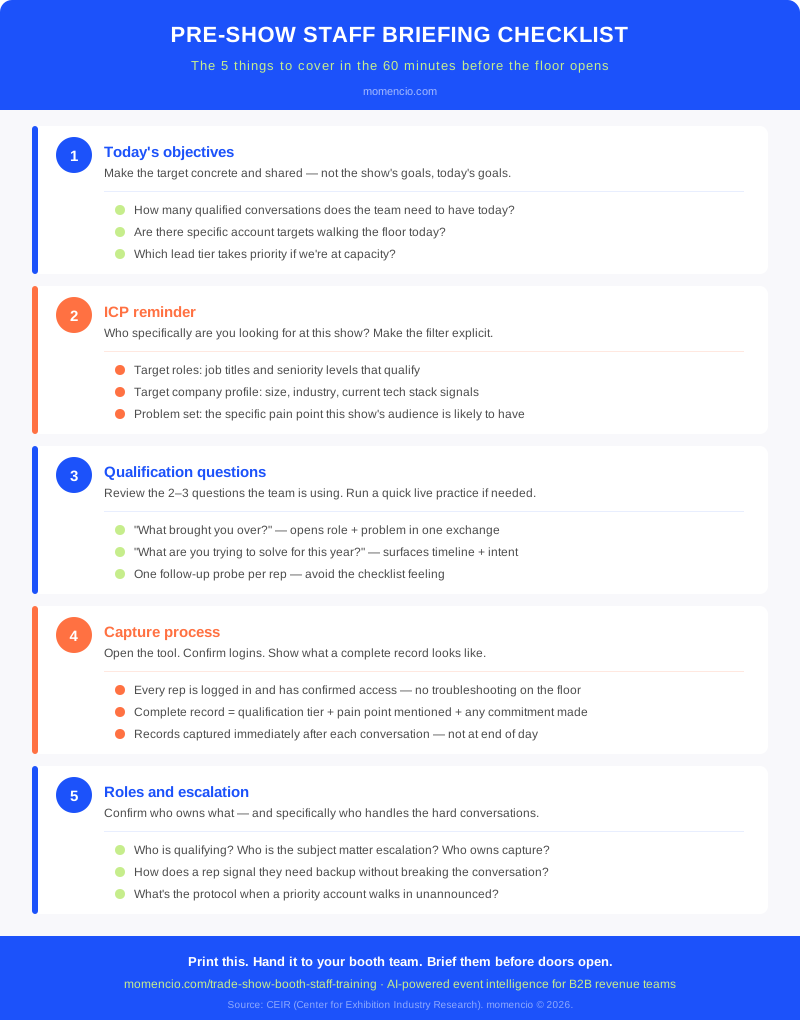
This is when context is freshest, stakes are tangible, and the team is assembled in one place. A good briefing takes 45 to 60 minutes and covers five things.
First: today’s objectives. Not the show’s objectives — today’s. How many qualified conversations does the team need to have? Are there specific account targets walking the floor? Is there a priority tier of lead that outweighs others? Make the target concrete and shared. Connecting these daily targets back to your event ROI measurement framework gives the team a line of sight from individual conversations to show-level outcomes.
Second: the ICP reminder. Who specifically are you looking for at this show? What does a qualified visitor look like in terms of role, company size, and problem set? This is the filter every rep applies to every passerby, and it needs to be fresh.
Third: the qualification questions. Review the two or three questions the team is using to qualify, and do a quick live practice run if the team includes anyone who hasn’t used them before.
Fourth: the capture process. Open the tool, confirm everyone is logged in, and show what a complete record looks like. This is not the time to troubleshoot authentication issues — which means the tech check should happen the day before, but the confirmation should happen here. If you are using a universal lead capture platform, confirm that badge scanning, business card capture, and manual entry are all tested and accessible.
Fifth: roles and escalation. Confirm who is doing what, and specifically confirm the escalation path: if a rep gets into a conversation that requires deeper expertise, who do they call in and how?
The briefing document that supports this conversation — a single printed or digital one-pager the team can refer to throughout the day — is the infographic that accompanies this article.
What well-prepared teams do that underprepared teams don’t
The difference between a booth team that generates a strong pipeline and one that generates a list of contacts comes down to a handful of consistent behaviors.
Well-prepared teams qualify actively rather than reactively. They engage passersby with a specific purpose — assessing fit — rather than waiting to be asked questions. They are comfortable saying, within two minutes, whether a conversation is worth pursuing further. Their approach to booth traffic is fundamentally different: volume is not the goal, fit is.
They capture leads completely, not partially. Every conversation that clears the qualification threshold produces a structured record with context, not just a badge scan. This discipline is the difference between a post-event follow-up that continues a conversation and one that restarts it.
They communicate across the team during the show. When a high-priority account walks the floor, the right rep knows about it. When a conversation surfaces a competitive objection the whole team should be aware of, it gets shared at the debrief rather than siloed with the rep who heard it. Real-time visibility into lead activity and engagement scoring helps event managers surface these signals without waiting for end-of-day readouts.
And they maintain their standard through the final hour of the final day. The leads that walk in during the last 90 minutes of a trade show are often the ones with the fewest competing demands on their time. Underprepared teams have already mentally checked out. Prepared ones haven’t.
See how momencio supports your booth team on the floor
From structured lead capture and real-time qualification notes to AI IntelliSense™, IntelliStream™ live event dashboards, and CRM-ready post-show records, momencio is built for the gap between badge scan and pipeline. See it in action before your next show.