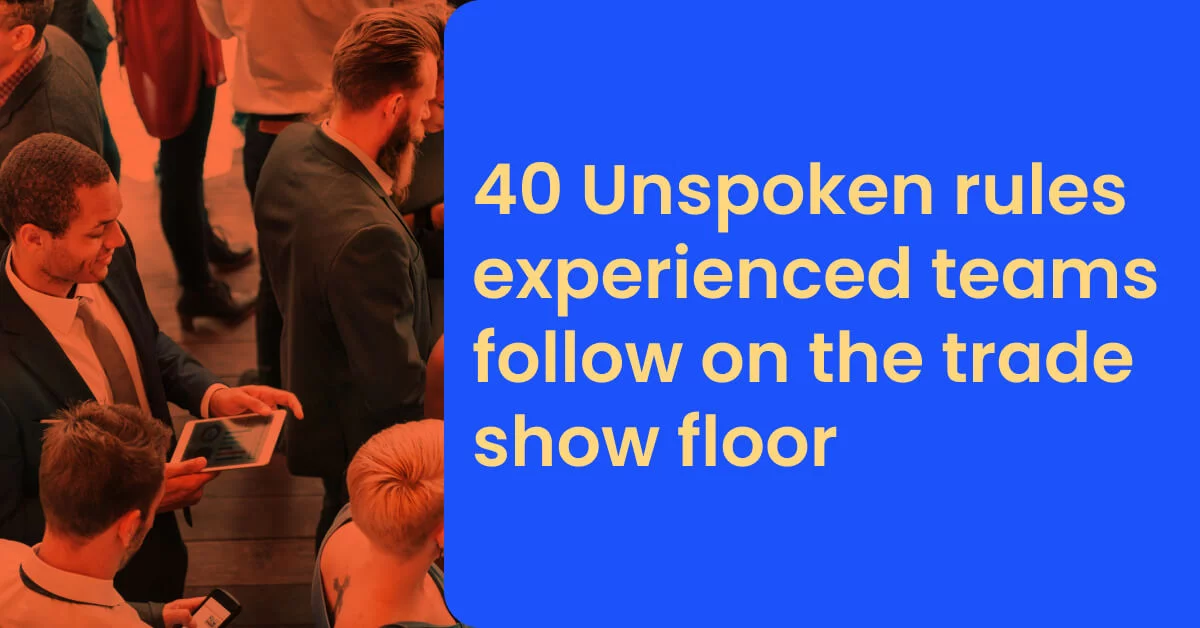
The floor truth that separates veterans from rookies
We have embraced 2026 with some learnings we picked up along the way and over the past year and from observing the trade show floor momentum. Anyone who’s been on the floor for over a decade would know how it has evolved at lightening speed over the past few years in comparison to all the previous years. You can read every trade show playbook ever written. Attend every webinar. Follow every best practice checklist. And still walk onto the floor, to be completely flummoxed by the utter chaos.
We have put together 40 truths, rules, whatever you want to call them, that can help unravel some of this chaos to bring more clarity on how to navigate the events of 2026.
Because the trade show floor operates on a completely different set of rules. The ones that never make it into the training manual. The ones that get discussed over drinks at the hotel bar after Day 1 crushes your spirit.
These are those rules.
Forty truths that veteran field reps know in their bones. If you’ve been doing this for a decade, you’ll nod along and probably add a few of your own. If you’re newer to the game, bookmark this. It might save your quarter.
The clock rules everything
1. The first 47 minutes after doors open belong to badge scanners, not buyers
That initial rush looks exciting. Don’t be fooled. The first wave is dominated by people completing passport challenges, collecting swag for colleagues back home, and competitors doing recon. Your actual buyers are still getting coffee and strategizing their floor walk. Save your best energy.
2. The 90 minutes before lunch is when decisions get made
Attendees have done their first pass. They know who they want to talk to. They’re trying to get serious conversations done before the food coma hits. If you’re not fully staffed and sharp between 10:30 and noon, you’re missing your best window.
3. Post-lunch lull is for relationship maintenance, not prospecting
Typically, between 1:30 and 2:45, the floor is sluggish. People are checking emails and fighting food comas. This is when you check in with existing customers who stopped by, send quick follow-up notes from morning conversations, and let your team rotate breaks. Don’t burn premium reps on low-traffic hours.
4. The last 90 minutes of Day 1 are when competitors reveal their hand
By late afternoon, the urgency drops. Booth staff get chatty. Conversations drift. This is when you send someone to casually observe competitor booths. Not to spy, but to notice what messaging they’re emphasizing, what demos are drawing crowds, and which problems they’re positioning against. Intelligence gathered here shapes Day 2.
5. Day 2 morning is your highest-intent window
Serious buyers who stayed through Day 1 come back on Day 2 with shorter lists and harder questions. They’ve already eliminated vendors. If they’re at your booth on Day 2 morning, they’re comparing finalists. Close differently.
6. The final two hours of any show belong to tire-kickers and desperate exhibitors
Decision-makers have left to catch flights. What remains are people who didn’t manage their time well, junior attendees sent to collect materials, and exhibitors walking the floor because their booth is empty. Staff appropriately. Don’t pack up early, but don’t expect miracles either.
Territory and positioning
7. Attendees intuitively walk right when entering any hall
This is behavioral science, not superstition. Studies of retail foot traffic confirm people default to the right upon entering any space. The booths on the right side of the entrance see fresher, higher-energy attendees. By the time they reach the back-left corner, they’re tired, bag-heavy, and mentally checked out. If you’re stuck in that corner, you need to work three times harder just to get baseline attention.
8. The booth next to the coffee station isn’t lucky, it’s cursed
Yes, foot traffic is high. But nobody is stopping for you. They’re stopping for caffeine. You get 4,000 people walking past your booth with their eyes locked on the espresso machine. Unless you’re physically intercepting them post-coffee, you’re just background noise.
9. Corner booths are worth the upcharge, back-wall booths rarely are
Corners expose you from two directions and create natural stopping points in attendee traffic flow. Back walls look great on the floor plan but get systematically avoided because attendees migrate toward aisles with booths on both sides. One-sided aisle real estate underperforms.
10. Being adjacent to your biggest competitor is either genius or suicide
There’s no middle ground. If you have a clear differentiation story and can handle the comparison shopping, the proximity becomes a gift. Every person visiting them will glance at you. But if you’re perceived as the smaller player or your messaging is muddled, you’ll spend three days playing defense. Know yourself before you request that placement.
11. The “island” booth in the center gets photographed but not engaged
Those massive island installations with hanging banners and four-sided access look impressive on LinkedIn. But attendees often treat them like monuments, not destinations. They take photos, grab a brochure, and keep moving. Without a clear entry point and visible engagement activity, all that square footage becomes an expensive landmark, not a conversion machine.
The human mechanics
12. Nobody approaches a booth where staff are talking to each other
This is the single most common mistake on any show floor. Two reps chatting creates an invisible barrier. Attendees assume they’re interrupting. They won’t. They’ll just walk past. If you have downtime, face outward, physically separate, and look available. The conversation can wait.
13. The rep who sits down has checked out
Standing creates readiness. Sitting creates hierarchy. When your rep sits, attendees have to look down at them, which psychologically positions them as supplicants requesting attention. The dynamic flips entirely. Chairs in the booth are for customer conversations, never for waiting.
14. Phone in hand is a “do not approach” sign
Doesn’t matter if you’re checking the lead capture app, responding to a hot email, or just killing time. Attendees see a person on their phone and process it as unavailable. Step off the floor if you must use your device. Or at minimum, keep it holstered and out of sight.
15. Your most charismatic rep isn’t always your best booth rep
Booth work requires a specific skillset: quick qualification, adaptive conversation steering, graceful exits from dead-end chats. Your top closer might thrive in 45-minute discovery calls but struggle with 3-minute booth interactions. Match the person to the format, not the title.
16. Three reps is the minimum, four is the sweet spot, five creates confusion
With three, you can cover breaks while maintaining engagement. Four lets you handle a rush without people waiting visibly. Five starts to feel crowded unless your booth is massive, and role ambiguity creeps in. Staff for coverage, not for impressive headcount.
17. The person who greets is not the person who qualifies
Assign roles. Have your most approachable person pull traffic in with open questions and friendly energy. Then hand off to a more technical or senior rep for deeper qualification. The greeter stays free to welcome the next visitor. Assembly line the process.
18. Rotate every 90 minutes or energy dies
Eight hours of standing, smiling, and repeating the same pitch drains anyone. Schedule hard rotation breaks. Not “take a break when you feel like it” but mandatory 20-minute offsite walks every 90 minutes. Your afternoon performance depends on morning discipline.
The unwritten codes
19. Competitors visiting your booth is normal and mutual
Don’t get offended. Don’t get paranoid. They’re walking your booth, and your team is walking theirs. This is standard competitive intelligence, not corporate espionage. Be polite, share nothing proprietary, and remember their badge tells you who they are. Check it early.
20. Never poach from an active conversation at another booth
This is the hard line. You can work the aisle. You can engage people who are clearly browsing. But interrupting a prospect in active dialogue with a competitor crosses from competitive to predatory. The industry is smaller than you think. Reputations follow.
21. The “competitor’s disappointed customer” is a gift, handle with care
Sometimes someone walks up to your booth and opens with “I’m using [Competitor] and I’m not happy.” Do not trash-talk. Do not celebrate. Ask what’s not working, what they need instead, and whether they’re actively evaluating. Empathy first, positioning second. These conversations require surgical skill.
22. Suitcasers and outboarders get remembered, and blacklisted
Working the floor without paying for booth space or hosting competing events that conflict with official programming violates unwritten industry code. Show management tracks it. Exhibitors notice it. And the next time you try to participate legitimately, you’ll find doors mysteriously closed.
23. The person who lingers but doesn’t engage is scouting, not buying
Real prospects ask questions. They have problems. They want demos. The person who hovers at the edge of your booth, takes photos of your pricing sheet, and declines every conversation offer? Competitor or consultant doing research. Be friendly but don’t invest selling time.
24. What happens at the hotel bar shapes what happens on the floor
The informal networking hours after the floor closes are where real relationships get built. The procurement director loosened up by two drinks tells you things they’d never say in a formal booth conversation. But it cuts both ways. Your team’s late-night antics travel fast through a tight industry. Professional presence extends beyond badge scan hours.
Qualification reality
25. The badge title lies more often than it tells the truth
Someone registers as “Director of Operations” but they’re a summer intern. Or the registration says “Marketing Coordinator” but they’re actually the VP’s right hand who controls vendor selection. Verify role through conversation, never through badge alone.
26. “We’re just looking” means you haven’t earned the real answer yet
Nobody flies across the country and spends three days at a trade show to “just look.” That response means they don’t trust you yet, or your opening question didn’t create space for them to share their real situation. Change your approach, not your target.
27. Questions about pricing in the first 30 seconds are disqualifying
Not always, but usually. Someone who leads with “how much does this cost” before understanding what it does is either shopping for a comparison anchor, gathering intel for a competitor, or fundamentally not your buyer. Redirect to value first. If they resist, they’ve told you what you need to know.
28. The person sent to “collect materials” isn’t your contact, but they might be your champion
Decision-makers send junior staff to do booth reconnaissance. The associate collecting brochures for their boss isn’t the buyer, but they influence what lands on the decision-maker’s desk. Treat them well. Give them something memorable to report back. They’re the gatekeeper you’ll never meet.
29. Conference attendees versus exhibitor-only visitors are completely different animals
Full conference attendees paid thousands to be there, likely have budget authority, and are in learning mode. Expo-only passes are cheaper, attract more tire-kickers, and often signal someone sent to gather info rather than make decisions. Adjust expectations accordingly.
30. The quiet person standing behind the talker is often the actual buyer
When groups visit booths, the most vocal person usually isn’t the decision-maker. Real power often stays quiet, observing how vendors respond. Make eye contact with everyone. Address the group, not just the speaker. The silent evaluator is forming the opinion that matters.
The follow-up game
31. The lead you don’t capture in the moment doesn’t exist
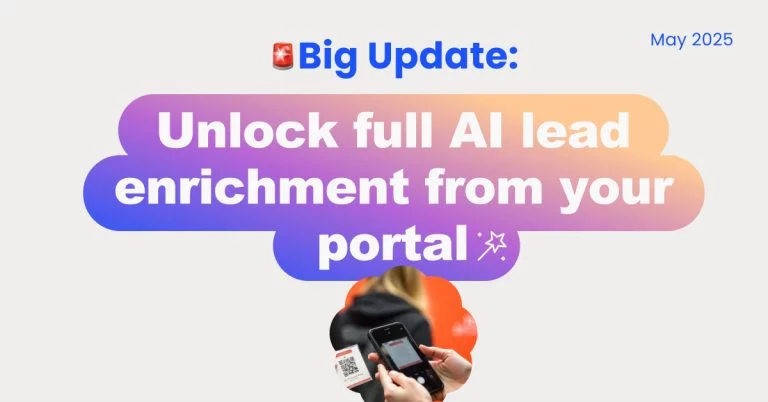
“I’ll remember to add them later” is a lie you tell yourself. After 50 conversations, names blur and contexts vanish. Capture and enrich every interaction at the point of contact using mobile event apps like momencio’s AI EdgeCapture, even if it feels disruptive. Incomplete data is worse than no data, because you’ll waste time chasing ghosts.
32. Notes without context are worthless
“Interested in product” tells your sales team nothing. What problem did they mention? Which competitor are they using? What triggered their visit to your booth? The note field isn’t for checking a box. It’s for arming your follow-up with enough intelligence to continue the conversation, not restart it.
33. Following up 72 hours later might as well be 72 days
By Monday morning after a Thursday-Saturday show, your prospects have 300 unread emails and no recollection of which booth had the blue banner. Using momencio’s LiveMicrosite to trigger personalized follow-up within minutes, not hours or days, is no longer optional. Our records prove that the companies following up on same-day have higher close rates than the ones who delay by 48 hours.
34. Your follow-up email is competing with 47 other follow-up emails
Every exhibitor they visited is sending the same “Great meeting you at the show!” template. If your follow-up reads like everyone else’s, it gets the same treatment: ignored. Reference something specific from your conversation. Include the exact asset they asked about. Make it impossible to mistake for a mass blast.
35. The scan is not the lead, the conversation is
Badge scan counts are vanity metrics. Sales cares about qualified opportunities, not badge volume. Using AI IntelliSense to track engagement depth, content interactions, and behavioral signals separates the leads that convert from the leads that clog your CRM. Ten qualified conversations beat 200 passive scans every time.
36. If you can’t see post-event engagement, you’re flying blind
Sending a follow-up and waiting for a reply is passive. Watching who opens what, who revisits your content, who shares materials internally, through IntelliStream visibility, tells you who’s actually interested versus who’s just being polite. Chase the signals, not the silence.
Self-preservation
37. The shoes you think are comfortable aren’t
What works for a day at the office does not work for 8+ hours on concrete convention center floors. Orthopedic insoles, compression socks, and brutally honest shoe choices are the difference between finishing the show strong and limping through Day 3. Your feet vote on your performance.
38. Night 1 ambition destroys Day 2 performance
The dinner runs late. Drinks happen. Someone suggests a nightcap. Then it’s 1 AM and you have to be on the floor at 8. One mediocre night out is not worth tanking your most productive show day. Network deliberately, exit early, and win while others struggle.
39. Pack snacks like you’re crossing a desert
Convention center food is overpriced, under-nutritious, and requires leaving your booth. Protein bars, nuts, hydration tablets in your bag mean you can maintain energy without abandoning post or crashing from a $18 pretzel carb bomb.
40. The best conversations happen when everyone else is packing up
Stay until they literally force you to leave. The last hour, when half the booths are already breaking down, is when the serious buyers who ran out of time finally circle back. They see you’re still professional, still present, still available. That visibility converts. Packing early costs more than the extra hour of standing.

The floor truth
None of these rules appear in official exhibitor manuals. You won’t find them in show management guidelines or vendor training decks.
They exist in the accumulated wisdom of people who have stood on trade show floors across hundreds of events, watched what works and what fails, and learned to read the invisible dynamics that separate successful exhibitors from those who pack up wondering why their investment didn’t pay off.
The trade show floor in 2026 still operates on human mechanics. Timing. Territory. Trust. Qualification instincts. Follow-through discipline.
Master these unspoken trade show floor rules, and you stop competing on booth size or swag budgets. You start competing on execution, where veterans consistently win.
Now get out there and own the floor.
Ready to capture what actually matters?momencio’s event intelligence platform helps field teams capture leads with context, follow up at speed, and see engagement in real time. No more flying blind after the show closes. Book a demo and see what floor truth looks like in your CRM. |
Frequently asked questions
What are the best times to engage serious buyers at a trade show?
The 90 minutes before lunch (10:30 AM to noon) and Day 2 morning are your highest-intent windows. Attendees have completed initial reconnaissance and are focused on serious evaluation rather than passive browsing.
How do I handle competitors visiting my booth?
Competitive intelligence gathering is standard practice and mutual. Stay professional, check badges early, share nothing proprietary, and remember your team is likely doing the same at their booth. Don’t get paranoid or confrontational.
How quickly should I follow up with trade show leads?
Same day or within 24 hours is the new standard. Research shows leads contacted within 24-48 hours are 60% more likely to convert. By 72 hours, your booth is already forgotten among dozens of other exhibitor contacts.
What booth positions should I avoid?
Back-wall positions with one-sided aisle traffic consistently underperform. Locations next to food stations seem attractive but generate pass-through traffic rather than engaged visitors. Seek corner positions or spots within the center-right triangle of the floor.
How many staff should I have at my booth?
For standard inline booths, three is the minimum for rotation coverage, four is optimal for handling traffic surges, and five creates role confusion unless your footprint is substantial. The general guideline is one staffer per 50 square feet of booth space.