Exhibitors spend between $500 and $1,500 on lead retrieval per show. For a team attending ten to fifteen events a year, that figure adds up to a material line item — and most of them are paying it repeatedly for a system that only partially works.
The failure is predictable. A team rents a badge scanner at Show A. It integrates cleanly with the organizer’s platform, scans quickly, and exports a CSV on Sunday night. They consider it a success. At Show B two months later, the organiser uses a different registration provider. The badge format is different. The device they used last time is not compatible. They rent again — a new device, a new setup, a post-event spreadsheet that does not map to their CRM the same way.
By Show C, the sales team has three disconnected lead lists in three different formats, no unified view of who they have spoken to across events, and follow-up that arrives too late to be relevant.
This is not a technology problem. It is a category problem. Most exhibitors choose a lead retrieval system built for one show, then discover too late that the industry’s fragmented infrastructure means that system will not travel with them.
The question is not which system performed best at the last event. The question is which system works at every event — regardless of the badge format the organiser prints, whether the venue has reliable connectivity, and whether leads reach the CRM before the follow-up window closes.
Three categories of system, and what each gives you
Not all lead retrieval systems are solving the same problem. There are three distinct categories, and each makes sense in a specific context.
Organiser-native systems are rented directly from the event organiser or their designated technology partner. They work within that event’s badge and registration infrastructure, which means they scan accurately — for that event. Data stays in the organizer’s ecosystem until export, pricing is per-show, and there is no continuity between events. For an exhibitor attending one or two shows a year, this is defensible. For anyone running a regular event program, the fragmentation compounds into the exact problem described above.
App-based systems run on a smartphone or tablet and scan badges using the device camera. They are more portable than organiser rentals and often support business card capture as a fallback. Quality varies significantly. Some offer CRM integration; many do not. Enrichment — where a scanned name and company automatically resolves to a verified business email and LinkedIn profile — is available in some, absent in others, and inconsistently accurate across the board.
Universal AI systems are built to operate independently of event infrastructure. They capture leads through badge scanning, business card scanning, or manual entry; enrich that data automatically; and sync directly to CRM regardless of which organiser ran the event. They are built for exhibitors who attend multiple shows across different venues, badge formats, and organiser platforms. momencio’s universal lead capture falls into this category — it functions at any event without organiser cooperation or per-show integration fees.
The category you need depends on how many shows you attend per year. One or two: organiser-native is reasonable. Three or more: you need a system that travels.

What ‘universal’ actually requires
Universal is a marketing term. Before accepting it at face value, exhibitors should understand what it requires technically — because systems that use the word often do not meet the standard.
Badge agnosticism is the first requirement. Trade show badges use a range of formats: 1D barcodes, 2D barcodes, QR codes, and in some cases RFID. A genuinely universal system captures leads from any of these, plus business cards, without requiring a show-specific API license or hardware rental. If scanning capability depends on an agreement between the vendor and the organiser, it is not universal — it is compatible within a closed network.
Offline functionality is the second requirement, and the one most systems fail at quietly. Convention center WiFi is unreliable during peak hours. A system that stops working when connectivity drops costs leads at precisely the moments when traffic is highest. Genuine offline mode captures and stores leads locally, then syncs automatically on reconnect — with no manual step required from booth staff. momencio’s offline lead capture works this way, which matters most at high-traffic shows where venue networks are under maximum strain.
Enrichment quality is the third requirement. Scanning a badge produces a name and a company. That is not enough to personalize follow-up. A system that enriches automatically — adding a verified business email, job title, and LinkedIn profile within seconds of capture — compresses the time between scan and meaningful outreach. Confirm whether enrichment is included in the base price or billed per lead. The hidden costs of event lead scanner rentals most often appear here, not in the headline fee.
CRM sync is the fourth. Not CSV export — sync. Exporting a spreadsheet after an event and importing it manually into Salesforce or HubSpot delays follow-up by days and introduces data errors at every step. Direct integration, with leads appearing in CRM during the event carrying notes, qualification tags, and engagement history, is the standard a universal system should meet.
How to evaluate a lead retrieval system: 8 criteria
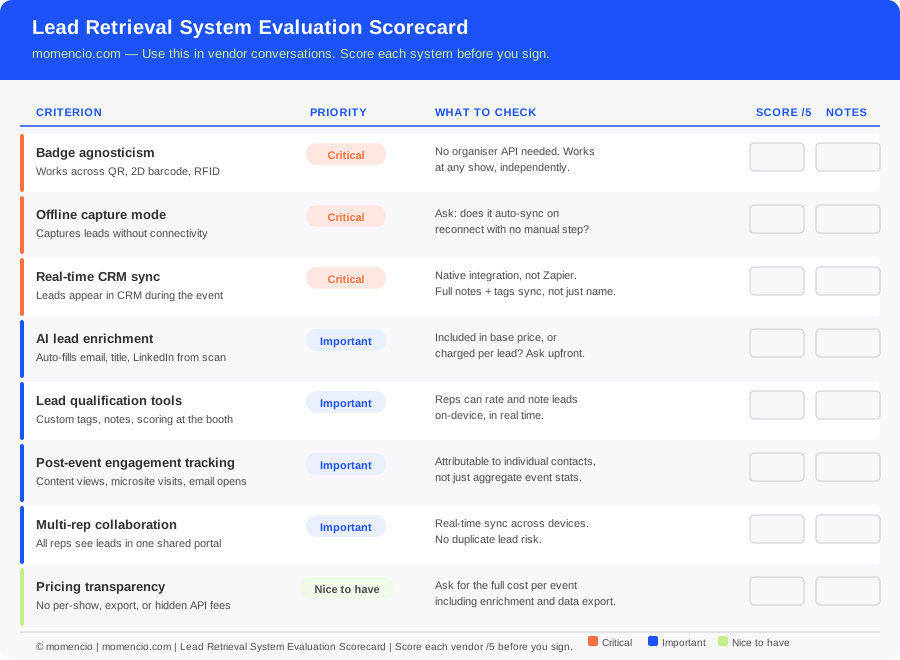
The scorecard below is the framework to take into vendor conversations. Download the printable version and score each system before you sign.
Criteria are weighted by priority tier. Critical means the system fails without it. Important means it materially affects performance. Nice to have means it adds value but is not a dealbreaker.
Before you sign anything
A useful test before committing: ask the vendor to demonstrate the system working at a show their team did not set up with the organiser in advance. If they cannot, or if the demo requires a pre-arranged event-specific API, you are looking at an organiser-dependent system marketed as a universal one.
Ask specifically whether enrichment is included in the base license or priced per lead. Ask whether offline capture is a core feature or a paid add-on. Ask whether CRM sync is native or requires a third-party connector such as Zapier, which introduces an additional failure point and an additional monthly cost.
Then test before your most important event of the year, not at it. Run the system at a smaller regional show first. Scan twenty leads, check how many arrive in CRM with complete data, verify that rep notes came through, and confirm that post-event engagement signals — content views, microsite visits — are visible in the dashboard and attributable to individual contacts.
The reality most exhibitors skip is this: a system that performed well in a vendor demo — on reliable WiFi, with pre-loaded test badges — may behave very differently on a show floor with hundreds of simultaneous scans and a venue network under pressure. Test in conditions that approximate reality.
If the evaluation above surfaces gaps in your current setup, AI EdgeCapture is worth examining as a direct response to the badge-agnostic, offline-capable capture problem. The goal is not to switch platforms for the sake of it. It is to stop re-solving the same problem at every show you attend.