Most exhibitors treat the booth as the center of their trade show strategy. They invest in the display, brief the team, set up the badge scanner, and wait. Some of those conversations are good. Most of the floor walks past.
The booth is where you process leads. The floor is where you find them.
The data on this is unambiguous. More than 78% of trade show attendees plan their booth visits in advance. If your company is not on their list before they arrive, the probability of a meaningful walkup drops sharply. Waiting for organic foot traffic is, for most exhibitors, a strategy that relies on luck more than process.
The exhibitors generating consistent pipeline from events operate differently. They treat the booth as a processing hub — the place where pre-arranged conversations happen and leads get formally captured. But the actual work of finding those leads starts before the show opens and continues across the entire floor: sessions, lunches, hallways, networking breaks, and the unofficial hours after the show closes.
This is not about being aggressive on the floor. It is about being intentional. The tactics below are how experienced teams build a proactive lead capture system around an event, rather than a passive one.
Before the show opens: scheduling conversations with people who are already registered
The highest-leverage activity at any trade show happens before you arrive. Most event organizers release the attendee list, and many exhibitors ignore it entirely. That list is a targeting database.
Pull the registrant data as early as it becomes available. Cross-reference it against your CRM and target account list. Identify the companies and titles that match your ideal customer profile. For the highest-fit accounts, reach out directly before the show — via email or LinkedIn — and schedule a conversation. Not a booth visit. A conversation, at a specific time, in a specific place. Coffee at a side table, a fifteen-minute slot in the meeting lounge, a breakfast before the floor opens.
Teams that do this arrive with eight to twelve pre-scheduled meetings already on the calendar. Those conversations have a fundamentally different quality than a walkup scan because both parties showed up intentionally.
Use the event app the same way. Most conference apps let attendees message each other before the event begins. That is a direct channel to people who are already engaged enough to download the app and complete their profile. A short, specific message — referencing something relevant to their company or a session they are speaking at — has a conversion rate that cold outreach rarely matches.
The goal of pre-show outreach is not to fill the booth schedule. It is to ensure that by Day 1, the most important conversations are already committed to your calendar rather than left to chance.
Sessions, panels, and networking breaks are lead environments, not educational ones
Conference programming is where your best prospects self-select by interest. The person asking a sharp question during a Q&A about supply chain resilience is almost certainly a more relevant prospect than the person who wandered past your booth looking for a pen. The challenge is capturing that signal before the session ends and the crowd disperses.
Assign at least one team member as a floor rep — someone whose job is not to staff the booth but to attend sessions, sit in panels, and work the networking breaks. Their KPI is conversations started, not badges scanned. The badge scan comes later.
Networking breaks are particularly high-value and consistently underused. Fifteen minutes between sessions, a crowd at the coffee station, no agenda. People are relaxed and open. A natural entry into a conversation — referencing something just said in the session — is not a cold approach. It is a contextual one. Those conversations move faster and go deeper than booth interactions that start with a pitch.
The floor rep role is not a junior assignment. Put your best conversationalist on it, not the person you can spare from the booth.
Panel speakers deserve specific attention. A speaker who just presented on a topic directly relevant to your product is a warm prospect by definition — they care enough about the subject to prepare a talk on it. Approaching them immediately after the session, with a specific observation about what they said rather than a generic compliment, is one of the highest-conversion approaches available at any trade show. Do it before three other vendors do.
Starting conversations that go somewhere, not just everywhere
The failure mode of floor networking is not talking to too few people. It is talking to too many people without a framework for knowing which conversations are worth developing and which are not.
Before the show, your team should agree on three to five qualifying signals that identify a relevant prospect quickly. Industry, company size, role, a specific challenge they are navigating, a technology stack signal. These do not need to be interrogation questions. They surface naturally in any competent conversation within the first two to three exchanges if the rep knows what to listen for.
When a qualifying signal appears, the conversation shifts. The rep’s job becomes two things: going deeper on the prospect’s situation, and creating a reason to stay connected. The reason does not have to be a follow-up call. It can be a specific piece of content, a case study relevant to what they just described, or an introduction to someone else at the event. The capture moment follows naturally from that value exchange rather than feeling like a transaction.
What does not work: approaching people with an opening line that sounds like a pitch, following someone to their next session because the first conversation was interrupted, or scanning a badge without asking. Floor networking that converts treats the other person’s time and attention with the same seriousness it expects in return.
Converting the conversation into a captured lead before you leave the room
This is where most floor networking fails to produce pipeline. The conversation happens. It is good. Both people walk away with a vague intention to follow up. Three days later, neither of them remembers the specifics, and the follow-up email is generic enough that the prospect has no reason to respond.
The fix is not better follow-up. It is capturing the lead, the context, and the next step at the point of conversation — not after.
For hallway conversations where the prospect has a badge, scanning it on the spot using a mobile app is the cleanest method. The scan takes three seconds. What matters is what gets added immediately after: a structured note with the specific pain point discussed, a tag for the product area they raised, a follow-up action. That context is what makes the follow-up email feel like a continuation of the conversation rather than a cold outreach.
For contacts without a badge — speakers, VIP guests, dinner attendees, people you met in a session — a business card scan works the same way. AI EdgeCapture processes the card and enriches the record automatically: verified business email, LinkedIn profile, job title, firmographics. The rep adds their note. The lead is in the system before the next conversation starts.
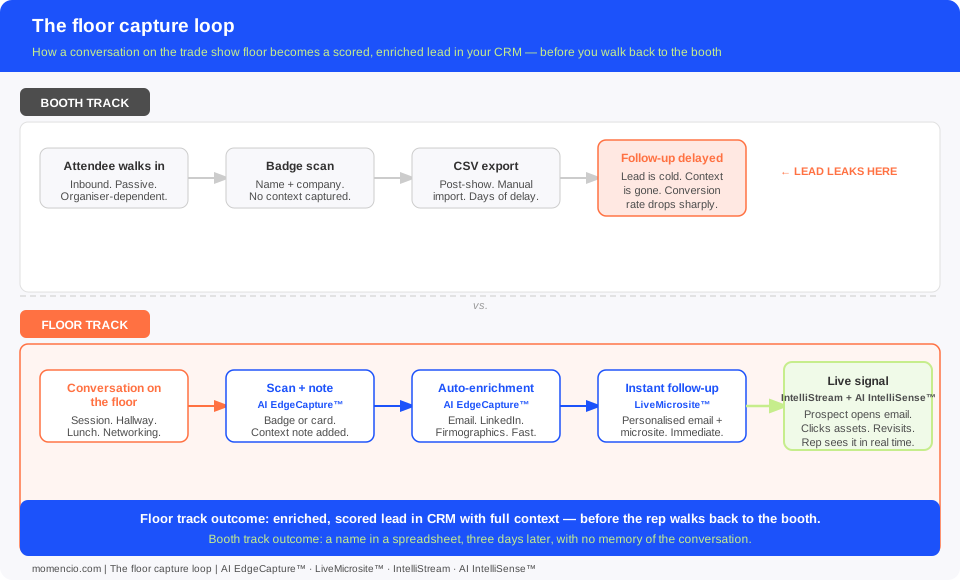
The enrichment step matters more outside the booth than inside it. Inside the booth, there is usually time. On the floor, in a hallway, between sessions — there is not. A system that captures a name and automatically fills the rest allows the rep to stay present in the conversation rather than typing contact details into a form.
What happens after the scan is the difference between a contact and a lead
Capturing a contact on the floor is the start of the process, not the end of it. What fires next determines whether that conversation becomes pipeline.
The moment a lead is captured, a personalized follow-up email goes out — not scheduled for tomorrow morning, but immediately. It references the conversation, links to content specific to what the prospect raised, and opens a LiveMicrosite, a personalized digital room built around that individual’s interest, not a generic product page.
If the prospect opens that email and clicks into the microsite while they are still at the event — while the conversation is fresh, while they are in a buying mindset — that engagement is visible in real time. The IntelliStream activity feed shows the rep exactly when it happened, which assets the prospect engaged with, and how long they spent. A prospect who spends twelve minutes with the ROI calculator on their microsite twenty minutes after your conversation is not a contact to follow up with next week. That is a call to make today.
This is the compounding advantage of capturing leads on the floor rather than hoping they walk into the booth. The timeline collapses. The signal quality improves. And the follow-up arrives when the prospect’s recall of the conversation is highest, not three days later when they have attended forty more booth meetings and spoken to half your competitors.
For contacts you spoke to but never formally captured — a dinner conversation, a chance meeting in the elevator, someone who gave you their card but left before you could scan — add them manually the same day. The note is the most important part. What did they say? What are they evaluating? What did you commit to sending them? A manual entry with a strong note is more valuable to sales than a badge scan with no context.
The floor networking strategies that produce consistent pipeline share one characteristic: they treat every conversation as a data point, not just an interaction. The contact details are table stakes. The context is what converts.
Related reading: In-booth engagement strategies | 10 ways to capture leads outside your booth | Follow-up on sales leads: booth behaviour signals | 10 ChatGPT prompts for event sales reps