
Most event leads fail because nothing happened fast enough afterward. Buyers at trade shows and field events are in active evaluation mode. They are comparing vendors, building internal business cases, and making shortlist decisions in real time. By the time a representative follows up two or three days later, after returning from travel, processing notes, and exporting the badge scan list, the window has already closed. The buyer has moved on, or worse, committed to a competitor who got there first.
This is not a motivation problem. It is a process architecture problem. And it is fixable.
The 24-hour conversion cliff is real, and most teams are falling off it
Event-captured leads lose up to 80% of their conversion potential within 24 hours of initial contact. Let that sink in.
Automated follow-up triggered within five minutes of lead capture consistently outperforms manual processes by 9x on contact rates. These aren’t aspirational benchmarks, they reflect how B2B buyers behave at events.
The structural reasons most teams miss this window are predictable:
- Lead data sits in badge-scanner exports until someone manually pulls and cleans it
- CRM records are created in batch at end of day, or worse, end of event
- Sales rep assignment happens during a post-event debrief, not in real time
- Follow-up email templates are written after the event, not before it
Every one of these delays is a process choice, not an inevitability. The teams converting event pipeline at a higher rate have simply removed the manual steps from the sequence.
Why speed alone is not enough: the quality problem underneath
Fast follow-up on a low-quality lead is just faster noise. The other half of the conversion problem is what gets captured at the moment of engagement.
Badge scan data gives you a name, title, and email. It tells you nothing about intent, budget authority, timeline, or what specific problem the buyer was trying to solve when they stopped at your booth. That qualification gap is what creates MQL-to-SQL drop-off even when follow-up timing is right.
The fix is capturing context at the point of engagement, not reconstructing it later from memory. Booth staff need to collect:
- The specific pain point or use case the buyer expressed
- Current vendor or solution in place
- Buying timeline and whether budget is allocated
- Level of engagement, product demo, pricing conversation, or casual pass-by
A buyer who spent four minutes at your demo station asking about a specific integration is not the same lead as someone who picked up a brochure. That distinction needs to be recorded and passed to sales with the record — not inferred later.
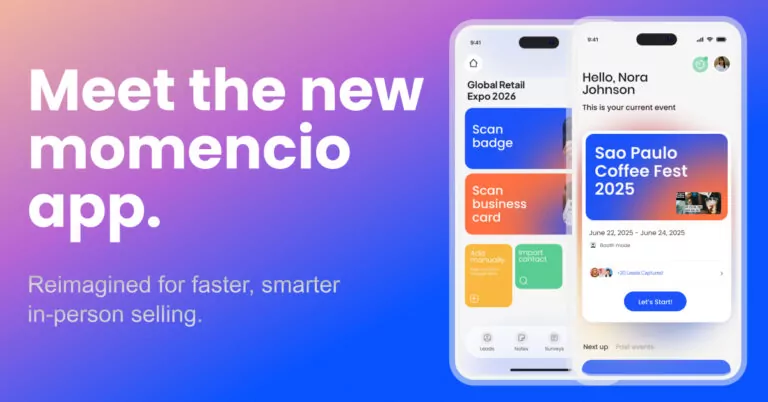
This is where purpose-built lead capture matters. momencio allows booth staff to log qualification signals directly alongside contact details during the conversation, so the CRM record that gets created carries context, not just a name.
What needs to be in place before the event
The single most common mistake is treating follow-up setup as post-event work. By the time the event is over, it’s already too late to build this correctly.
Everything below needs to be configured, tested, and ready before the first badge scan:
A defined MQL threshold for events specifically
Not all event leads should enter the same follow-up sequence. Establish explicit qualification criteria, title, company size, expressed intent, demo attendance, that determine whether a lead is handed to sales or routed to nurture. Without this threshold, reps receive unqualified lists and conversion rates reflect that.
Real-time CRM integration, not batch export
Your lead capture platform needs to push records to Salesforce, HubSpot, or equivalent via API at the moment of capture. End-of-day batch exports introduce the exact delays that kill conversion velocity. If your current setup doesn’t support real-time push, that’s the first thing to fix. See how CRM integration for event leads should be structured to eliminate this lag entirely.
Pre-assigned routing logic
Determine in advance how leads are distributed: by territory, account size, product line, or rep availability. Routing ambiguity after an event creates handoff delays and rep confusion. Every lead that arrives in CRM should have an owner within the same automated workflow. A solid set of CRM best practices for event leads will keep your records clean and your reps moving.
Pre-written, persona-specific follow-up sequences
Generic follow-up underperforms segmented outreach by a significant margin. Before the event, build three to four email variants mapped to distinct buyer personas or use cases. The first email in each sequence should be specific enough that the buyer recognizes the conversation they had at the booth — not a template that could have been sent to anyone.
How does five-minute follow-up work
When a lead is captured and meets MQL threshold criteria, the following should happen automatically and in sequence — no human intervention required for standard assignments:
- A CRM record is created with event source tagging, qualification data from enrichment, and engagement context appended
- Lead scoring rules are applied automatically based on the captured qualification signals
- The lead is routed to the assigned rep or SDR within the same workflow
- A triggered email fires within five minutes, personalized using the qualification data from capture
- The assigned rep receives a Slack or Teams notification with the lead context — they don’t need to log into CRM
For high-priority leads — C-suite contacts, large enterprise accounts, or buyers who expressed active purchase intent — a parallel task should trigger a phone call within the same window.
momencio’s CRM integration with Salesforce and HubSpot is built to execute this sequence in real time, including the automated lead scoring and rep notification steps that most teams handle manually.
Prioritizing sales action after the event: not all leads are equal
Once the automation is running, the next challenge for sales teams is knowing where to focus. A ranked follow-up list with context is measurably more effective than an alphabetical spreadsheet of everyone who visited the booth.
AI-driven lead scoring helps here by surfacing conversion probability based on engagement behavior, demographic fit, and expressed intent — not just job title. At the start of each day following an event, SDRs should receive a prioritized call list that distinguishes between:
- Leads who attended a product demo and requested follow-up pricing information
- Leads who opened the follow-up email and clicked through to a product or pricing page
- Leads who match high-converting firmographic profiles from previous events
- Leads who need nurture before they’re sales-ready
Real-time engagement signals should update prioritization continuously. A lead who clicks through to your pricing page the morning after an event should move up the call list immediately — not wait for the next manual review.
Measure pipeline, not number of badge scans
If your post-event reporting leads with badges scanned or booth visits, you’re measuring activity, not outcome. The metrics that drive decisions are:
- MQL-to-SQL conversion rate by event, by rep, and by follow-up response time
- Pipeline dollars sourced from event leads, tracked through to close
- Cost per SQL by event type
- Conversion rate delta between automated follow-up and manual follow-up
Source attribution needs to persist through every pipeline stage. A structured approach to event ROI measurement ensures you can trace a closed deal back to the specific event, session, and capture method that originated it — and make smarter budget decisions as a result.
The business case for automation becomes straightforward when you run a comparison: events where follow-up was triggered within five minutes versus events where manual processes were used. The conversion delta speaks for itself.
Present event ROI to your VP Sales or Revenue Operations team as a pipeline contribution report, not an activity report. Pipeline dollars sourced from events — not badges scanned — is the metric that earns budget and cross-functional alignment.
Where this most commonly breaks down
Teams that have attempted to implement instant follow-up workflows and not seen results typically hit one of four failure points:
Follow-up was built for the average lead, not segmented by persona
One email sequence for all event leads is the most common performance killer. If you have four buyer types at an event, you need four follow-up variants. The specificity of the first email is what signals to the buyer that the follow-up is worth reading.
Routing logic wasn’t defined before the event
Leads that arrive in CRM without a clear owner get picked up late or not at all. Rep confusion at handoff is a structural problem, not a motivation problem. Define routing rules before the event, not during post-event debrief.
Qualification happened at export, not at capture
If reps are trying to score leads from badge export data — without the context of the actual conversation — they’re guessing. Qualification must happen at the moment of engagement. Building a lead pipeline for your trade show that works starts with getting this right on the floor, not in a spreadsheet the following week.
Success was measured in volume, not conversion
Teams that optimize for lead volume at events get what they measure. When the incentive is badges scanned, qualification suffers, follow-up quality drops, and MQL-to-SQL rates reflect it. Shift the measurement to pipeline contribution, and behavior follows. For a deeper look at converting event leads to clients, the distinction between volume and conversion thinking is where most improvements start.
The competitive reality
At most B2B events, every vendor in your category is having conversations with the same buyers. The product pitch, the case studies, the pricing — much of that converges across competitors. What doesn’t converge is what happens in the 24 hours after the conversation ends.
Response time is itself a competitive differentiator. Buyers notice when follow-up is specific, fast, and relevant. They also notice when it arrives three days later and reads like it was written for someone else.
The process architecture described here isn’t complex. But it requires that the decisions — workflow configuration, CRM integration, routing logic, follow-up sequences — get made before the event, not after it.
That’s the part most teams keep deferring. And that deferral is where the pipeline goes.