
Every trade show generates hundreds of conversations. Most of them produce a badge scan and a vague impression: “seemed interested,” “nice guy, works in manufacturing,” “asked about pricing.” That is not intelligence. It is a memory fragment that degrades within hours and becomes useless within days.
Intelligence is specific, structured, and actionable. It tells your sales team what this person needs, when they need it, who else is involved in the decision, what they are comparing you against, and what their next step should be. The difference between a conversation that produces a memory fragment and one that produces intelligence is not rep talent. It is conversation structure.
The framework described here has four phases. Each phase has a clear objective, specific questions, and a defined data output. When your team internalizes this structure before the show, every conversation becomes an intelligence capture event, not a casual chat that ends with “let me send you some info.”
Why most booth conversations produce names, not intelligence
The default booth conversation has no structure. A visitor walks up. The rep says hello. Someone asks “so what do you guys do?” The rep launches into a product overview. The visitor nods. The rep scans the badge. The visitor moves on. The lead record contains a name, a company, and nothing else.
This happens because reps are trained on the product, not on the conversation. They know every feature, every integration, every pricing tier. They do not know how to steer a two-minute interaction through a qualification sequence that produces the five data points sales needs to work the lead. Research consistently finds that the majority of booth visitors will have a meaningful conversation with an exhibitor if approached correctly. The problem is not visitor reluctance. It is that most reps do not have a conversation model that moves naturally from introduction to qualification to next step.
A conversation framework solves this. It gives every rep, whether they have ten years of sales experience or are staffing a booth for the first time, a repeatable structure that produces consistent, high-quality data from every interaction.
The four-phase conversation framework
The framework has four phases. Each one flows into the next. The total conversation takes two to five minutes, depending on the visitor’s level of engagement. The phases are sequential, but the transitions should feel natural, not scripted.
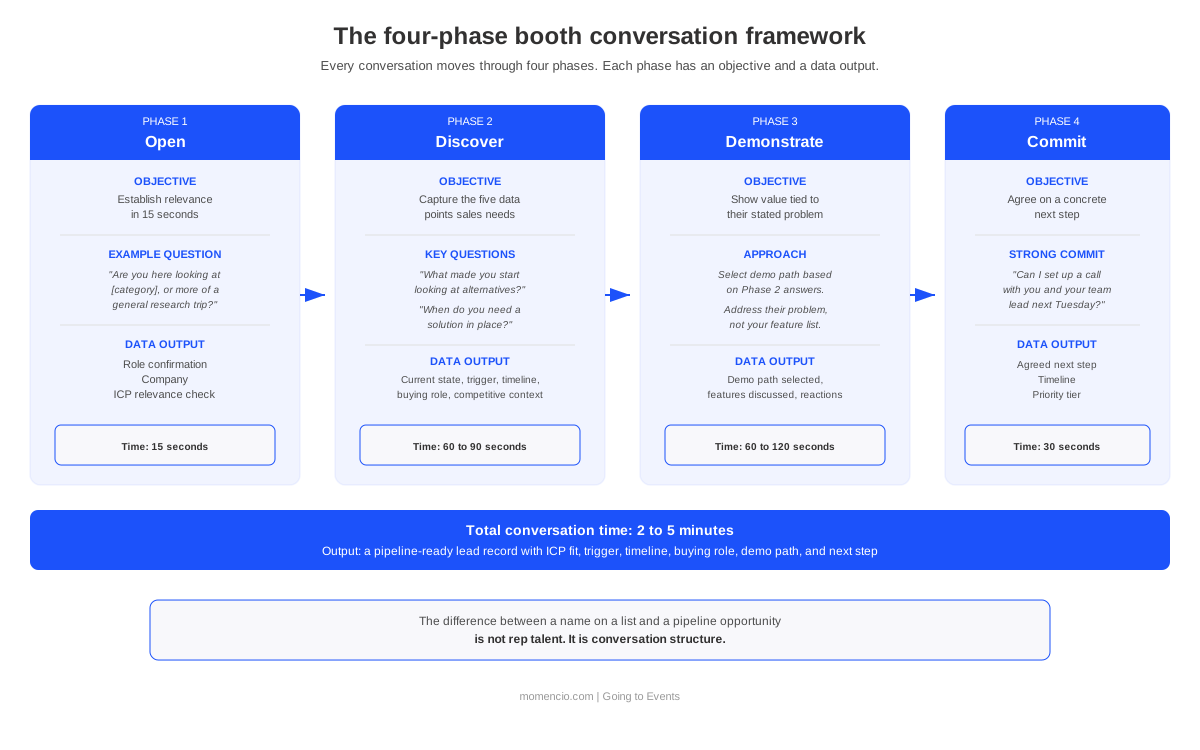
Phase 1: open (establish relevance in fifteen seconds)
The first fifteen seconds determine whether the conversation continues or dies. The visitor is deciding whether your booth is worth their time. Your job is not to pitch. It is to establish that you are relevant to their situation.
Open with a question that signals you are interested in their world, not yours. “What brings you to the show this year?” is a safe opener, but it is generic. A stronger opener references the event context or the visitor’s badge: “I see you are with (company). Are you here looking at (product category), or is this more of a general research trip?”
The goal of Phase 1 is a single data point: is this person worth the next three minutes? If they are a student, a journalist, or a competitor, you can be polite and move on. If they are a practitioner with a relevant role at a relevant company, you transition into Phase 2.
Data captured in Phase 1: role confirmation, company, and a quick relevance check (are they a potential buyer, a researcher, or someone outside your ICP?).
Phase 2: discover (ask the questions that produce scorable data)
This is the phase most reps skip. They go from “hello” directly to “let me show you a demo.” Phase 2 is where the intelligence lives.
The discover phase has three to five questions, asked conversationally, that produce the data your lead scoring model and your sales team need. The specific questions depend on your product and your ICP, but the categories are universal:
Current state: “What are you using today to handle [problem]?” This tells you whether they are an active buyer, a passive researcher, or already locked into a competitor. It also reveals whether they have a system in place that needs to be replaced or whether they are starting from scratch.
Trigger: “What made you start looking at alternatives?” or “What changed that has you exploring this now?” This is the most valuable question in the entire framework. The answer tells you the pain point that is driving the evaluation. It gives your sales team the opening line for every subsequent conversation: “When we met at [event], you mentioned that [trigger]. Here is how we address that.”
Timeline: “When do you need a solution in place?” This separates active buyers from future prospects. A lead with a Q3 timeline is a different priority than one who says “we are just starting to look.” Both are worth capturing. They belong in different sequences.
Decision structure: “Who else is involved in this evaluation?” This tells you whether you are talking to the decision-maker, an influencer, or a researcher. It also flags multi-threaded opportunities where multiple stakeholders from the same account may visit the booth.
Data captured in Phase 2: current solution, trigger or pain point, evaluation timeline, buying role, and any competitive context volunteered during the conversation.
Phase 3: demonstrate (show value tied to their stated problem)
Only after Phase 2 should you show anything. The demo, the product walkthrough, the case study, the content piece, whatever you show should be selected based on what the visitor just told you. If they said their biggest problem is slow follow-up after events, you show the follow-up capability. If they said they are drowning in unqualified leads, you show the scoring and qualification workflow.
This is the opposite of the standard booth demo, which starts with a feature tour and hopes something resonates. A demo informed by Phase 2 resonates by design because it addresses the specific problem the visitor just described. The event activations and interactive content that your team prepares before the show should include multiple demo paths so reps can select the right one based on the discover conversation.
Phase 3 also generates a data point: which content or demo the visitor engaged with. This tells your follow-up team what to include in the personalized post-show outreach. A visitor who watched the CRM integration demo gets different follow-up content than one who spent time on the analytics walkthrough.
Data captured in Phase 3: demo or content path selected, specific features discussed, and the visitor’s reaction or questions during the demonstration.
Phase 4: commit (agree on a concrete next step)
Every conversation should end with a next step. Not “I will send you some info.” A specific, concrete, time-bound next step that both parties agree to.
Strong commits: “Can I set up a thirty-minute call with you and your team lead next Tuesday to walk through the integration in detail?” or “I will send you a personalized page with the case studies we discussed. Can you take a look by Thursday and let me know if you want to loop in your VP?”
Weak commits: “I will send you an email” or “check out our website” or “let’s stay in touch.” These are not next steps. They are polite exits that produce no forward motion and give sales nothing to act on.
The commit phase also determines the lead’s priority tier. A lead who agrees to a call next week is a different priority than one who says “send me some info and I will look at it when I get back.” Both are valid outcomes. They trigger different follow-up sequences and different response timelines.
Data captured in Phase 4: agreed next step, timeline, who needs to be involved, and priority tier.
Mapping the framework to your capture fields
The framework only works if the data it produces has somewhere to go. Before the show, map each phase’s data output to a specific field in your lead capture system.
Phase 1 outputs (role, company, ICP fit) map to identity and qualification fields. Phase 2 outputs (current state, trigger, timeline, buying role) map to structured qualification fields. Phase 3 outputs (demo path, features discussed) map to engagement tracking fields. Phase 4 outputs (next step, timeline, priority) map to routing and disposition fields.
When these fields are predefined and available in your capture tool, reps can log the data during the conversation in under ninety seconds. When they are not predefined, reps resort to free-text notes that nobody will read. The difference between structured fields and free-text notes is the difference between intelligence and noise. For more on how to design the full trade show management process around these capture points, including daily briefings and debrief protocols, the trade show management guide covers the operational layer end to end.
How to train your team on the framework before the show
A framework that lives in a document is not a framework. It needs to be practiced. The trade show booth staff training process should include at least two role-play sessions before the show where reps practice moving through all four phases with a colleague playing the visitor.
The first session focuses on Phase 2 (discover). This is the phase most reps find hardest because it requires asking questions instead of talking about the product. Practice the specific questions. Practice the transitions between questions. Practice capturing the answers in real time without breaking the conversational flow.
The second session focuses on Phase 4 (commit). Reps are often uncomfortable asking for a specific next step. They default to “I will send you an email” because it feels less pushy. Role-play the stronger commits. Show them that a specific ask (“Can we set up a call next Tuesday?”) is actually more respectful of the visitor’s time than a vague promise that leads nowhere.
During the daily morning briefing at the show, remind the team of the four phases and review the qualification questions. If specific high-priority accounts are expected on the floor that day, brief the reps on those accounts so Phase 2 can be even more targeted.
What changes when every conversation is structured
The most immediate change is data quality. When every rep follows the same four-phase structure, every lead record contains the same five data points: ICP fit, trigger, timeline, buying role, and next step. Sales receives a set of leads they can act on immediately, without spending a week researching who these people are and what they need.
The second change is consistency. On a three-day show with four reps, you might have forty to eighty qualified conversations. Without a framework, each rep captures differently: one writes detailed notes, one scans and moves on, one spends twenty minutes with every visitor regardless of fit. With a framework, all four reps produce comparable data because the structure guides the conversation and the capture.
The third change is speed to follow-up. When the lead record already contains the trigger, the demo path, and the agreed next step, the follow-up email writes itself. Your team does not need to reconstruct the conversation from memory. They send a personalized follow-up that references the specific problem discussed, includes the relevant content, and confirms the next step that was agreed at the booth. That email goes out the same day, while the visitor still remembers the conversation. Event ROI measurement becomes straightforward when every lead carries the context needed to track it from conversation to pipeline.
A booth conversation is worth exactly as much as the intelligence it produces. A framework ensures that every conversation produces the maximum amount of intelligence with the minimum amount of friction. The reps feel more confident because they know what to ask. The visitors feel more respected because the conversation is about their needs, not your features. And the lead record tells a complete story that sales can act on from the first call.
momencio gives your booth team the capture infrastructure to put this framework into practice: structured qualification fields, real-time engagement scoring, and personalized follow-up that deploys while the show is still running. Book a demo to see how conversation intelligence becomes pipeline.