B2B exhibitions take 40.8% of exhibitor marketing budgets, the largest single share of any channel, according to CEIR’s 2026 Marketing Spend Decision Report. Gartner’s 2026 CMO Spend Survey puts total marketing budgets at 7.8% of company revenue, roughly 18% below where they sat four years ago, with 62% of CMOs saying that missing growth targets in 2026 would trigger further cuts.
Those two numbers describe an uncomfortable position. The event line is the biggest thing on the marketing page, sitting inside a budget that has not grown in four years, at a company where somebody has already been asked to find savings. Gartner’s guidance to CMOs facing that squeeze is to give up investments that are not contributing to performance goals, no matter how entrenched those investments have become. In most B2B organizations, events are the most entrenched line item there is.
Event budget approval has stopped being a question about whether events work. The people reviewing your request already believe events work, because they approved them last year and the year before that. What they are deciding now is whether this particular money produces more here than it produces somewhere else, and most event budget requests never answer that question at all.
Why event budget requests get cut even when the events worked
CEIR’s 2026 report documents a gap that most event marketers will recognize on sight. Sales metrics dominate how management evaluates exhibition performance, with lead volume and post-show closed deals ranking highest. The measures that fill most post-event reports, including booth traffic, badge scans, session attendance, meeting counts, and social reach, sit further down the list or do not appear on it.
That gap becomes expensive at budget time. A request built on activity data describes effort, and effort is not what gets funded in a flat budget year. The requests that survive describe revenue, in the same units the finance team is already using for every other allocation on the page.
The problem compounds because of who is in the room. Event programs usually report into marketing, but event budget decisions get made in a conversation that includes sales leadership and finance. The deck that persuaded your CMO often gets forwarded, unchanged, into a meeting where nobody has any context for what 4,200 booth visitors means or why it is a good number. Anything that requires the reviewer to already understand event marketing is doing your argument harm.
There is a second reason good programs lose funding, and it has nothing to do with performance. When an event program runs well, it stops generating internal noise. Nobody escalates, nothing breaks, and the leads arrive on schedule. Line items that generate no noise are the easiest ones to trim, because trimming them creates no immediate consequence anybody can point to. A quiet program with weak documentation is more vulnerable than a chaotic one with good numbers.
What your finance team is actually comparing your event budget against
Your reviewer is not deciding between running events and not running events. They are deciding between your request and every other request competing for the same pool, and the comparison happens whether or not you participate in framing it.
Gartner’s 2026 data shows where the money has been moving. Awareness and conversion now account for 62.6% of total media spend, a rise of more than 10% since 2024, while spending on loyalty and retention has fallen 29% over the same period to under 15% of media spend. Budget is flowing toward channels that report quickly and cleanly. Paid media has become the default comparator in most B2B budget conversations, not because it performs better, but because it produces a dashboard that updates every morning.
This is why naming your own comparator matters. If your request does not specify what it should be measured against, it gets measured against whichever channel has the tidiest reporting, on that channel’s timeline. A show that generates pipeline over three quarters compared against a paid program that reports weekly will lose that comparison every time it is made implicitly.
The fiscal calendar creates the same trap. Paid spend converts inside the quarter it is spent. Event pipeline converts across two or three quarters, sometimes four. When the payback window is left unstated, the reviewer applies the default assumption, which is that money spent this year should show returns this year. Stating your actual cycle length in the request turns that from a hidden mark against you into a planning input the reviewer can work with.
The four numbers that decide event budget approval
Most event budget requests contain a total cost and a rationale. The requests that get approved without a fight contain four specific numbers, each of which answers a question the reviewer was going to ask anyway.
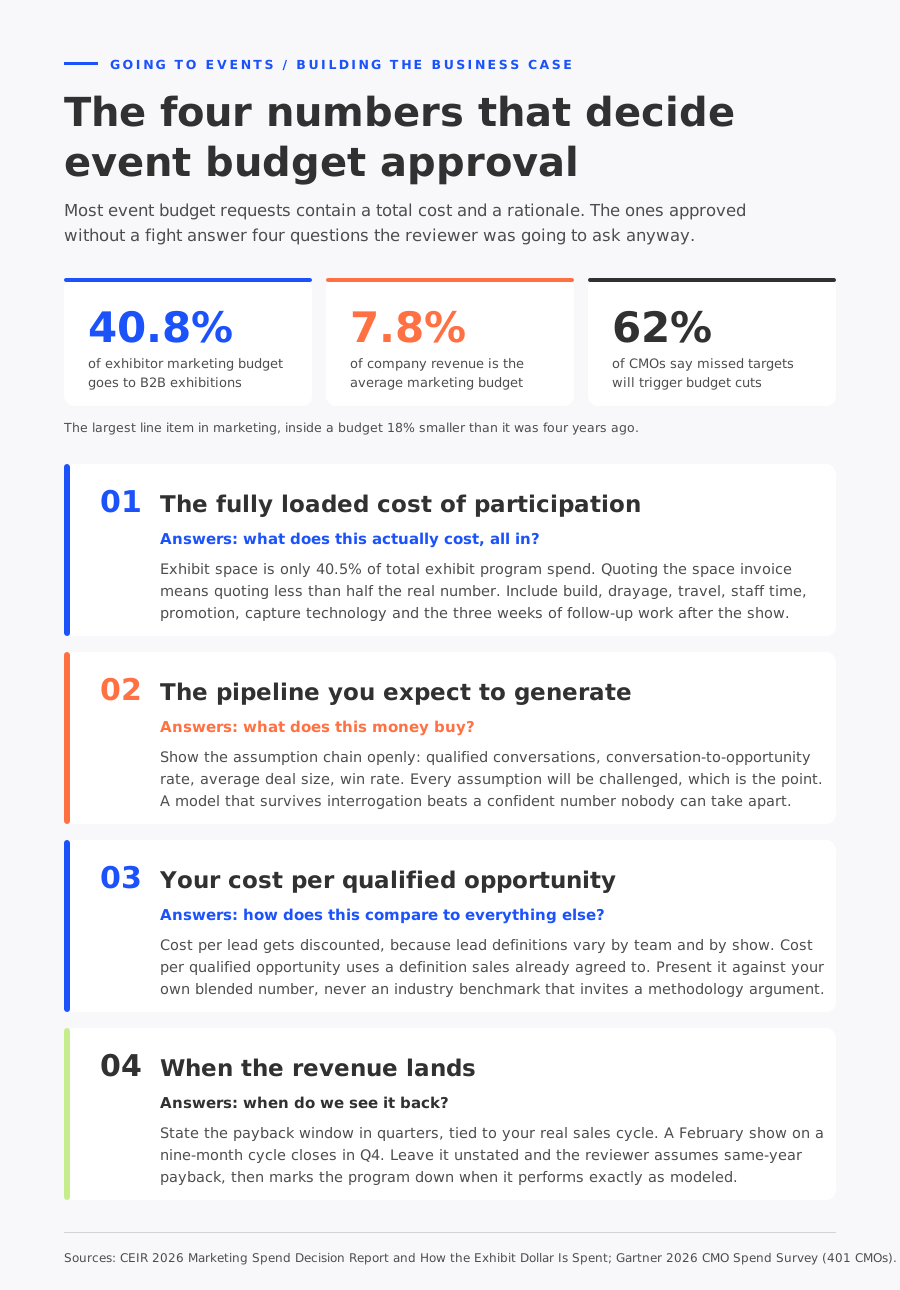
The fully loaded cost of participation
CEIR’s companion study on how the exhibit dollar is spent found that exhibit space accounts for 40.5% of total exhibit program spend, up modestly from 37.9% in 2017. Quoting the space invoice therefore means quoting less than half of what the show will genuinely cost.
The rest sits in booth design and build, shipping and drayage, electrical and rigging, travel and accommodation for the team, staff time valued at real cost, pre-show promotion, lead capture technology, giveaways and collateral, and the follow-up work that happens in the three weeks after. Some of those costs are already sitting in other budget lines, which is a defensible way to structure the program but a poor way to present it. A reviewer who discovers additional event costs hiding in the travel line after approving your request will not forget it during the next cycle.
The working standard is straightforward. If you could not defend a number line by line under questioning, it will not survive the first round of questions. Submit the real total, show its composition, and mark clearly which portions are committed and which are still variable.

The pipeline you expect to generate
This is where the projection belongs, and it needs to exist before the request goes in rather than being assembled afterward to justify a number you already picked. The method matters less than the transparency of the assumption chain: expected qualified conversations, expected conversion from conversation to opportunity, average deal size, and expected win rate.
Every one of those assumptions will get challenged, which is precisely what makes them useful. A model that survives interrogation is worth considerably more in a budget meeting than a confident single figure that nobody can take apart. Build it the way you would build a forecast you expected to be held to, because that is what it becomes the moment it is approved.
Your cost per qualified opportunity
Cost per lead is the number event teams reach for first and the number finance discounts fastest, because lead definitions vary between teams, between shows, and sometimes between two reps at the same booth. Cost per qualified opportunity travels better through an organization because it rests on a definition sales has already agreed to and uses in its own forecasting.
Present that figure against your own company’s blended cost per opportunity rather than an industry benchmark. External benchmarks invite an argument about methodology and sample composition, and that argument is one you cannot win in a budget meeting. Your own pipeline data cannot be dismissed the same way, and if events are running at a premium to your blended number, you are far better off naming the premium yourself and explaining what it buys.
When the revenue lands
State the payback window explicitly, in quarters, tied to your actual average sales cycle rather than the one in the pitch deck. A show in February with a nine-month cycle produces closed revenue in Q4, and possibly in the following fiscal year for the larger deals.
Saying this in the request costs you nothing and protects the program later. Leaving it out means the reviewer assumes a faster return, does not see it, and arrives at next year’s conversation with the impression that the show underdelivered when it performed exactly as modeled.
How to answer the three objections you will get
Last year’s show did not produce anything
This is usually accurate in the data and usually wrong as a conclusion. The most common cause is attribution failure rather than event failure. Leads were captured without campaign tagging, follow-up happened from personal inboxes, and the pipeline those conversations created was eventually credited to whichever touch happened to be recorded in the CRM.
Answer with what you can honestly reconstruct, and be specific about what you cannot. Then propose the tracking change that makes next year’s answer unambiguous. Requesting budget and requesting measurement discipline in the same document is a stronger position than requesting budget alone, because it signals that you want the number as much as they do.
Can we do this for less
Almost always yes, and answering yes is a better opening than defending the full figure. Bring a tiered version of the program: full footprint, reduced footprint, and attending without exhibiting. Attach the pipeline consequence to each tier rather than the cost saving, since the cost saving is already obvious from the numbers.
Three options with three pipeline forecasts turns the discussion into a portfolio decision, which is the conversation you want. A single number invites one question, and that question is whether it could be smaller.
Why not put it into paid
The honest answer is that some of it probably should go into paid, and conceding that early buys credibility for defending the rest. The case for the event portion rests on what paid cannot do, which is put your team in front of several members of a buying committee at the same time, in an unstructured conversation, at a moment when those people have deliberately traveled to evaluate solutions in your category.
Make that argument in pipeline terms rather than relationship terms. Multi-threaded opportunities close at higher rates and stall less often, and your own CRM will confirm whether that holds true in your business. Relationship language reads as unmeasurable to a reviewer whose entire job this quarter is measuring things.
What to submit when you do not have last year’s numbers
A large share of event budget requests get written without clean historical data, either because tracking was never properly in place or because the person who ran the previous program has left. Working around that gap quietly is riskier than naming it.
Build the request in three parts. The first is what you can actually verify, however thin it looks, with the gaps stated plainly rather than papered over. The second is a conservative model built on your own average deal size and win rate instead of industry averages, since your reviewer can validate your internal numbers and has no way to validate anyone else’s. The third is a measurement commitment that specifies which fields get captured at the booth, who owns follow-up and within what timeframe, which CRM campaign the leads attach to, and what report you will bring back and when.
That third part carries more weight than most event marketers expect. A reviewer approving a request with weak historical support is accepting risk, and a precise measurement commitment is the only element in the document that reduces it. It also has a useful secondary effect, which is that it makes the following year’s request substantially easier to write.
When to make the ask
Space contracts for major shows are typically signed nine to twelve months ahead, and the best positions and rates go to whoever commits earliest. Annual budget allocation usually happens later than that. The mismatch is why so many event requests arrive as exception approvals rather than planned line items, and exception approvals get scrutinized considerably harder than anything that was in the original plan.
Working backward from the planning calendar rather than the show calendar removes most of this problem. Get the event portfolio into the annual plan as a single category with a total attached, then handle individual show selection inside that envelope. One argument for the category is far easier to win than seven separate arguments for seven shows, and it leaves room to swap a show mid-year without going back for a fresh approval each time.
Frequently asked questions
- How much detail should an event budget request include?
- Enough that every number can be defended line by line, presented so the summary is readable in two minutes. A one-page summary with the four core numbers, backed by a detailed appendix, works better than either a single figure or a forty-slide deck. Reviewers who want the detail will ask for it, and having it ready is what makes the summary credible.
- Should I include brand awareness in an event budget request?
- Include it, but never as the primary justification. Brand and category presence are real returns from exhibiting, and CEIR consistently finds brand awareness among the top-ranked reasons companies exhibit. In a flat budget year, however, awareness arguments are the first ones cut, because they cannot be compared against a pipeline number. Lead with the pipeline case and treat brand value as additional return rather than as the argument itself.
- What is a reasonable cost per qualified opportunity to present for events?
- There is no universal figure, and quoting one from an industry report tends to invite the wrong argument. The number that matters is your own blended cost per opportunity across all channels. Events running at or below it need very little defense. Events running above it need an explanation of what the premium buys, usually deal size, seniority of contact, or access to accounts that other channels cannot reach.
- How do I get budget approved for a show we have never exhibited at?
- Model it against your closest comparable show and state clearly that this is what you have done. Use the organizer’s audited attendee data where it exists, filtered to your ICP rather than total registrations. Ask for a reduced first-year footprint with an explicit review point, which lowers the amount at risk and gives the reviewer a decision to make later rather than a commitment to make now.
- Who should present the event budget request?
- Whoever owns the pipeline number attached to it. When event marketing presents alone, the request reads as a marketing program. When it is presented jointly with the sales leader whose team works the booth, it reads as a pipeline plan, and pipeline plans get approved more often. Securing that co-sign before the meeting is usually worth more than any additional slide.
The number to have before the meeting
Before the next planning cycle opens, pull what your company actually spent on events last year, fully loaded and including the costs sitting in other budget lines, and put it beside the pipeline you can defensibly attribute to those events. Whatever that ratio turns out to be, somebody is going to ask you for it. Knowing it before you walk into the room is the difference between making a case and answering questions.