Research shows that 67% of trade show attendees are companies that exhibitors have never been in contact with before. At the same time, 72% of those attendees say they are more likely to buy from a company they meet in person at an event.
Those two numbers together should make a well-chosen trade show the most productive three days on your sales calendar. For most account executives, it isn’t.
The problem isn’t access. It’s what you do with access once you have it.
Most AEs leave a trade show with a list of names and a rough memory of conversations that leave no trace in the CRM. They collected data. They didn’t build intelligence. There’s a difference, and it’s the difference between a follow-up email that gets a reply and one that gets archived.
This guide is for account executives who want to close that gap. It covers what to do before the show opens, how to run conversations that generate usable context, what to log and how, and what to do in the 24 hours after the show floor closes.
The difference between data and intelligence
When you scan a badge, you get a name, a title, and a company. That’s data. When you learn that the same person is currently evaluating three vendors, their procurement cycle opens in Q3, and their leadership team just handed down a 30% efficiency mandate for every tool in the stack, that’s intelligence.
The distinction matters because data ages badly. A contact’s email address is useful for a few weeks. The context around the conversation that produced it stays relevant for months. It tells your sales team what this buyer cares about, what language resonates, what objections are already forming, and how urgently they’re actually moving.
Events are one of the few places where buyers volunteer this kind of context freely, in real time, without a formal sales call on either side. They’re there because they have a problem to solve or a decision to make. Your job as an AE isn’t to pitch them. It’s to understand their situation well enough that every touchpoint after the event feels like it was written specifically for them.
That starts before the event opens.
What to do before you walk onto the show floor
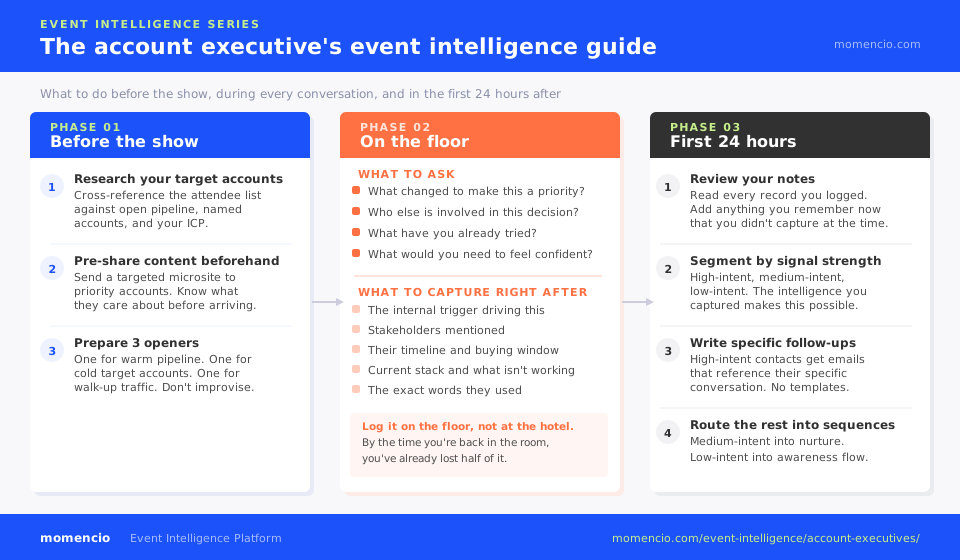
The AEs who get the most out of events are the ones who arrive prepared. Not with a 20-slide deck. Not with a memorized product script. With three specific things done before the doors open.
Know your target accounts in the room
If the organizer publishes an attendee list, use it. Cross-reference it against your open pipeline, your named accounts, and your ideal customer profile. You’re looking for three groups: existing opportunities you can advance, accounts in your pipeline that have gone quiet, and net-new companies that match the kind of customer you’re targeting.
For each group, do the minimum viable research. For existing opportunities, review the last few CRM interactions and know exactly where the deal stands. For quiet pipeline, understand why it stalled. For net-new accounts, spend five minutes on their website and LinkedIn. What are they focused on publicly? Has there been a leadership change, a funding announcement, or a new initiative worth knowing about before you walk up to them?
Pre-share content before the event starts
Send a targeted microsite to your highest-priority accounts ahead of the event. Not a generic company overview. A microsite built around the specific challenges you know that account is dealing with, with content that speaks directly to those challenges.
When a contact opens it before arriving, you walk into the conversation already knowing which problems they’ve been paying attention to. That changes the quality of your first question entirely. It’s also one of the most underused preparation moves in B2B events. Most teams don’t do it. The ones who do arrive with context instead of hoping to gather it.
Prepare three conversation openers by account type
Don’t improvise your opening line. For warm accounts already in your pipeline, reference the last real conversation: “Last time we spoke, you were heading into budget planning. How did that go?” For cold accounts at target companies, open with context: “I noticed you’re running a heavy event schedule this year. Is lead quality part of the conversation?” For unknown walk-ups, open with curiosity rather than pitch: “What are you here to solve this week?”
Three openers. That’s the entire preparation your conversations need.
What to ask during the conversation
Discovery questions are designed to qualify a lead. Intelligence-generating questions are designed to understand a buyer. These are not the same thing, and confusing them is one of the main reasons booth conversations produce data instead of intelligence.
A qualifying question tells you whether the budget exists, whether there’s a timeline, whether the person in front of you is the right stakeholder. It produces a score. An intelligence-generating question tells you what changed internally to make this a priority, who else is being pulled into the conversation, and what the team has already tried that didn’t work. It produces understanding.
In practice, the difference looks like this. Asking someone “are you evaluating solutions right now?” gets you a yes or a no. Asking “what changed that made this a priority this quarter?” gets you the internal trigger that moved this from conversation to active project. That trigger is what makes your follow-up land.
A few questions that consistently surface useful intelligence at events:
- “What made you decide to come to this show this year?” This tells you whether they’re in early research or late evaluation, and what problem they’re specifically trying to solve.
- “What have you already tried that hasn’t worked?” What they’ve tried tells you what objections are already live in their head before you’ve said anything about your product.
- “Who else is going to be part of this decision?” This surfaces the buying committee without you needing to ask for an org chart.
- “What would you need to see to feel confident moving forward?” This tells you the standard they’re evaluating against.
You’re not running a full discovery call in a convention center. You have 7 to 10 minutes on a noisy show floor. Pick one or two of these questions. Listen more than you talk. The intelligence is in their answers.
What to capture during the conversation
This is where most AEs fall short, and it’s usually not because they don’t understand the value. It’s because the habit of logging context in real time hasn’t been built yet.
The rule is simple: log the context, not just the contact. If all you record is a name and a company, you’ve done what the badge scanner does. You need to capture why this conversation matters.
The moment the conversation ends, or as soon as you can step away without being rude, note down the following:
- The trigger: What’s the internal pressure driving this? A budget cycle, a leadership mandate, a competitive threat, a previous solution that failed?
- The stakeholders mentioned: Did they say “my VP of Marketing is pushing this” or “our CTO is still skeptical”? The buying committee is mapping itself for you in real time. Write it down.
- The timeline: Not “eventually” or “this year.” Specifically: is there a quarter, a review cycle, or a budget window driving them?
- The current state: What are they using now? Why isn’t it working for them?
- The exact language they used: This is underrated. The specific words a buyer uses to describe their problem are the exact words that make your follow-up email feel like it was written for them instead of pulled from a template.
Tools like momencio’s AI EdgeCapture and Smart Notes let you log structured context directly into a lead record on the show floor, syncing it to your CRM in real time. The goal is simple: capture what you learned while the conversation is still fresh, before the next scan, the next coffee, and the next conversation crowd it out.
If you’re waiting until the hotel room that night to log what you learned at 10am, you’re already losing half of it.
The 24-hour rule
Research consistently shows that the conversion advantage of fast follow-up degrades sharply after the first 24 hours. After 48 hours, the likelihood of making a meaningful connection drops tenfold compared to same-day outreach.
But speed without context is just spam arriving faster.
The AEs who convert trade show conversations into pipeline don’t just follow up quickly. They follow up specifically. The context you captured during the event is what makes that possible.
In the 24 hours after the show floor closes, do four things:
- Review what you captured: Pull up every lead record you logged. Read your notes. Does the context still hold up? Is there anything you remember now that you didn’t log during the show?
- Segment by signal strength: Not every conversation was equal. Separate your leads into three groups: high-intent contacts who showed clear buying signals, medium-intent contacts who showed interest but no urgency, and low-intent contacts who were politely curious.
- Write the high-intent follow-ups before you get home: Not “great meeting you at the show.” Something that references the specific conversation: “You mentioned your procurement cycle opens in July and the pressure is coming from the CMO’s efficiency mandate. Here’s how other teams in your situation have handled this.” This email could not have been sent to anyone else. That’s the bar.
- Sequence the rest: Medium-intent contacts go into a nurture sequence with relevant content and no hard sell. Low-intent contacts go into your standard awareness flow. The intelligence you captured determines which bucket they land in.
Why your CRM is the memory your brain isn’t
You can run a perfect booth conversation. Ask the right questions. Capture everything you learned. But if none of it makes it into your CRM in a structured, searchable, usable form, it exists only in your head, and your head is not a reliable sales tool.
The intelligence you gather at a trade show needs to live somewhere your whole team can use. Your manager needs to understand which accounts are active. Your marketing team needs to know which conversations generated content engagement. Your SDRs need to know which accounts to prioritize in the follow-up sequence.
That only happens if what gets logged is actually useful. A note that says “interested, follow up next week” is not useful. A note that says “VP of Marketing, driven by CMO mandate to cut event spend 30%, evaluating three vendors, decision by end of Q3, current stack is Cvent plus Salesforce, biggest concern is implementation complexity” is what a CRM record is supposed to look like after a real conversation.
Build the habit of logging on the show floor. Not the night before you fly home. Not when you’re back at your desk. While the conversation is warm.
The compounding value of doing this well
One event produces leads. A series of events where each one adds to a growing picture of what a buyer cares about produces something more useful: a buyer profile that gets sharper every time you interact with that account.
The first time you interact with a contact at an event, you learn about their current situation. The second time, you see how that situation has evolved. The third time, you walk in knowing more about their buying pattern than most of their own colleagues do. You know what triggers them, what slows them down, and what matters to each person in the room.
This is what separates teams that attend events from teams that run events as a strategic program. The intelligence you capture at a single show doesn’t just matter for that show’s follow-up. It becomes the foundation for every conversation you have with that account going forward.
Every note you don’t log is a piece of that foundation you’re choosing not to build.
Ready to turn every booth conversation into intelligence your team can actually use? See how momencio helps account executives capture, structure, and act on event signals in real time — Book a demo.