The show ends. The booth comes down. The lead list goes into the CRM. And most teams immediately start treating every lead from last week the same way they will treat every lead from next month’s show.
That is the wrong frame. Event intelligence does not have an on/off switch. It has a decay curve. The behavioral signals you captured at the booth, the content your prospect engaged with on the LiveMicrosite, the conversation context your rep logged in real time, all of it has a shelf life. And that shelf life is not the same for every signal, every lead, or every buying situation.
This piece in the Event Intelligence Series zooms out to the long game: how to read signal decay accurately, how to reactivate dormant leads without sounding generic, and how to build the kind of longitudinal buyer profiles that make every future event more precise than the last.
The decay curve: how behavioral signals lose value over time
Not all post-event intelligence ages at the same rate. Contact data and behavioral context are two different things, and they decay on different timelines. Understanding that distinction matters before you build any post-event process.
Contact data (names, emails, job titles) decays through external changes: people change roles, companies restructure, email addresses go dead. Industry research puts B2B contact data decay at roughly 22 to 30 percent annually. That is a background rate you cannot control.
Behavioral context decays differently. It does not become inaccurate over time. It becomes less predictive. A lead who spent eight minutes on your pricing page the day after the show is showing you something. The same lead, three months later, has not un-seen that page. But the signal has cooled. Their situation may have changed. The urgency that drove that behavior may have resolved in a different direction.
Here is a practical framework for reading signal age: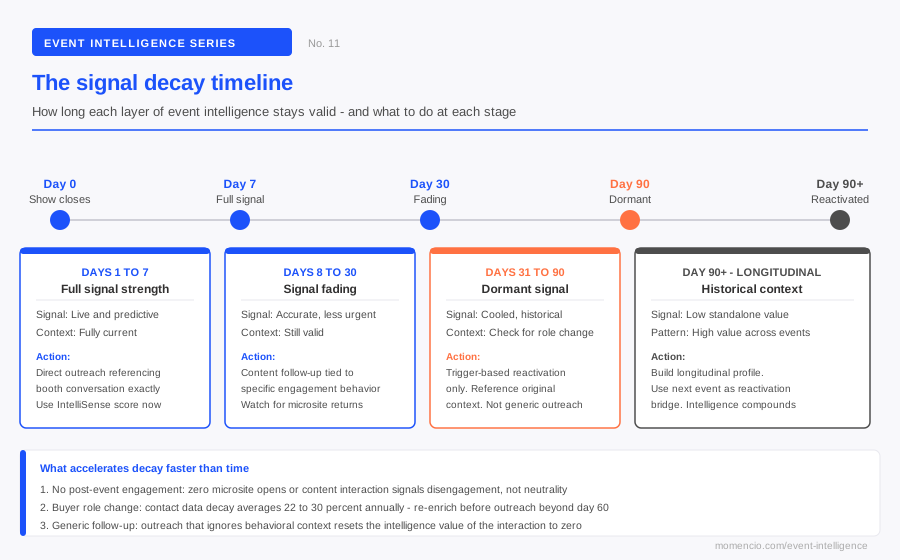
Days 1 to 7: full signal strength
Behavioral context is at its highest predictive value. Conversation notes are fresh. Microsite engagement is occurring. The AI IntelliSense score reflects real-time buying behavior. This is the window for direct, personalized outreach that references the booth conversation specifically. A rep who calls during this window and mentions the exact content the prospect engaged with is not following up. They are continuing a conversation.
Days 8 to 30: signal fading, context still valid
The booth conversation is no longer front of mind for the buyer, but the intelligence you hold is still accurate. Their role, their evaluation context, their stated timeline are all still current. This window calls for content-driven follow-up that connects to what they showed interest in, not a generic check-in. A lead who spent time on your integration case study gets a follow-up that addresses integration. Not a newsletter. IntelliStream activity in this window, a microsite return visit, a content download, is a signal that the evaluation is still active and the lead should be moved up the priority queue immediately.
Days 31 to 90: dormant, not dead
A lead that has not engaged in 30 days is not a lost lead. It is a dormant signal. The behavioral context you captured is still there. The intent they showed at the show did not disappear. What has changed is that their buying cycle may have shifted, their budget may be under review, or they may be in a quiet period. A generic re-engagement email at day 45 will not land. A specific, contextually grounded reactivation trigger will.
Beyond 90 days: longitudinal context
Past 90 days, a single event touchpoint has low standalone predictive value. But it never loses its value as historical context. A contact who engaged at a show nine months ago, then reappears at your next event, is not starting from scratch. They are a known account with a behavioral trail. That trail is exactly what longitudinal profiling is built on.
What accelerates signal decay
Two factors kill event intelligence faster than time does.
The first is the absence of post-event engagement. A lead who received a LiveMicrosite and never opened it is telling you something. That non-engagement is itself a signal: the context from the booth conversation did not translate into continued interest, or the timing was wrong. Teams that treat non-engagement as neutral noise miss the diagnostic information it contains. A lead who opened the microsite once and never returned has cooled. A lead who never opened it may need a different outreach angle entirely, not just a resend.
The second accelerant is a change in the buyer’s organizational situation. A contact who was evaluating vendors at your show may have since changed roles, lost budget in a planning cycle, or had their initiative deprioritized. These changes are not visible in behavioral data alone, but they are often visible through LinkedIn activity, company news, or a simple data enrichment refresh. AI EdgeCapture enrichment data can surface role changes before your sales team wastes outreach on a contact who no longer holds the decision.
The practical implication: signal decay is not just a calendar problem. It is a context problem. The question is not how many days have passed. The question is whether anything has happened, on their side or yours, that changes the intelligence picture.
Reactivating dormant event leads with precision
Most re-engagement campaigns fail for a simple reason: they do not use the intelligence they already have. A “just checking in” email sent six weeks after a show tells the prospect exactly how much you remember about them. Nothing.
Precision reactivation uses the original behavioral context as the trigger. That means:
- Referencing the specific content they engaged with, not the event in general
- Connecting the reactivation to something new and relevant, a product update, a case study from their industry, a stat that maps to the conversation they had
- Timing the outreach to a trigger, not a calendar date. A new event in their region, a relevant company announcement on their end, a new piece of content you just published that directly addresses the objection they raised at the booth
The intelligence captured in your event intelligence playbook is the raw material for this. Qualification answers, conversation notes, content engagement, all of it becomes the brief for a reactivation outreach that sounds like it came from someone who was paying attention. Because it did.
There is also a category of reactivation that the next event enables naturally. A contact who was dormant for 60 days but is attending the same show you are next quarter is no longer a cold lead. They are a warm reactivation opportunity with a known context window. Reaching out before the event, referencing where things stood last time, and offering a specific follow-on conversation is one of the highest-conversion outreach moves in the event intelligence toolkit.
Building longitudinal buyer profiles across events
This is where the long game actually lives. A single event interaction is a data point. Two or three interactions across different events, over six to eighteen months, is a behavioral pattern. And patterns are what predictive intelligence is actually built on.
A longitudinal buyer profile captures what standard CRM records do not: how a contact’s engagement behavior has evolved over time, which content consistently draws their attention, what objections surface repeatedly, and whether their engagement intensity is increasing, flat, or declining across events.
The teams that build this kind of profile stop treating each event as a standalone lead generation exercise. They treat it as one more data point in an ongoing intelligence picture. The event dashboards that surface cross-event engagement data make this possible at the program level: which accounts have appeared at multiple events, what content engagement patterns repeat, which leads are showing acceleration in their signal intensity across the portfolio.
The compounding effect is real. A rep who walks into a booth conversation knowing that this contact attended two previous shows, spent time on your enterprise case study both times, and asked about CRM integration at the last event is not starting a new conversation. They are advancing one that has been running for eighteen months. That context does not come from a badge scan. It comes from an intelligence system that was designed to hold onto signals across time, not reset after every show.
The five-layer framework from earlier in this series describes compounding intelligence as Layer 5: the point where cross-event patterns generate insights no single event could produce. Most teams never reach it because they treat each event as a clean slate. The ones who do reach it stop competing on lead volume and start competing on intelligence depth.
How momencio supports the full signal lifecycle
Most event technology is optimized for the first 48 hours after a show. Capture, enrich, send the LiveMicrosite, trigger the follow-up. That is the immediate layer.
momencio is built to support what comes after. AI IntelliSense does not stop scoring when the show closes. It keeps reading behavioral signals from microsite engagement, content interactions, and return visits across the full post-event window. IntelliStream surfaces that ongoing activity in a unified timeline so reps and managers can see exactly where each lead stands, not at the moment of capture, but now.
At the program level, event dashboards consolidate cross-event data across your entire portfolio. That is the infrastructure that makes longitudinal profiling possible at scale, not as a manual research project, but as a live intelligence layer that updates as your accounts continue to engage.
What to do with the intelligence you already have
The signal from your last event is still there. The question is whether your process is built to use it beyond the first two weeks.
Start with a simple audit: how many leads from your last show have had zero post-event engagement tracked, no microsite visit, no email open, no follow-up activity logged in the CRM? That population is not dead. It is an untouched intelligence asset. Some of them are dormant. Some are waiting for a relevant trigger. Some have changed roles and need re-enrichment before outreach.
If you are building toward the full picture, the Event Intelligence Series covers every layer from definition to real-time execution. This article is the final one. The work it describes is not.