
Roughly 13,000 trade shows run in the United States every year. That works out to about 250 events every single week — each one with a booth package, a sponsorship deck, and a sales team waiting to take your money.
Most exhibitors say yes to the wrong ones. Not because they’re careless, but because the decision usually comes down to two things: which shows their competitors attend, and which ones the sales team remembers fondly from three years ago. Neither of those is a framework. Both of them are expensive habits.
69% of B2B event leaders reported flat or decreasing budgets in 2025 — even as event costs have risen 40–50% since the pandemic. That combination makes choosing poorly more consequential than it used to be. When the margin for error was wider, a middling show just meant a quiet debrief. Now it means a real conversation about why a six-figure line item delivered a spreadsheet of badge scans.
This article is about making that decision deliberately — before you commit, not while you’re building the booth.
The problem with how most companies choose events
Ask most exhibitors how they decided to attend a show and the answer is some version of: “we’ve always gone,” “our main competitor is there,” or “the organizer called us.” These are not bad starting points. They’re just not sufficient endpoints.
The show you’ve “always gone to” may have peaked three years ago. The show your competitor attends may be where they go to be seen, not where they go to win business. And the organiser calling you is, by definition, doing their job — not yours.
For 64% of exhibitors, the quality of attendees is the most important factor when deciding to participate in a trade show. Yet most companies make that decision without ever asking the organiser for attendee composition data. (CEIR, 2025)
The exhibitors who consistently get better outcomes from their event programs share one habit: they ask harder questions before saying yes. Not complicated ones. Just harder.
Five questions that actually matter before you commit
These aren’t designed to make the decision for you. They’re designed to surface the information that should.
1. Who actually walks the floor — and are they your buyer?
A show can sit squarely in your industry and still attract the wrong people. Procurement teams. Junior evaluators. People collecting brochures. The title of the attendee matters less than whether they have the authority and intent to buy what you sell.
Ask the organiser for attendee data by job title, seniority, and industry vertical. Ask your best customers whether they attend — and if they don’t, ask why not. Check LinkedIn for the show’s hashtag in the weeks after previous editions and see who was actually posting.
46% of trade show attendees are in the final stages of their buying decision. But that figure hides enormous variation between shows. At the right event, you’re talking to people who are actively evaluating. At the wrong one, you’re generating awareness for someone else’s pipeline.
2. What does historical performance actually tell you?
If you’ve exhibited before, you have data. The question is whether you’re using it.
The most useful thing an exhibit team can track is leads-to-opportunities by show, tracked consistently over two or three years. Companies that do this build something their competitors don’t have: a clear picture of where their investment performs. That’s exactly what event performance dashboards are designed to surface — not as a retrospective exercise, but as a forward-looking input into every show decision.
If you’re attending a show for the first time, ask peers who’ve exhibited there. Not other vendors selling adjacent products — companies close enough to your ICP that their experience is actually relevant. What was their qualified lead rate? What happened to those leads six months later?
3. What is the real cost, not the booth cost?
The booth space fee is the number on the invoice. The real cost is everything else.
Staff travel and accommodation typically runs $600–$1,000 per person per show. Shipping booth materials adds $2,000–$5,000. Drayage, electrical, graphics, lead capture technology, pre-show outreach, post-show follow-up time — by the time you add it all up, the average B2B exhibitor spends $18,000–$42,000 per event, not counting the opportunity cost of pulling your sales team off their normal activity for four days.
The real ROI calculation isn’t booth cost versus leads. It’s total investment versus pipeline generated — tracked over a 12-month cycle, because most B2B deals won’t close in 30 days. A show that looks expensive in month one may look very different in month twelve.
Before you commit, build the full cost picture. Then ask yourself what pipeline outcome would make that number acceptable — and whether that outcome is realistic given what you know about the show’s audience.
4. Where does this show sit in the buying cycle?
Not all shows are the same kind of event. Some are where your buyers go to discover new vendors — high awareness, low purchase intent. Others are where buying decisions get made — procurement teams, shortlists, late-stage evaluation. Most are somewhere in between, which is the problem.
The type of show should match the stage of your pipeline motion. If your sales cycle is 6–9 months and you need early-funnel conversations, a discovery-stage show makes sense even if the immediate close rate is low. If you’re trying to convert existing opportunities, a show full of early-stage browsers is the wrong room.
Understanding where a show sits in your buyers’ decision cycle is different from understanding where it sits in your industry calendar. Ask the question deliberately before you commit. For companies attending trade shows and live events, the pipeline stage question should come before the show selection decision, not after.
5. What’s your competitive position in that room?
Competitor presence at a show is often cited as a reason to attend. Sometimes it is. If your category is consolidating and the key decision-makers are evaluating multiple vendors at once, being absent from a show where your competitors are present is genuinely costly.
But competitor presence is a signal, not a mandate. The better question is: what is your competitive position in that room? If you’re going up against three well-funded incumbents with double your booth space and a side event on the last night, your $25,000 spend may produce very little signal against very loud noise.
The shows where your investment works hardest are often the ones where you have a credible reason to be there and room to be noticed — not the ones where everyone else already is.
Building a weighted scoring model
The five questions above generate qualitative judgement. To make that judgement defensible — to your CFO, your VP of Sales, or yourself in six months — it helps to put numbers to it.
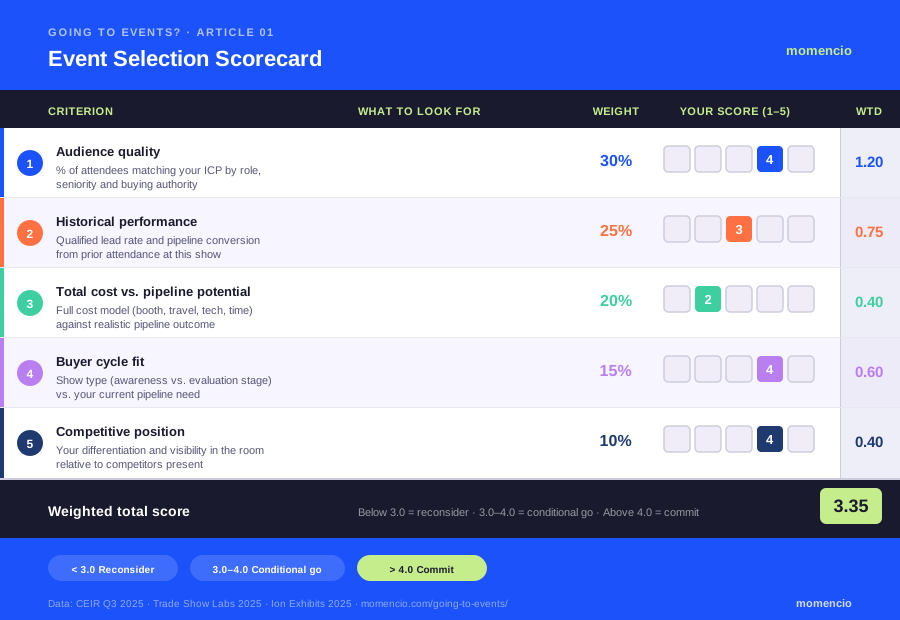
A simple scoring model doesn’t need to be elaborate. It needs to be consistent. Here’s a starting structure:
| Criterion | What to evaluate | Weight |
| Audience quality | % of attendees matching your ICP by role, seniority, and industry | 30% |
| Historical performance | Qualified lead rate and pipeline conversion from prior attendance | 25% |
| Total cost vs. pipeline potential | Full cost model against realistic pipeline outcome | 20% |
| Buyer cycle fit | Show type vs. your pipeline stage need | 15% |
| Competitive position | Your differentiation in the room relative to competitors present | 10% |
Score each criterion from 1 to 5 for any event under consideration. Multiply by the weight. A show scoring below 3.0 on the weighted average warrants serious scrutiny. One above 4.0 is worth committing to. The middle range — and most shows will land there — is where the qualitative context matters most.
The value of a scoring model isn’t that it makes the decision for you. It’s that it forces you to articulate what you know and what you don’t — before the contract is signed.
The shows that are hardest to evaluate
First-time shows are the most difficult call. You have no historical data, limited peer intelligence, and an organiser whose job is to sell you on the potential. A few things help:
Ask for a pilot commitment — a smaller booth space for one edition before scaling. Track not just leads but qualified conversation rate: the percentage of booth visits that turned into a real next-step conversation. If that number is strong at a first-time show, it’s a signal worth acting on.
Niche industry events and regional shows frequently outperform their size. Because they attract less exhibitor competition, the signal-to-noise ratio for buyers is better. A show with 2,000 attendees where 60% are in your ICP is often more valuable than a show with 20,000 attendees where 8% are. The absolute numbers look worse. The opportunity rate usually doesn’t.
84% of exhibitors say they would upgrade to a larger exhibit space if there are a considerable number of high-quality attendees. The implication: attendee quality, not volume, drives exhibitor confidence.
What a go/no-go decision actually looks like
The output of this process isn’t a spreadsheet. It’s a one-page case — clear enough to share with the people who need to approve the budget and specific enough to hold yourself accountable to in six months.
That case should include: the event, the total cost (real, not just booth space), the audience composition data you’ve gathered, your historical performance at this or comparable shows, the pipeline outcome that would justify the investment, and a brief rationale for why this show fits your current pipeline motion.
If you can’t write that case in a page, you probably don’t know enough yet to commit. That’s not a failure — it’s useful information.
The exhibitors who get the best returns from their event programs aren’t necessarily at the most shows. They’re at the right ones — with a clear reason for being there. For event and field marketers running multiple shows a year, that discipline compounds: a tighter selection process in Q1 usually means better pipeline quality by Q3.