Your team just came back from a show you have exhibited at for three years running.
Somewhere in this year’s lead export is a contact from an account that also appeared in last year’s export, and the year before that. Possibly a different person each time. The same company every time.
Nobody on your team knows this. The rep who ran that conversation has never seen the two records that came before it, so the account reads as brand new. The file it landed in is brand new, which makes everything inside it look new as well.
The failure here is not capture. Your team captured that contact correctly all three times, tagged it properly, and pushed it to the CRM on schedule. What failed was memory, and that failure costs more than any single show ever will.
This article is about the layer that fixes it.
The buying cycle does not reset just because your calendar does
Start with what a complex B2B purchase actually looks like right now.
Forrester’s The State Of Business Buying, 2026 found that a typical buying decision now involves 13 internal stakeholders plus nine external influencers, and that number climbs on more complex or strategic purchases. Procurement professionals are decision makers in 53% of buying cycles and engage from the start rather than appearing at contract review. More than 60% of buyers now run a trial before committing, rising to 78% on purchases above 10 million dollars.
None of that resolves in a quarter. Every one of those findings describes a process that takes a long time on purpose, because the buyers running it are trying to reduce risk.
Now look at your event calendar. CEIR’s 2026 Marketing Spend Decision Report found that 47% of exhibitors expect to participate in the same number of exhibitions next year, while 28% expect to add shows. Most exhibitors return to the same flagship events on a predictable annual cadence.
Put those two facts side by side and the problem is obvious. A single buying cycle can easily span two or three appearances at the same show. The account experiences one continuous evaluation. Your systems hold three unrelated files.
Year two is not new lead generation. It is the same evaluation reached at a later stage, recorded as though it were a first contact.
The four things that reset
When one show ends and the next begins, four specific things disappear. They are worth naming separately because each one breaks for a different reason and each one needs a different fix.
Identity resets
The person you met in year one may have changed roles, changed companies, or simply not attended in year two. A colleague came instead.
A system that resolves leads at the contact level sees two unrelated people. A system that resolves at the account level sees one account sending a second representative, which is a meaningfully different event and usually a sign that the evaluation has widened internally.
This is the reset that causes the most damage because it happens silently. No error appears. The record simply enters as new.
Conversation history resets
Whatever was said at the booth last year lives in a note field inside last year’s export. It does not surface when the same account walks up this year.
So the rep runs discovery again, gets slightly different answers, and never learns that the objection raised this year is the same one raised twelve months ago. That matters, because an objection repeated across two years is a structural blocker worth solving, while the same objection heard only once tends to get filed away as a preference.
Engagement pattern resets
Post-event behavior is where a large share of the real signal lives. Someone opened the follow-up, revisited a page, came back to the pricing content twice in one week, then went quiet.
That pattern gets read once during follow-up season and then goes cold. When the same account reappears at the next show, nobody checks what they did after the last one, even though it is often the most predictive thing on file.
Rep knowledge resets
This is the reset nobody plans for. Reps leave, territories get reassigned, and the person working the booth in year three has no relationship with anything that happened in year one.
Institutional memory living in an individual’s head is not institutional memory. It is a single point of failure with a shelf life measured in job tenures.
What the same account looks like when nothing resets
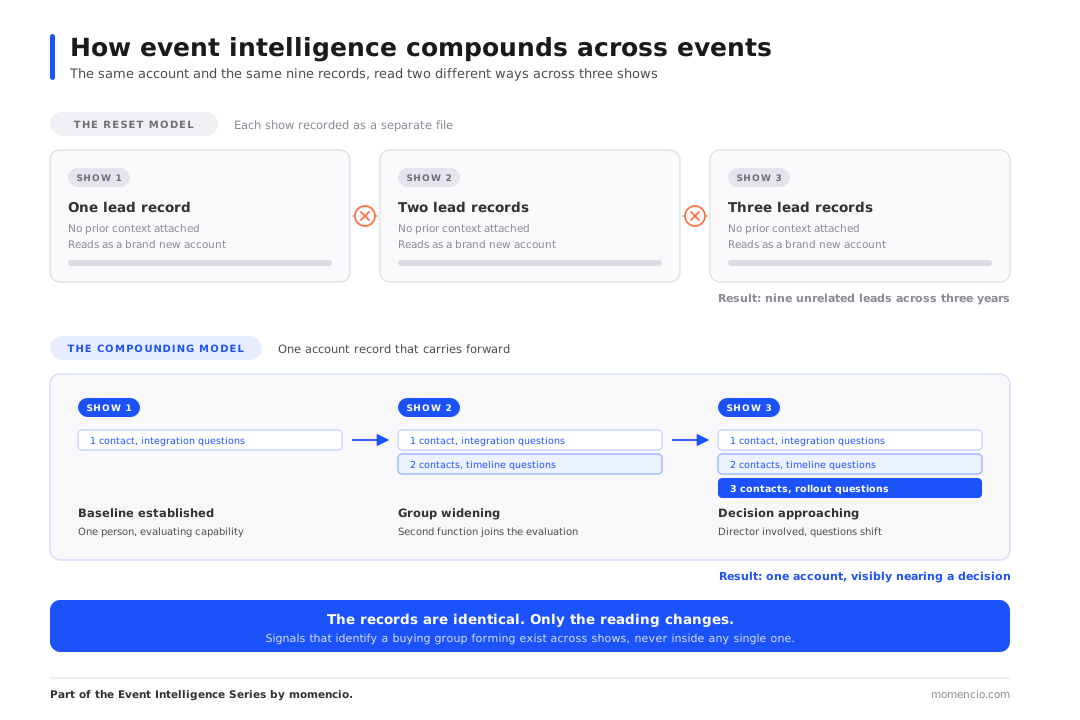
Here is a single account rendered as a continuous record rather than three separate ones.
In year one, one contact attended, a mid-level manager. She asked about integrations, engaged with two technical assets after the show, and went quiet after roughly six weeks.
In year two, two people came from the same account, including that original manager plus a colleague from operations. Both asked about implementation timelines rather than capabilities. Their post-event engagement concentrated on pricing and case study material.
In year three, three people came, now including a director. The technical questions had stopped entirely. The questions were about rollout and support.
Read as three exports, this is nine leads of varying quality spread across three years, most of which were probably marked unqualified at some point. Read as one account, it is an evaluation that has been widening internally and moving toward a decision in plain view.
The table below shows the same raw facts interpreted both ways.
| Signal | Read as three separate shows | Read as one continuous account |
| Headcount | One lead, then two, then three. Nine leads total across three years. | A buying group forming. One person became three, which is how internal evaluations widen. |
| Questions asked | Integration questions one year, timeline questions the next. Unrelated conversations. | Movement from capability to implementation to rollout, which is the shape of an account nearing a decision. |
| Seniority | A manager, then an operations contact, then a director. Three unrelated titles. | Escalation. Senior involvement usually arrives when a purchase is being justified internally. |
| Content engagement | Technical assets one year, pricing content another. Two follow-up campaigns that performed differently. | A predictable progression from evaluating fit to building a business case. |
| What sales does | Opens with discovery every year because nothing carries forward. | Opens with the answer to last year’s objection and asks what changed. |
Neither of the signals in the right-hand column exists inside any single show. They only exist across shows, which means no amount of improvement to a single event will ever surface them.
How to build the connective layer
Three things need to be true before intelligence carries forward. None of them require new tooling if your capture system already writes to CRM correctly.
Resolve every lead to an account, not just a contact
This is the foundational one, and it is where most programs break. If your event records key on email address alone, every new person from a known account enters the system as a stranger.
Lead records need a company identifier that matches the account object already sitting in your CRM. Enrichment handles most of this automatically when it runs at the point of capture rather than as a batch process after the show, because a record that is already resolved when it is created never needs to be reconciled later.
Keep the account record open between shows
Most teams treat an event as a campaign with a start date and an end date. The follow-up window closes, attribution gets calculated, the report goes to leadership, and the record effectively goes dormant.
Treat the event instead as an entry in an account’s history that stays queryable indefinitely. The specific ask is small. Before the next show, any rep should be able to open an account and see every prior event interaction without asking a colleague or filing a request with ops.
Carry a cross-event history a human can read in ten seconds
Raw activity logs do not count. A rep standing at a booth cannot parse a timeline of thirty engagement events while someone waits in front of them.
What works is a short structured summary attached to the account: which shows they attended, who you met, the last stated objection, the last thing they engaged with, and the current stage. Five fields, maintained automatically, readable at a glance.
The test for this field is whether a rep who has never met the account can use it in the ninety seconds before a conversation starts. If it needs interpretation, it is a report rather than a tool.
What year two and year three actually produce
The payoff is not sentimental and it is not about relationship building in the abstract. It shows up in three specific places.
Booth conversations start further along. A rep who knows an account raised integration concerns last year can open with the integration answer instead of running discovery. That recovers several minutes of a booth conversation that is short to begin with, and it signals to the buyer that your organization retains information, which is itself a differentiator.
Target lists stop being guesses. Pre-show planning becomes a query against accounts with prior event history rather than a scan of a registration list. You already know which accounts have been circling and which ones sent more people last time.
Show selection becomes defensible. When you can see which accounts appear at which shows, the annual budget conversation shifts from attendance figures to account coverage. In a room where every line item is being questioned, coverage of named target accounts is a considerably stronger argument than badge counts.
There is a fourth benefit that only appears later. Once you hold two or three years of connected history, patterns start to emerge at the program level, including which accounts consistently send more people in the year before they buy, which shows produce accounts that eventually convert rather than accounts that merely engage, and which content reliably pulls people back months after a conversation.
That analysis is impossible in year one. It becomes routine by year three, but only if year one was recorded in a way that year three can still read.
Who owns this between shows
This is where most programs quietly fail, and it has nothing to do with technology.
The event team owns the show, sales owns the follow-up, and marketing operations owns the CRM. The period between shows belongs to nobody in particular, which is exactly when continuity either holds or breaks.
Somebody needs to own account history as an ongoing asset rather than a post-show deliverable. In most organizations the natural home is marketing operations or revenue operations, because the work is record structure and data hygiene rather than event execution.
The practical test is simple. Ask who would notice if cross-event history stopped being maintained. If the honest answer is that nobody would notice for a year, then it is not owned by anyone and it will decay.
How momencio handles continuity across events
Continuity depends on whether intelligence lands in a structure that outlives the show it came from.
AI EdgeCapture™ enriches contact records at the point of capture, which is what makes account-level resolution possible without manual cleanup afterward. LiveMicrosites™ track how each individual engages with content across the follow-up window, so post-event behavior becomes part of the permanent record rather than an email metric that expires.
AI IntelliSense™ and IntelliStream™ assemble that behavior into a readable engagement narrative for each lead instead of a raw activity feed. Event dashboards report at the program level across event history, which is where cross-event patterns become visible to the people defending the budget.
CRM sync runs continuously from the point of capture, so the record your team queries before next year’s show is the same record that has been updating the entire time.
What to do before your next show
Four things, in order.
- Pull your last three lead exports and count how many accounts appear more than once. That number is your baseline, and it is almost always higher than teams expect before they check.
- Confirm your capture system writes a company identifier that matches your CRM account object, not just an email address. This single change prevents most future resets.
- Build or request a short account-level event history field containing the five items described above.
- Give your reps access to it before they walk the floor rather than after the show closes.
None of this makes a single show perform better. It makes every show after this one perform better than it otherwise would, and across a three year program that is the larger number by a wide margin.
Frequently asked questions
- How is this different from post-event intelligence?
- Post-event intelligence covers the weeks after a show closes, while behavioral signals are still active and follow-up is underway. Compounding covers what survives after that window ends and is still useful at the next show. One is about the follow-up cycle, the other is about the year in between.
- Does this only work for annual flagship shows?
- It works anywhere the same accounts appear more than once, which includes regional shows, industry conferences, and partner events. Annual flagship shows are simply where the pattern is easiest to see, because the cadence is predictable enough to plan against.
- Our event lineup changes every year. Does this still apply?
- Yes, because continuity keys on the account rather than the show. An account you met at one conference and again at a different event the following year is running the same continuous evaluation, and connecting those two interactions is the same exercise.
- What if our CRM data is already messy?
- Start with account-level resolution at the point of capture for upcoming events rather than trying to reconstruct history. Clean forward first. Backfilling older exports is worth doing eventually, but it should never block the next show.
- How long before this produces anything useful?
- The account-matching exercise in step one produces something immediately, because it quantifies how much repeat contact you already have. Genuine cross-event patterns need at least two connected events, so most teams see the first real payoff at the show following the one where they started.
- Does this require a bigger event technology budget?
- Usually not. The requirements are account-level resolution, a persistent record, and a readable summary field. Most of that is configuration of systems a team already owns rather than new procurement.