Event intelligence has a temporal dimension. The signals a live event generates are only intelligence for as long as a team can act on them. The moment the venue closes, a window closes with it, and a specific set of decisions becomes impossible until the next show opens.
Real-time event intelligence is the operational layer that sits inside that window. Not faster reporting. Not a live dashboard that gets reviewed on Monday. A structured practice of reading signals, making decisions, and taking action while the show is still running, against leads who are still in the building.
Most B2B exhibitor teams miss this window entirely. They treat the show as a capture phase and the week after as the analysis phase. The result is a set of decisions that get made too late to matter, and a set that does not get made at all because the team never saw the signal in time.
This article defines real-time event intelligence as a discipline, names the live window in specific terms, and maps the decisions that window uniquely enables. It is the eighth article in momencio’s Event Intelligence Series. Article 7 covered pre-event intelligence. This piece covers the during.
What real-time event intelligence actually means
A working definition. Real-time event intelligence is the capture, enrichment, and activation of behavioral signals as they occur at a live event, producing structured context that a revenue team can act on within the same hour, not the same week.
Three specific words in that definition carry weight.
As they occur. Not at the end of the day. Not after a post-event data sync. The signal enters the system and is visible to the team within minutes of the interaction that produced it.
Structured context. Not an activity feed with no shape. The signal arrives identity-tied, attached to a specific lead record, with enough information for a rep to know what to do about it.
Within the same hour. The threshold for real-time is not a number of seconds. It is whether the window to act is still open. A signal that arrives five minutes before the prospect leaves the venue is real-time. The same signal arriving after they are on a flight home is not.
The distinction separates real-time intelligence from near-time reporting, which is most of what gets labeled as real-time in the category. Near-time reporting shows you what happened. Real-time intelligence enables you to change what happens next.
The three windows of event intelligence
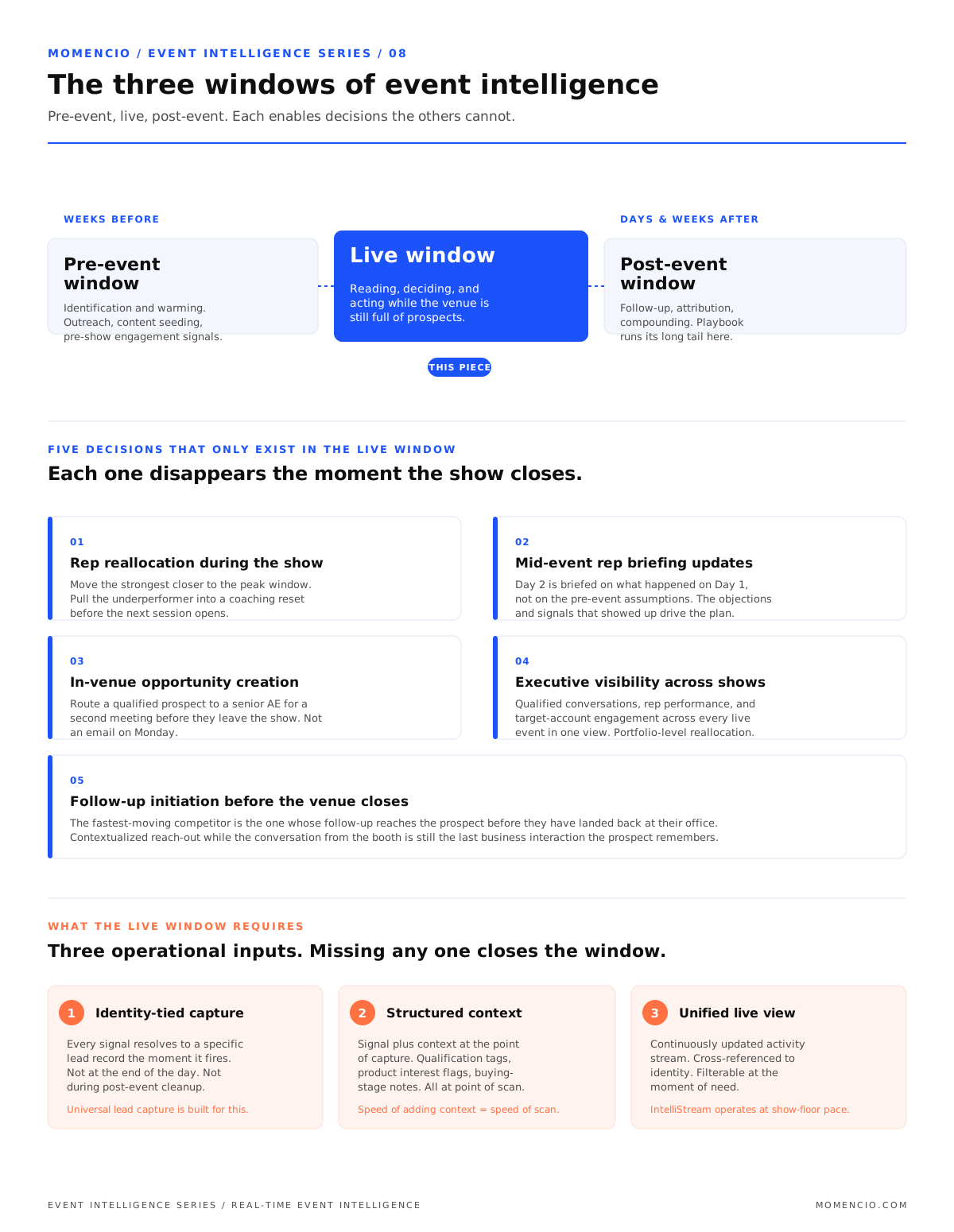
Event intelligence operates in three distinct windows, each with its own logic and its own set of decisions.
Pre-event window
The weeks before the show opens. The intelligence work here is identification and warming. Building an ICP-filtered target list from the registered attendee list. Running pre-event intelligence through personalized outreach. Reading engagement signals from the content you sent ahead of time. Briefing reps on who is coming and what they have already engaged with.
Live window
The hours and minutes while the show is running. The intelligence work here is reading, deciding, and acting. Who just engaged with your content. Which booth conversation just produced a qualification signal. Which target account walked the floor an hour ago. What to do about any of it before the day ends.
Post-event window
The days and weeks after the show closes. The intelligence work here is follow-up, attribution, and compounding. Structured sequences, tracked engagement on sent assets, pipeline creation, and the debrief that informs the next show. This is where the event intelligence playbook does most of its long-tail work.
The three windows are connected, but they are not interchangeable. A decision that belongs in the live window does not survive being moved to the post-event window. It is not that the decision becomes harder. It becomes impossible. The prospect has left. The meeting slot has passed. The competitive window has closed.
This is the structural argument the rest of this piece rests on. The live window is not a faster version of the post-event window. It is a categorically different operating environment with its own set of exclusive decisions.
What the live window uniquely enables
Five categories of decisions exist only inside the live window. Each one disappears the moment the show closes.
Rep reallocation during the show
Booth staffing is usually set before the event opens and held constant across the show. Real-time intelligence changes that. When the live stream shows that one rep is running qualified conversations at twice the rate of another, the booth manager has an actionable signal. Move the stronger rep to the peak window. Pull the underperforming rep into a training adjustment before the next session opens. Reassign the target-account greeter based on who just walked in. None of these decisions work the day after the show.
Mid-event rep briefing updates
The signals from Day 1 of a multi-day show are the briefing material for Day 2. Which product questions came up repeatedly. Which objections dominated. Which competitor got named most often. A team operating in the live window holds a fifteen-minute stand-up at the start of each show day, and the briefing is built on what actually happened yesterday, not what the team expected based on the pre-event plan. Teams operating only post-event repeat Day 1 on Day 2 whether it worked or not.
In-venue opportunity creation
The highest-value decision the live window enables. A rep at the booth captures a qualification signal. The signal is tagged, scored, and visible in the system within minutes. A manager sees the signal, triages it, and routes the prospect to a senior account executive for a second conversation before they leave the show. That prospect walks out with a meeting booked, a LiveMicrosite already in their inbox, and a named contact expecting their follow-up. Post-event, the best a team can do is email them on Monday.
Executive visibility across concurrent shows
Enterprise exhibitors run multiple concurrent events. A VP of Marketing watching a single event dashboard is blind to what is happening at the other three. Real-time intelligence aggregates across the portfolio. The executive sees qualified conversation counts, rep performance, and target-account engagement across every live show in one view, and can reallocate budget, staff, or executive attention toward the event that is outperforming. This is pure live-window value and it is the single most common decision pattern a mature exhibitor organization builds.
Follow-up initiation before the venue closes
The fastest-moving competitor at any show is the one whose follow-up reaches the prospect before they have landed back at their office. IntelliStream surfaces the moment a LiveMicrosite is opened, a specific asset is viewed, or a prospect returns to pricing content for a second time. A rep working the live window can reach out with a contextualized message while the conversation from the booth is still the last business interaction the prospect remembers. That advantage cannot be replicated in the post-event window because the window has closed.
All five of these decisions are about operating in time, not about capturing data. The capture infrastructure is table stakes. The intelligence discipline is what separates the teams who act on the live window from the teams who only report on it afterward.
What real-time event intelligence requires, operationally
Three operational inputs are non-negotiable. A team missing any one of them has a real-time dashboard, not real-time intelligence.
Identity-tied capture at the point of interaction
Every signal needs to be attached to a specific lead record the moment it is generated. Not at the end of the day. Not during post-event cleanup. The booth scan, the conversation note, the content interaction, and the microsite visit all need to resolve to the same person in the system immediately. This is what universal lead capture is built to do, and it is why a team relying on disconnected tools cannot operate in the live window. When identity resolution happens overnight, so does intelligence.
Structured context alongside the capture
A signal without context is not actionable intelligence. A booth scan on its own produces a name and a company. A booth scan with a one-sentence qualification note, a tag for buying stage, and a product-interest flag produces a prioritized follow-up instruction. The capture system needs to make adding context as fast as the scan itself. If it takes the rep longer to add context than to engage the next prospect, the context does not get added, and the live window collapses back into a name list.
A unified live view that does not require manual refresh
The live window operates at the pace of the show floor. A manager making a staffing decision, a rep reading a re-engagement alert, or an executive checking portfolio performance cannot wait for a dashboard to be rebuilt. The activity stream has to be continuously updated, cross-referenced to identity, and filtered at the moment of need. This is the difference between an event dashboard that reports yesterday and an activity stream that is alive. Both are useful. Only one supports decisions inside the live window.
When any of the three is missing, the live window closes for that team regardless of what the dashboard looks like. Intelligence requires all three operating together.
Why most B2B teams miss the live window
The reason is not discipline. It is structural. Three specific tooling and process patterns prevent most exhibitor teams from operating in the live window, even when they want to.
Batch-processed data
The capture tool syncs to CRM overnight. The enrichment runs as a next-morning batch. The dashboard updates at the end of each show day. Every one of these defaults makes sense for post-event reporting and breaks real-time intelligence. By the time the signal is visible, the prospect is halfway home.
Fragmented tools across the capture journey
One tool for badge scanning. Another for business card OCR. Another for session attendance. Another for follow-up email. Each produces data in its own format on its own cadence. Identity resolution happens manually during post-event cleanup, not at the point of capture. The data eventually gets stitched together, but never within the live window. The event intelligence playbook covers what the five layers of event intelligence framework describes as the structural gap most teams face at Layer 1 to Layer 2 transitions.
No operating model for in-show decisions
The team has the tooling but no one is watching the stream. The booth manager runs the booth. The executive watches the strategic view. Nobody is dedicated to reading the live signals and triggering the decisions. The dashboard exists. It just does not drive action, because no one has been assigned to read it while the show is open.
Fixing the first two is a tooling decision. Fixing the third is an organizational one, and it is the one most teams skip. The event intelligence vs. event data distinction matters here because even a team with excellent live-window tooling produces event data if no one is activating the intelligence.
What changes when teams operate in the live window
The visible shifts are operational.
Booth staffing becomes dynamic across the show day. The strongest closer works the peak window. The greeter role rotates based on who is about to walk in. The rep who had a difficult first session gets pulled into a coaching conversation before the second session starts.
Qualification quality improves because the reps can see their own signals in context. A rep who knows the prospect they are talking to viewed the pricing page on their LiveMicrosite yesterday runs a different conversation than a rep who does not. The AI IntelliSense™ score that surfaces at the booth is informing the conversation, not just the post-event ranking.
Booth-to-floor coordination becomes possible. A prospect who said they were attending a specific session gets followed to the session. A target account that registered but has not appeared yet gets outreach before the show ends, not after. A competitor that sponsored the coffee break gets monitored for who they are talking to, not reported in the debrief.
Executive reporting cadence shifts from post-event to during-event. The VP of Marketing gets a twice-daily portfolio update during the show, not a single deck two weeks later. Course corrections happen at the cadence of the show, not the cadence of the reporting cycle.
The compounding effect across a portfolio of events
The value of the live window does not stop when the show closes. Every decision made inside the live window produces an outcome that gets logged, measured, and carried forward. Which rep closed which conversation. Which mid-event briefing shift worked. Which target-account intercept converted. Which executive reallocation mattered.
Over a portfolio of events, these outcomes compound. The team that operated in the live window at five shows last year has five shows’ worth of structured live-window decisions to draw on. The team that operated only in the post-event window has five shows’ worth of reports that describe what happened, without a trace of what was decided in the moment. That is the structural difference between an event intelligence program and an event reporting program.
The compounding is why who owns event intelligence is a more important question than which tool a team is using. Live-window operations require an owner. Without one, the tooling produces the signal, and no one acts on it. The signal quality degrades, the muscle atrophies, and the program reverts to reporting. The teams that build live-window discipline into the ownership model keep the compounding effect alive across every show.
Real-time event intelligence is the operating system, not the feature
Most B2B exhibitor content treats real-time as a feature claim, a box on a comparison grid. That framing misses the point. Real-time event intelligence is not a feature. It is the operating discipline that determines whether a show produces a list of leads or a set of decisions that shape pipeline.
The live window is unforgiving. It opens when the show opens and closes when the last prospect leaves. Inside it, teams with the right tooling, the right capture discipline, and the right operating model make decisions that their competitors cannot make at all. Outside it, everyone is running the same post-event playbook.
Event intelligence, considered as a maturity model, runs through sales enablement and into pipeline operations. The live-window dimension is the one most programs are furthest behind on, and the one with the highest compounding return. Building it is the work.
See what real-time event intelligence looks like in motion
momencio’s IntelliStream surfaces every lead interaction across the event lifecycle, identity-tied and structured, the moment it happens. Book a demo to see the live window in action.